Best Inverter Chargers for Boats: Reliable Power on the Water
If you need steady AC power on a boat, an inverter charger designed for marine use is essential. This guide highlights five solid options that balance smooth pure-sine-wave power, robust charging, and practical protections. Each product is selected for boaters who want reliable appliances, calm UPS behavior, and straightforward installation. The top picks are best for different boat sizes and power needs—from compact weekend cruisers to mid‑sized liveaboards.
| Product | Output Power | Best For | Notes |
|---|---|---|---|
| ECO-WORTHY 1000W Pure Sine Wave Inverter Charger | 1000W inverter / 55A charger | Small boats, RVs, and on-deck setups needing UPS | UPS within 20ms, LiFePO4 support |
| VEVOR Pure Sine Wave Inverter Charger 6000W | 6000W continuous | Off-grid or larger boats needing heavy load handling | 5 modes, broad battery compatibility |
| Renogy 3000W Pure Sine Wave Inverter Charger | 3000W continuous | Mid-size boats with diverse battery setups | Bluetooth monitoring, broad battery compatibility |
| Renogy 2000W Pure Sine Wave Inverter Charger | 2000W continuous | Standard mid-range boat power | High efficiency, versatile battery support |
| ALLWEI 300W Power Inverter | 300W continuous | Compact boats or as a secondary hull system | PD USB-C and QC USB ports |
ECO-WORTHY 1000W Pure Sine Wave Inverter Charger

Best for: Small boats and compact electrical setups that require a compact UPS-capable inverter. This model combines an inverter with a 55A LiFePO4 battery charger, offering a practical one-box solution for limited spaces. The pure sine wave output protects sensitive electronics common on boats, such as fridges and navigation gear.
Why selected: It delivers a reliable 1000W continuous power with a peak of 2000W, and its UPS feature switches to battery power within 20ms during grid failures. This is helpful when you need immediate power when shore power is unavailable or intermittent.
Limitations: Best suited for lighter loads; larger, heat-intensive appliances may run at reduced efficiency. Ensure proper ventilation and safe mounting to prevent overheating in enclosed bilges.
FOVAL 200W Car Power Inverter
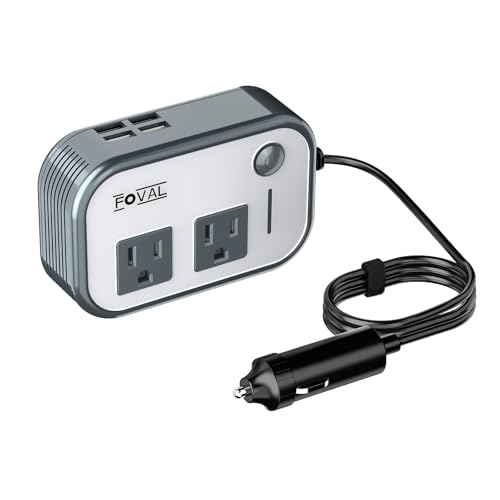
Best for: Very small boats, dinghies, or as a portable secondary unit for lightweight devices. It provides two AC outlets and multiple USB ports, making it suitable for charging phones, tablets, small laptops, or GPS devices without overloading the boat’s main power system.
Why selected: Its compact size and built-in protection are attractive for tight spaces. The multi-port approach offers flexibility for running essential electronics while docked or at anchor.
Caution: Capable of only limited sustained load. Do not use for high-draw appliances like full-size refrigerators or air pumps for extended periods on a small vessel.
VEVOR Pure Sine Wave Inverter Charger

Best for: Off-grid or larger boats that require substantial continuous power and flexible operation modes. Ideal for boats with higher daily energy use, such as chillers, pumps, or multiple electronics running at once.
Why selected: The 6000W continuous output supports heavy-duty loads, and the five operating modes accommodate different sailing scenarios—grid priority, battery priority, energy-saving, and generator mode—helping optimize fuel and energy use on long journeys.
Limitation: For best performance, maintain a reasonable load per outlet (recommended keep each outlet under 1.2KW) to minimize waste heat and maximize lifespan.
Renogy REGO 3000W Pure Sine Wave Inverter Charger

Best for: Mid-size boats that demand strong continuous power with modern monitoring. The 3000W output makes it suitable for running larger appliances or multiple devices simultaneously, with Bluetooth for remote status checks.
Why selected: It supports a broad battery spectrum and offers an app-enabled view of charging and system status, simplifying maintenance aboard. It is a strong all-around choice for boaters who value monitoring and adaptability.
Limitation: Bluetooth monitoring relies on mobile connectivity; ensure you have at least basic smartphone access for real-time updates on voyage days.
Renogy 2000W Pure Sine Wave Inverter Charger

Best for: Boats that need a reliable mid-range inverter with robust protection and good efficiency. This is a practical choice for many sail and powerboat setups without stepping up to heavy-duty systems.
Why selected: The 2000W output is well-suited for standard household appliances aboard, and the high efficiency helps conserve battery power during long cruises. It also supports a broad set of battery chemistries.
Limitation: While versatile, it may require attention to heat during sustained high loads—adequate cooling and ventilation are important aboard smaller vessels.
Buying Guide: What To Check Before You Buy
Power needs: Determine peak and continuous loads. Boats often run a mix of fridges, pumps, lights, and electronics. Match the inverter’s continuous power to your typical daily draw, and ensure the surge rating covers motor-start or compressor loads.
Battery compatibility: Consider LiFePO4, AGM, flooded lead-acid, and other battery chemistries you use. A good inverter charger should support Lithium and traditional chemistries with safe charging profiles.
Protection and safety: Look for short-circuit, over-current, over-temperature, and over-voltage protections. A built-in cooling fan is a plus for marine environments where space may limit ventilation.
Battery charging: If you rely on shore power or solar, a charger with robust multi-stage charging and proper amperage (like 55A or higher for LiFePO4) can improve longevity and readiness of your bank.
UPS capability: For boats that must maintain essential electronics during transient power loss, a UPS-enabled inverter can switch to battery power within a fraction of a second, preserving critical devices.
Monitoring: Bluetooth or app-based monitoring helps you track voltage, current, temperature, and charging status from anywhere on board. This is particularly helpful for remote or offshore voyages.
Installation: Check the physical footprint, heat dissipation, mounting options, and wiring requirements. Marine-grade enclosures and corrosion resistance are worth prioritizing on saltwater boats.
Portability vs. capacity: Small boats benefit from compact units, while larger vessels justify higher power and more elaborate battery setups. Balance weight, space, and performance to avoid unnecessary complexity.
FAQs: Quick Answers For Boat Owners
- Do inverter chargers work well on boats? Yes. They convert stored DC power to AC while recharging batteries, and many models offer UPS features and multi-mode operation for marine use.
- Can I use LiFePO4 and lead-acid batteries with the same inverter? Many inverters support multiple chemistries, but check each unit’s specifications and charging profiles to prevent damage.
- What amperage should I look for in a marine inverter charger? Choose based on your loads; typical boater needs range from 1000W to 6000W, with chargers from 55A to several hundred amps for faster replenishment.
- Is a monitoring app necessary? Not strictly, but it improves convenience and helps prevent unexpected outages by providing real-time system status.
- What about safety and installation? Use marine-rated equipment, mount properly, and ensure adequate ventilation to prevent overheating and corrosion.
- Should I buy a separate inverter and charger? A combined inverter/charger simplifies wiring and reduces losses, but a split solution can offer modular upgrades for expanding systems.