Best 24 Series Marine Batteries for Boats and RVs
Choosing the right 24 series marine battery means balancing starting power, deep-cycle endurance, and fit for your vessel or RV. This guide highlights five top options, clarifying who benefits most from each and where to use them. The listed products cover AGM configurations and dual-purpose designs, helping you optimize engine starts, trolling motor performance, and onboard electronics on water and land adventures.
| Product | Type | Key Specs | Best For |
|---|---|---|---|
| Interstate Batteries Marine/RV Battery 24M-AGM | AGM Dual-Purpose | 70Ah, 750CCA | Boat and RV owners needing reliable starts and deep-cycle power |
| UPLUS 24M Dual Purpose Marine Battery | AGM Dual-Purpose | 79Ah, 550CCA | Compact space, combined starting and deep-cycle needs |
| Mighty Max MM-G24M | AGM Dual-Purpose | 90Ah, 550CCA, 700 MCA | Durable, long-lasting power for fishing and cruising |
| WEIZE 24M Dual Purpose AGM Battery | AGM Dual-Purpose | 90Ah, 550CCA | Balanced performance and quick charging |
| ACDelco Gold M24AGM | AGM Deep Cycle | Group 24, AGM technology | Maintenance-free reliability for marine and RV systems |
Interstate Batteries Marine/RV Battery 24M-AGM

The Interstate 24M-AGM is a dual-purpose marine battery designed to start the motor and power trolling motors or accessories. It utilizes pure lead AGM technology for robust performance in harsh conditions, with claims of longer service life and faster recharge compared with conventional AGM options. Best for boaters who need dependable starts and extended deep-cycle support in challenging environments. A limitation is that real-world cycle life depends on charging practices and usage, so follow charging guidelines to maximize life.
UPLUS 24M Dual Purpose Marine Battery

The UPLUS 24M integrates cranking and deep-cycle capabilities in a space-saving form. It delivers 150RC and 550CCA with 79Ah capacity, suitable for engines in the 70–350hp range and powering navigation, lights, and electronics. Choose this if you have limited battery space and want a single unit to handle both starting and long-running loads. A potential drawback is a slightly heavier unit at nearly 40 pounds, which may affect removal or replacement in tight compartments.
Mighty Max Battery MM-G24M
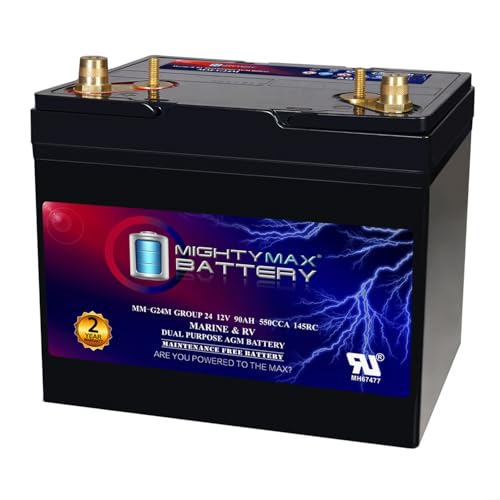
The Mighty Max MM-G24M offers 90Ah deep-cycle capacity with 550 CCA and 700 MCA, delivering solid starting power and enduring runtime for electronics and trolling motors. It’s a strong choice for boats and RVs that require reliable starts plus extended use of devices like fish finders, lights, and pumps. Limitations include standard AGM care requirements and ensuring the unit fits your battery tray and compartment geometry.
WEIZE 24M Dual Purpose AGM Battery

WEIZE presents a 90Ah, 550CCA dual-purpose AGM battery with quick charging features and an emphasis on low internal resistance for efficient power delivery. It suits boaters who value faster recharge and solid starting capacity in a compact package. A caution: ensure proper charging practices to avoid overheating during rapid charging cycles.
ACDelco Gold M24AGM

ACDelco Gold M24AGM emphasizes maintenance-free AGM technology for deep-cycle performance with a leak-proof design. It is well-suited for marine and RV systems needing dependable, spill-free operation and consistent power delivery. The main limitation is that some models may require time to reach full voltage after extended periods of inactivity, depending on storage conditions and charging history.
Buying Guide: Key Considerations For 24 Series Marine Batteries
- Battery chemistry and AGM: AGM batteries offer maintenance-free operation, spill resistance, and robust vibration tolerance. They’re typically preferred for marine use and rugged RV environments.
- Dual-purpose vs. dedicated: Dual-purpose 24M batteries provide starting power and deep-cycle capability in one unit, helpful when space is limited. If you regularly run high-amp accessories, a dedicated starting battery plus a separate deep-cycle may be more efficient.
- Capacity and CCA/RC: Higher amp-hour (Ah) ratings improve deep-cycle performance; higher cold-cranking amps (CCA) improve cold-weather starts. Choose based on engine size, climate, and accessory load.
- Size and compatibility: Confirm Group 24 dimensions fit your boat’s tray and compartments. Check terminal layout and weight to ensure proper fit and installation.
- Charging profile: AGM batteries require careful charging voltages (often around 14.4V to 14.6V or as specified). Use a charger compatible with AGM chemistry to maximize lifespan.
- Maintenance and warranty: Look for sealed designs with spill protection and manufacturer warranties. Understand what the warranty covers and how to claim it.
Frequently Asked Questions
- What is a Group 24M battery?
A Group 24M battery is a size-class and terminal configuration used for marine and RV batteries, often with dual-purpose AGM construction for starting and deep-cycle use. - Why choose an AGM over flooded lead-acid?
AGM batteries are maintenance-free, resistant to leaks, and better at vibration, making them well-suited for boats and RVs. - Can I use a dual-purpose battery for trolling motors?
Yes, many dual-purpose 24M AGM batteries power trolling motors and electrical systems, though a dedicated deep-cycle may extend lifespan for heavy continuous loads. - How do I know if a 24M fits my battery tray?
Check the tray dimensions and look for Group 24M compatibility; measure length, width, and height and verify terminal placement. - How should I charge AGM batteries?
Use a charger set to AGM-compatible parameters, typically a regulated float/absorb charging profile with proper voltage and current limits to avoid overcharging. - Are lithium 24-series options worth it?
Lithium LiFePO4 options offer longer cycle life and lighter weight but require different charging strategies and higher upfront cost; assess needs and budget.