Best Heavy Duty Boat Anchor Solutions for Safe, Secure Mooring
When choosing a heavy-duty boat anchor, select a kit that matches your boat size, water conditions, and maintenance preferences. This guide highlights five solid options for anglers, weekend cruisers, and small-to-mid sized vessels. Each pick emphasizes durability, rust resistance, and reliable hold in sand or mud. Best for: pontoon, dinghy, fishing, and small to mid-sized craft operating in lakes, coastal bays, or rivers with moderate currents.
| Product | Why It Stands Out |
|---|---|
| Extreme Max 3006.6652 BoatTector Cube Anchor | Cube design, quick setting, folds flat for in-boat storage |
| MUS-LEX 13 lb Danforth Anchor Kit | Complete kit with chain, rope, shackles; pre-drilled recovery hole |
| Attwood 15-Lb Navy Fluke Anchor | Strong hold in mud/sand; rust-protected coating |
| Better Boat 8.5lb Fluke Anchor Kit | Hot-dip galvanized; comprehensive gear included |
| Young Marine Portable Galvanized Fluke Kit | Compact, ready-to-use for small boats |
Extreme Max 3006.6652 BoatTector Cube Anchor

The Cube Anchor sets quickly and holds fast in changing wind or current. It folds flat for compact in-boat storage, making it ideal for boats with limited deck space. Best for owners who prioritize rapid placement and space-saving storage on small to mid-sized craft.
Best for: boats needing a quick-deploy, stow-away solution in lakes or protected coastal areas. Limitations: cube anchors may require exact positioning to maximize grip in rocky bottoms.
MUS-LEX 13 lb Danforth Anchor Kit

This kit pairs a 13 lb Danforth anchor with 5 ft chain, 100 ft rope, and shackles. It features hot-dip galvanized steel for rust resistance and includes a pre-drilled hole for easier anchor retrieval. Best for boats operating in mixed-water conditions where reliable digging and long reach are needed.
Best for: boats in lakes or nearshore areas with mud or soft bottoms and the need for straightforward assembly and retrieval. Caution: larger chain and rope add weight; ensure proper storage and handling on smaller vessels.
Attwood 15-Lb Navy Fluke Anchor

Solid cast iron weight with a navy fluke design digs deeply for a secure hold in mud and sand. A thick black PVC coating protects against rust and helps prevent hull scuffs. Best for boats requiring strong drag resistance and hull protection in low-to-moderate wind and current.
Best for: standard recreational boats on calm to moderately windy days. Limitation: heavier than lighter-duty options, so consider storage and handling on smaller vessels.
Better Boat 8.5lb Fluke Anchor Kit

Hot-dip galvanized to resist rust in salt and freshwater, this 8.5 lb fluke anchor comes with 75 ft rope, 6 ft chain, and two bow shackles. It is a complete kit that stays put in sand and mud, offering dependable performance for boats up to 24 ft.
Best for: mid-sized pontoon or fishing boats needing a ready-to-rig solution with durable corrosion protection. Caution: lower weight may be less effective in strong winds or heavy currents compared to heavier anchors.
Young Marine Portable Galvanized Fluke Kit

This portable kit includes an 8 lb galvanized fluke anchor with 75 ft nylon rope and 6.5 ft of chain, designed for boats in the 12–22 ft range. It is compact and easy to store, with hot-dipped galvanization for rust resistance. Best for small boats requiring a lightweight, ready-to-go option.
Best for: smaller boats needing portability and quick setup in calm to moderate conditions. Caution: lower overall weight may limit holding power in strong currents or heavier seas.
MUS-LEX 5 lb Danforth Anchor Kit
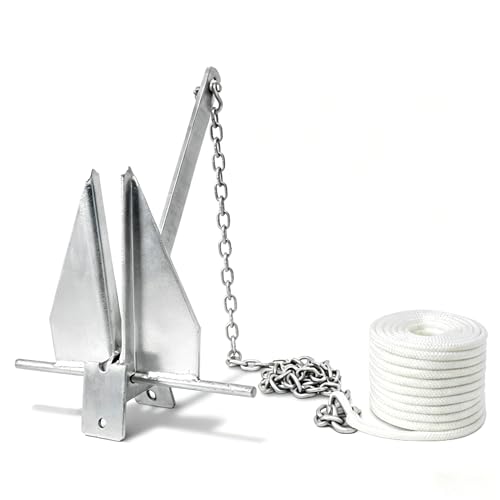
A lighter Danforth option with 5 ft chain, 75 ft rope, and 5/16″ shackle. The kit emphasizes rust resistance through hot-dip galvanized materials and includes a pre-drilled hole for simple retrieval. Best for small crafts or as a spare anchor set.
Best for: small day boats needing a compact, corrosion-resistant anchor with essential rigging. Caution: may not provide sufficient holding power in very windy or current-heavy environments.
Buying Guide: Choosing the Right Heavy-Duty Boat Anchor
What boat size and water conditions do you typically encounter? For light to mid-sized boats in calm to moderate water, anchors in the 5–10 lb range with complete rigging are common. For larger pontoons or boats operating in stronger currents, consider heavier anchors (10–15 lb) with longer chains and ropes to improve stability.
Material matters: hot-dip galvanized steel provides rust resistance and long life in saltwater or freshwater. Flat-folding, compact designs add storage convenience, while pre-drilled holes speed up retrieval after anchoring.
Bottom type influences hold: mud and sand require fluke-shaped anchors that can dig in deeply, while rocky bottoms may need larger, heavier anchors or specialized designs.
Kit completeness: a full kit with chain, rope, shackles, and a recovery hole supports ready-to-use setups and easier anchor retrieval. Consider your boat length and deck space when selecting a kit.
Practical tips: always inspect anchor hardware for corrosion, replace worn ropes, and maintain proper rope length to ensure adequate scope for effective anchoring in varying wind and current conditions.
Frequently Asked Questions
- What size anchor should I choose for a 20-foot boat? For boats around 20 feet, anchors in the 8–13 lb range with sufficient chain and rope are typical, depending on wind, current, and bottom type.
- Is hot-dip galvanization better than zinc plating? Yes. Hot-dip galvanization generally offers longer rust resistance and durability in saltwater environments than zinc plating.
- Do I need a complete anchor kit? A complete kit with chain, rope, and shackles simplifies setup and retrieval, especially for beginners or when anchoring in unfamiliar waters.
- How important is the recovery hole in a Danforth anchor? A pre-drilled recovery hole facilitates quick retrieval, which can save time in rough conditions or when re-anchoring.
- Can I use a lighter anchor in strong currents? Lighter anchors are generally less effective in strong winds or currents; consider upgrading to a heavier, more robust anchor for those conditions.
- Which anchor type performs best in mud? Fluke-style anchors (Danforth/navy-fluke) typically dig well in mud and sand, providing solid holding power when properly set.