Best Marine Onboard Battery Chargers for Reliable Boat Power
Boat owners looking for dependable onboard battery charging will find these options ideal. This guide highlights five top marine onboard chargers that cover multiple banks, compatibility with lead-acid and lithium batteries, and rugged marine-grade design. Best for powerboat crews needing fast multi-bank charging, best for small sailboats with limited space, and best for deep-cycle applications where 24/7 maintenance matters. The table below compares the key specs to help you choose quickly.
| Product | Banks / Total Amps | Best For | Notes |
|---|---|---|---|
| NOCO Genius GEN5X2 | 2 banks, 10A total | Mid-size boats needing two independent banks | Compact, versatile modes |
| NOCO Genius GEN5X3 | 3 banks, 15A total | Boats with three battery systems | Excellent for diverse battery types |
| NOCO Genius GEN5X1 | 1 bank, 5A | Compact installations | Best for space-constrained setups |
| NOCO Genius GENPRO10X2 | 2 banks, 20A total | Higher power needs on larger boats | Highest per-bank current here |
| ProMariner ProSport HD 44021 | 3 banks, 20A (total) | Rugged, all-weather charging | Digital control and distribution tech |
NOCO Genius GEN5X2: 2-Bank Onboard Charger
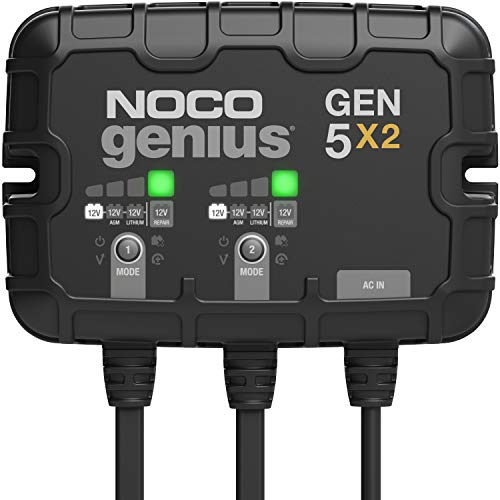
The GEN5X2 supports two independent banks with a combined 10 amps (5A per bank). This model is designed for compact marine environments, offering selectable charging modes for 12V, 12V AGM, 12V Lithium, and a 12V Repair Mode. It’s suited for boats that deploy multiple 12V lead-acid or lithium systems and want reliable, per-bank control. Best for boaters who need two dedicated charging channels without sacrificing space.
Best for: small-to-mid sized boats with two battery banks and diverse chemistries. Why selected: high reliability, compact form, and independently controllable banks streamline maintenance and charging efficiency. Caution: ensure proper heat management in very tight bilge spaces, as performance relies on stable ambient temps.
NOCO Genius GEN5X3: 3-Bank Onboard Charger
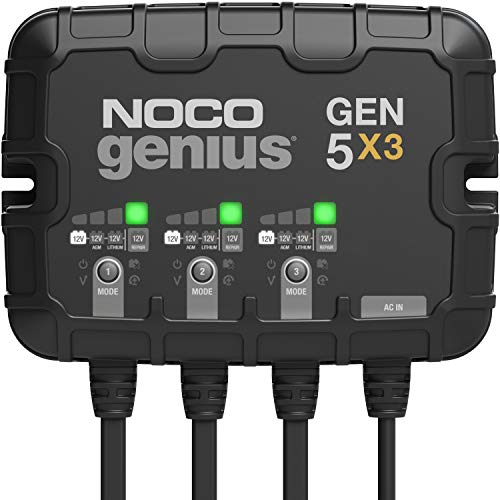
The GEN5X3 adds a third bank to deliver 15 amps total (5A per bank). Each bank supports 12V, 12V AGM, and 12V Lithium modes, plus a 12V Repair Mode to recover discharged batteries. This is an ideal choice for boats with three separate battery systems or when you need more simultaneous charging capacity without increasing overall footprint. Best for: larger inflatables or cruisers with multiple 12V systems. Caution: with three banks, ensure adequate space and ventilation to maintain optimal performance.
FirstPower Pro 2 Bank Marine Charger 5X2

The 5X2 design provides two banks at 5A per bank with IP68 waterproof sealing, suitable for 24/7 onboard charging. It supports three charging modes: 12V SLA/AGM, 12V Lithium, and 12V Calcium. Its independent bank operation allows simultaneous charging while accommodating different chemistries in each battery. Best for: boats that require flexible chemistry options and continuous maintenance. Limitation: some users may need to manually confirm mode selections for optimal charge on unusual battery types.
ProMariner ProSport HD 44021

The ProSport HD 44021 is a three-bank, 20A system with microprocessor and software-controlled charging. It uses Distributed-On-Demand Technology to allocate charging amps where needed, maximizing efficiency across all connected batteries. Best for: boats that demand intelligent distribution across multiple batteries and robust performance in variable conditions. Caution: ensure compatibility with battery chemistries beyond standard lead-acid and lithium, as some setups may require specific mode configurations.
Buying Guide: Key Purchase Considerations
What should you look for in a marine onboard charger? Prioritize multi-bank capability if your boat has several 12V systems, and verify each bank’s compatibility with lead-acid and lithium chemistries. Temperature compensation helps protect batteries in hot or cold marine environments. Waterproof ratings (IP68 or IP67) are essential for bilge or exposed installations. Consider the space available on deck or console when choosing a form factor and bank count.
How do you choose between 2-bank and 3-bank units? If you regularly run multiple 12V systems (starter, house, and engine) or manage deep-cycle batteries, a 3-bank charger provides more parallel charging without sacrificing time. For smaller boats with limited space or simpler setups, a 1- or 2-bank unit can be more practical while still offering independent bank control.
What about charging lithium batteries on marine boats? Look for models with dedicated 12V Lithium modes per bank. Lithium readiness often includes temperature compensation and safety protections. If you routinely mix battery types, confirm that the charger can manage each chemistry in its own bank without cross-interference.
Maintenance considerations: some units include a repair or recovery mode that helps revive deeply discharged batteries. A robust warranty and water resistance are practical assurances for the marine environment. Finally, check installation requirements and mounting method to ensure secure, vibration-resistant setup aboard.
FAQ
- Q: Can a single charger handle both lead-acid and lithium batteries in the same boat? A: Yes, if the charger supports multiple modes per bank; verify that each bank can independently select the appropriate mode.
- Q: Is a higher bank count always better? A: Not necessarily. It depends on your battery count and space. More banks offer more independent charging but require more space and proper wiring.
- Q: Do these chargers require frequent maintenance? A: Typical use requires ensuring connections are clean and dry, and that vents or heat sinks remain unobstructed for proper cooling.
- Q: Are waterproof ratings essential for all boats? A: For boats with exposed installations or bilge exposure, IP67/IP68 ratings provide added protection against moisture and salt air.
- Q: Can I install these chargers in a cabin or near living areas? A: Yes, but select a model with appropriate thermal design and ensure it’s mounted in a well-ventilated, dry location away from extreme heat.
- Q: How do I know which mode to select for my battery? A: Use the manufacturer’s guidelines for your battery type (SLA/AGM, Lithium, Calcium). Most units offer automatic detection as well as a manual mode selector.