Best AGM Marine Battery Charger Solutions for Boats and Yachts
Answering the question most boaters have: which AGM marine battery charger should I choose for reliable on-board charging? This guide highlights five top options that balance performance, safety, and compatibility with lead-acid and lithium batteries. It’s ideal for boat owners, marina managers, and DIY enthusiasts who want robust charging with temperature compensation and multiple bank options. Below is a quick summary table of the chosen products to compare core specs at a glance.
| Product | Banks | Per Bank | Best For | Notes |
|---|---|---|---|---|
| NOCO GEN5X2 | 2 | 5 A | Two-battery boats, starter + deep-cycle setups | Compact, versatile modes |
| NOCO GEN5X3 | 3 | 5 A | Three-battery systems, versatile charging | Largest among GEN5X series |
| NOCO GENPRO10X1 | 1 | 10 A | Single-battery high-capacity packs | High current for fast top-ups |
| NOCO GENIUS10 | 1 | 10 A | All-around maintenance and primary charging | All-in-one charger/maintainer |
| YONHAN Battery Charger 20A | 1 | 20 A | Fast charging for larger 12V/24V systems | Supports LiFePO4 and multiple chemistries |
NOCO GEN5X2: 2-Bank 10A Onboard Marine Charger
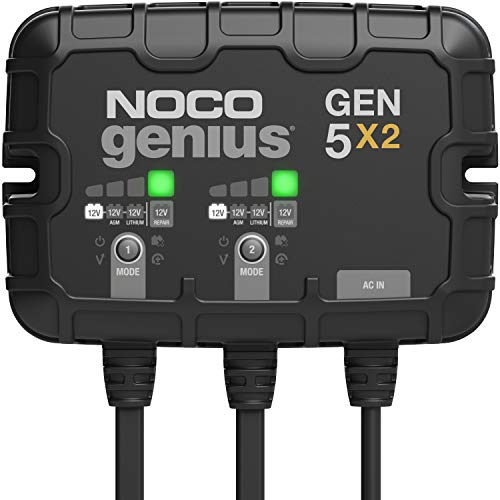
The GEN5X2 provides two independently controlled charging banks, totaling 10 amps (5 A per bank). It is designed for marine environments with robust waterproofing and temperature compensation to protect both lead-acid and lithium batteries. This model supports multiple charging modes including 12V, 12V AGM, and 12V Lithium, along with a dedicated Repair Mode for maintenance scenarios.
Best for: Boat owners with two separate battery banks needing balanced charging for cranking power and deep-cycle use. It’s a practical choice when space is limited and you want precise control per bank.
Caution: While versatile, ensure both banks are compatible with your battery chemistries and that installation space accommodates the unit’s dimensions. Over- or under-sizing can affect charging efficiency in chilly or hot conditions.
NOCO GEN5X3: 3-Bank 15A Onboard Charger
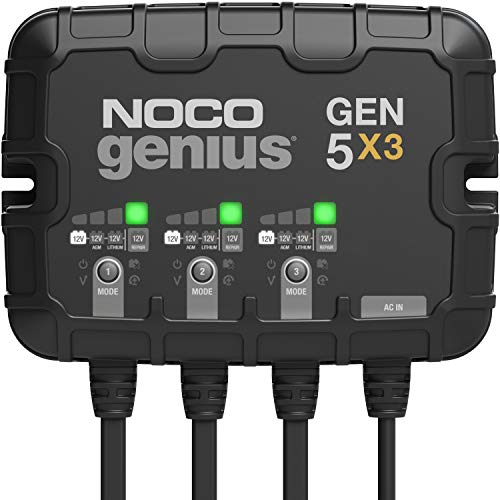
The GEN5X3 expands to three banks with a total of 15 amps (5 A per bank). It follows NOCO’s GEN5 platform, offering selectable modes per bank for 12V, AGM, Lithium, and Repair. The compact design targets multi-battery systems on boats that need reliable, per-bank management.
Best for: Larger boats or yachts with multiple battery banks (starter, house, and thruster packs) that benefit from parallel, yet independently controlled charging per bank.
Limitation: Larger footprint than the GEN5X2; ensure proper space and ventilation to maintain internal temperatures in hot docks or enclosed compartments.
NOCO GENPRO10X1: 1-Bank 10A Onboard Charger

The GENPRO10X1 focuses on a single bank with a robust 10-amp output. It’s engineered for peak performance in harsh marine environments and offers precise charging modes for various battery chemistries. This unit is compact and straightforward for boats with one primary battery bank needing reliable top-up power.
Best for: Boats with a single high-demand battery bank, such as sport boats or smaller vessels that require efficient 12V charging without extra banks.
Caution: If you later add a second bank, you’ll need a separate charger or shift to a multi-bank model to maintain independent control and simultaneous charging for all batteries.
NOCO GENIUS10: 10A Smart Charger and Maintainer

The GENIUS10 combines charging, maintenance, trickle charging, and a desulfator in a single unit. It’s designed for 6V and 12V lead-acid and lithium chemistries, including LiFePO4. A thermal sensor dynamically adjusts charging to prevent overcharging in heat and undercharging in cold environments.
Best for: Viewers seeking an all-in-one solution that handles charging, maintenance, and recovery in one device, suitable for boats with intermittent use or long storage periods.
Limitation: As a single-bank device, it’s most suitable for one main battery or a backup charger setup; not ideal for large multi-battery systems requiring independent bank management.
Buying Guide: Key Considerations For Marine Battery Chargers
- Battery chemistries supported: Confirm compatibility with AGM, Gel, VRLA, flooded lead-acid, and LiFePO4. Some models handle all broadly, others skew to one chemistry.
- Bank configuration: Determine how many banks you need. For yachts with multiple house and starting batteries, multi-bank units (two or more) can streamline charging without cross-interference.
- Current capacity: Match the charger’s per-bank amperage to battery capacity. Higher amp ratings reduce charge time but may require more robust wiring and ventilation.
- Temperature compensation: A charger with temperature sensing adapts charging to ambient conditions, protecting batteries during extreme heat or cold.
- Waterproofing and rugged build: Marine environments demand IP-rated enclosures and corrosion resistance. Ensure the unit is rated for outdoor use and, if needed, IP67 or higher for exposed locations.
- Repair and maintenance features: Look for Repair Modes or desulfation features that can help revive slightly aged batteries, especially for boats used seasonally.
- Installation footprint: Consider panel space, mounting options, and wire routing. Some units are compact, while others require more space for multiple banks.
- Future expansion: If you anticipate adding batteries or expanding systems, select a charger with extra bank capacity to minimize future upgrades.
Frequently Asked Questions
- What is the advantage of a multi-bank marine charger?
It charges multiple batteries independently, preventing cross-charging between banks and allowing simultaneous top-ups for starting and deep-cycle batteries. - Can these chargers handle LiFePO4 batteries?
Yes, several GEN5X, GENPRO, and GENIUS models support LiFePO4 as well as lead-acid chemistries. - Do marine chargers require installation by a professional?
Installation complexity varies. For multi-bank units and high-current outputs, professional wiring and marine-grade connectors are recommended. - Is temperature compensation necessary in marine environments?
Temperature compensation helps prevent overcharging in hot weather and undercharging in cold weather, improving battery longevity. - What should I consider when replacing an old marine charger?
Compare bank count, total amperage, battery chemistries supported, and the unit’s weather rating to ensure compatibility with your existing system.