Best Marine Band Radio Antennas for Clear VHF Communication on the Water
Answering a mariner’s need for reliable VHF communication, these marine band radio antennas offer range, durability, and installation options for different boats. This guide highlights five well-suited choices, with best uses and practical cautions. It helps you pick based on mounting style, cable length, gain, and frequency coverage. The top picks are ideal for boaters who prioritize solid reception, easy mounting, and compatibility with common VHF radios.
| Product | Best For | Key Strength |
|---|---|---|
| Long Range VHF Marine Radio Antenna (Eifagur) | Saltwater boats needing extended range | 2.5 dBi gain, 50W power handling |
| Tram 1600-HC Pretuned 35-Inch | All-around VHF coverage with simple setup | Full marine band coverage, 6 dB gain |
| HYS VHF Marine Antenna Low-Profile | Compact installations and reliable signals | 2 dBi gain, 50W, 16.4 ft cable |
| HYS VHF Marine Antenna Waterproof 3DBI | Higher gain with rugged build | 3 dBi gain, 43.3 inches, 7 m cable |
| Tram VHF 38-in. Marine Antenna | Sturdy mounting options and broad coverage | 6 dB gain, stainless steel L-bracket |
The following sections summarize five competitive options. Each entry notes the target user, why the antenna was selected, and a practical caveat to consider before buying. All models are designed for common VHF marine frequencies around 156–163 MHz and use PL-259 connections or similar and include a coaxial cable for straightforward installation.
Long Range VHF Marine Radio Antenna (Eifagur)

Best for boats needing extended receive and transmit reach. This Eifagur antenna operates across 156–163 MHz with a 2.5 dBi gain and 50W maximum input. It ships with a 5 m low-loss RG-58 cable and PL-259 connector, making it a convenient upgrade for fixed-mount installations on mast tops or rails. The stainless steel bracket supports durable mounting and stable performance in rough seas. A potential limitation is physical size and weight for very small vessels or low-clearance locations.
Tram 1600-HC Pretuned 35-Inch VHF Antenna

Best for boaters seeking ready-to-install, all-band coverage. The Tram 1600-HC covers all marine-band frequencies with a 1/2 wavelength design and a solid 6 dB gain. The pretuned setup reduces on-water tuning time, which is convenient for boats that want quick improvements. Limitations include larger physical length that may not fit tucked-away mounts on very small vessels.
HYS VHF Marine Antenna Low-Profile

Best for installations where profile height matters. This HYS low-profile model operates in the 156–163 MHz range with 2 dBi gain and includes a 16.4 ft coaxial cable for flexible mounting. It supports up to 50W, which is sufficient for typical recreational radio setups. A consideration is that the lower gain may reduce reach in poor conditions compared to higher-gain options.
HYS VHF Marine Antenna Waterproof 3DBI

Best for maximum gain on robust vessels that can accommodate a taller whip. The 3 dBi gain and 43.3-inch fiberglass build provide strong signal reception and transmission, with a 7 m RG-58 coaxial cable and a built-in nylon ratchet mount for flexible positioning. A limitation is the longer whip, which may interfere with low-clearance areas or overhead deck fittings.
Tram VHF 38-in. Marine Antenna
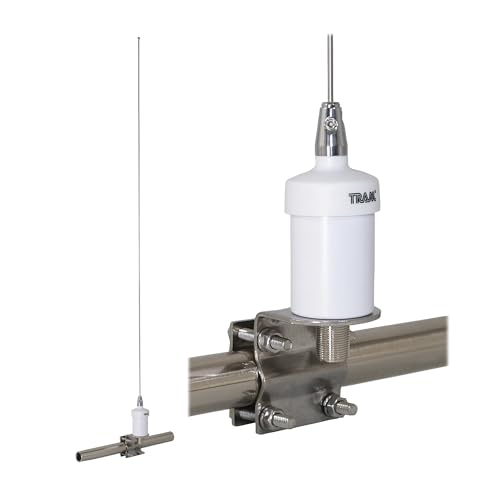
Best for boats requiring sturdy mounting and broad marine-band coverage. This Tram model uses a heavy-duty stainless steel “L” bracket for side or mast mounting and includes hardware for rail mounting. It delivers solid 6 dB gain, offering a good balance between durability and performance. A consideration is the mounting hardware weight and space needed for side mounting on smaller decks.
Tram 1604 39″ Marine Antenna

Best for comprehensive frequency needs, including AIS and all VHF marine bands. It features a base loading coil with triple chrome-plated brass for durability and strength, plus 2.5 dBd gain with a 1/2 wave design. The 15 ft coaxial cable supports flexible mounting. A limitation is that the taller assembly may be bulky for compact boats and shore-side storage between trips.
Buying Guide
What should you consider when choosing a marine band antenna? Start with frequency coverage, gain, and mounting options. Higher gain can extend range but may require a taller mast and sturdier mount. Check the transmitter power handling (watts) to ensure compatibility with your radio. Cable length matters for installation distance from the radio to the antenna. Material quality and weather resistance are essential for saltwater use. If space is tight, opt for a low-profile model, but be mindful of potential gains and performance trade-offs.
How do mounting and mast height influence performance? Taller antennas can improve vertical radiation and range, especially in open water. However, creating a taller profile increases wind load and may demand reinforced mounts. For smaller sailboats or kayaks, consider compact or low-profile designs with sufficient gain. In fixed installations, a robust bracket and corrosion-resistant materials extend service life in harsh marine environments.
What about coaxial cable and connectors? Use low-loss RG-58 or RG-58U cables with PL-259 connectors for standard marine radios. Longer runs can introduce minor signal loss; plan routing to minimize bends and exposure to heat or abrasion. Ensure cable length matches your vessel layout to reduce slack and clutter on deck or inside cockpit areas.
FAQ
- What frequency range do these antennas cover?
Most options in this guide cover 156–163 MHz, the standard VHF marine band, with some extending to AIS bands in specific models.
- Which antenna is best for small boats?
Low-profile models like the HYS Low-Profile or compact Tram options are preferable when deck space and visibility are limited.
- Do higher-gain antennas always provide longer range?
Higher gain can improve receive/transmit range, but it often requires a taller antenna and sturdier mounting; performance also depends on radio power and line-of-sight conditions.
- Is coax length important?
Yes. Longer coax can introduce more signal loss. Choose a length that suits your installation while avoiding excessive runs.
- Can I install these on a fiberglass boat?
Yes. Most marine antennas are designed for fiberglass hulls, but ensure a proper ground or mounting point and sealant to prevent leaks.
- What maintenance is needed?
Regularly inspect for corrosion, check coax seals, and verify mounting brackets are tight to maintain optimal performance in rough sea conditions.