Best Marine GPS Sonar Combo for Clear Underwater Views and Accurate Navigation
Looking for a reliable marine GPS sonar combo? This guide highlights five top options that balance digital mapping, sonar clarity, and ease of use. Each pick targets different boat sizes and fishing needs, from kayak-friendly setups to bigger vessel navigation. The best choices cover CHIRP traditional sonar, SideVü/Down Scan views, built-in mapping, and wireless sharing features. Use the buyer’s guide to compare screen sizes, transducer options, and chart compatibility to match your fishing or cruising style.
| Product | Best For | Key Feature |
|---|---|---|
| Humminbird Helix 5 G3 GPS | Small boats and kayaks needing versatile sonar and Basemap | Dual Spectrum CHIRP + Basemap with LakeMaster/CoastMaster compatibility |
| Garmin GPSMAP 1243xsv | Waters with detailed mapping and SideVü/ClearVü | Ultra-high-definition sonar and pre-loaded mapping |
| Lowrance Elite FS 10 | Mid-sized boats seeking Live Sonar and Active Imaging | Active Imaging 3-in-1 transducer, FishReveal, high-detail mapping |
| Garmin Striker 7SV | All-around performance with Quickdraw Contours | CHIRP traditional, ClearVü, SideVü + Quickdraw Contours |
| Garmin Striker 4cv | Compact setups with reliable CHIRP and profiling maps | CHIRP traditional + ClearVü, built-in Quickdraw Contours |
Humminbird Helix 5 G3 GPS Fish Finder

Best for compact boats needing strong mapping and dual-spectrum sonar. The Helix 5 G3 offers Dual Spectrum CHIRP Sonar for broad coverage (Wide) and detailed scanning (Narrow). The Low-Q transducer improves target separation, while the Basemap provides 10,000+ lakes and U.S. coastlines. It is compatible with premium LakeMaster, CoastMaster, and Navionics charts. Choose this if you want a budget-friendly, multi-feature unit with robust mapping in a small-boat package. Caution: Some advanced charts may require optional map subscriptions.
Garmin GPSMAP 1243xsv SideVü and ClearVü

Best for anglers and boaters who want high-definition scanning sonar and integrated mapping. The 1243xsv includes Ultra HD SideVü and ClearVü alongside traditional CHIRP sonar, plus Pre-loaded mapping. It is well-suited for larger vessels where sharp fish arches and structure details aid trolling and reefing. Limitations include a potentially steeper setup due to larger screen, and premium cards are optional for expanded mapping.
Lowrance Elite FS 10 Active Imaging
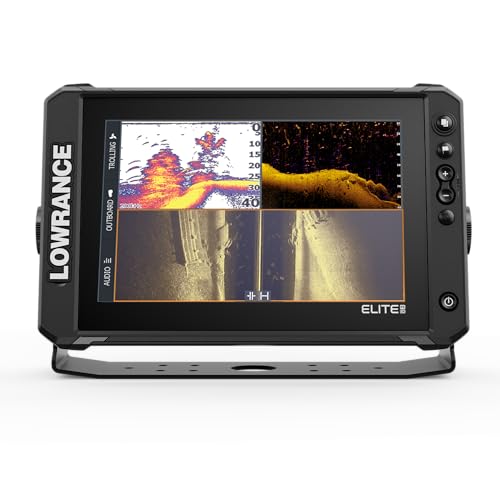
Best for serious anglers who want real-time sonar and precise mapping. The Elite FS 10 includes Active Imaging 3-in-1 transducer with CHIRP, SideScan, and DownScan plus FishReveal for clearer fish targets. It supports high-detail contour mapping to reveal ledges and productive zones. Choose this if you prioritize live sonar and advanced imaging in a mid-to-large boat. Caution: Transducer and wiring complexity may require installation expertise.
Garmin Striker 7SV with Transducer

Best for a feature-rich, easy-to-use sonar on mid-sized boats. The Striker 7SV provides CHIRP traditional, ClearVü, and SideVü with built-in Quickdraw Contours mapping. It includes Wi-Fi for connecting to the ActiveCaptain app to view updates and share data. Choose this if you want a versatile, map-ready option with straightforward operation. Limitation: Some users might prefer higher-resolution display on larger screens for deep-water work.
Garmin Striker 5CV / 5″ GPS Fishfinder
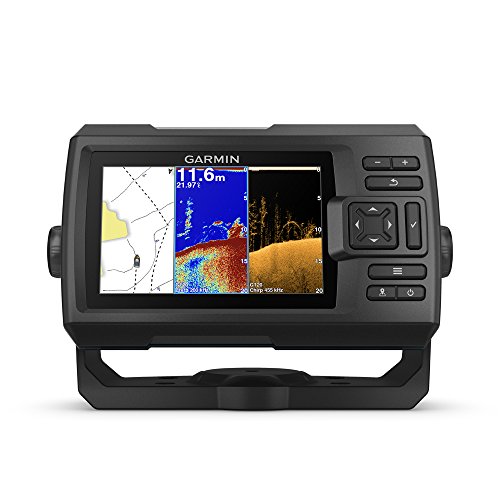
Best for compact boats needing dependable CHIRP traditional and ClearVü with mapping. The Striker 5CV includes CHIRP traditional plus ClearVü scanning sonar and Quickdraw Contours for simple, fast map creation. It’s ideal for small boats and DIY installers. Better for users who want a compact, straightforward setup over larger screen readability. Limitation: Smaller display may limit detail in rough conditions or deep water.
Buying Guide: How To Choose A Marine GPS Sonar Combo
- Charting and mapping: Determine if you need built-in basemaps or premium cartography (Navionics, LakeMaster, CoastMaster). If you fish or navigate in unfamiliar waters, preloaded maps plus upgrade options matter.
- Sonar technology: CHIRP traditional sonar is standard, but SideVü and DownScan provide better structure imaging. Consider Active Imaging or Panoptix if you fish near structure or vegetation.
- Screen size and readability: Larger screens enhance visibility in sunlight and rough seas. For compact boats, 5–7 inches is typically sufficient; bigger boats benefit from 9–12 inches.
- Transducer options: Transducer type (single vs. dual, CHIRP/SideScan/DownScan) affects how you scan water columns and bottom contours. Confirm compatibility with your boat transom needs.
- Connectivity and sharing: Built-in Wi-Fi or network features let you share routes and waypoints across units. This helps with multi-crew boats or multiple cockpits.
- Ease of use: Look for intuitive menus and quick access to waypoint marking, depth, and temperature readings. A well-designed interface reduces on-water distraction.
- Power and installation: Check power requirements and installation complexity. Some units are easier to install on smaller vessels, while others may require professional help for mounting and wiring.
Frequently Asked Questions
- What is the difference between SideVü and DownScan?
SideVü images the sides of the boat for wide-area scanning, while DownScan focuses downward, showing the bottom and structures directly below the boat. - Do I need built-in maps for a marine GPS unit?
Built-in maps are convenient, but you can often add premium charts via SD cards or downloads. Preloaded basemaps help on trips, while premium charts improve detail. - Is CHIRP better than traditional sonar?
CHIRP provides clearer target separation and better bottom detail across a range of depths compared to fixed-frequency traditional sonar. - Can these units share data between boats?
Some models support Wi-Fi or network sharing to transfer waypoints, routes, and sonar logs between compatible units. - What should I consider when choosing screen size?
Consider cockpit space, glare resistance, visibility in sunlight, and whether you mainly fish standing or sitting. Larger screens reduce eye strain but require more mounting space. - Are these devices easy to install on a small boat?
Installation varies by model; compact units with simple transducer setups are easier for DIY installations on small boats.