Best 24 Volt Bilge Pump Options for Boats
Answering the question: a 24-volt bilge pump is best for larger boats or systems that require robust, high-capacity water removal with reliable performance. This guide highlights five top 24V bilge pumps, suitable for different boat sizes and needs. It explains who each pump is best for, plus practical considerations like flow rate, automatic vs non-automatic operation, and durability in harsh marine environments.
| Product | Flow | Operation | Best For |
|---|---|---|---|
| Rule 2000 GPH Non-Automatic 24V | 2000 GPH | Non-Automatic | Large boats needing strong manual control |
| Rule High-Performance 1500GPH 24V | 1500 GPH | Manual/Pressure Switch compatible | Medium-to-large vessels seeking reliable water removal |
| SEAFLO Automatic Submersible 750GPH 24V | 750 GPH | Automatic with float switch | Small to mid-sized boats preferring auto operation |
| SEAFLO 2000 GPH 24V | 2000 GPH | Non-Automatic | High-capacity, non-auto setups |
| SEAFLO 3700 GPH 24V Bilge Pump | 3700 GPH | Non-Automatic | Very large boats or demanding bilge needs |
Note: Each product listed below is shown with its official features to help you compare performance, reliability, and suitability for different marine scenarios.
Rule 2000 GPH Non-Automatic 24V Bilge Pump

Features reference: RULE 12, RUL12. This non-automatic pump focuses on high flow with straightforward operation, suitable for installations where manual activation is preferred or required by system design. Best for boaters who want simple, high-capacity water removal without automatic switches.
Best for: Large vessels that demand robust water handling and where manual control is acceptable or preferred. Caution: Non-automatic operation means you must trigger pump activation to remove water.
Rule High-Performance 1500GPH 24 Volt Pump
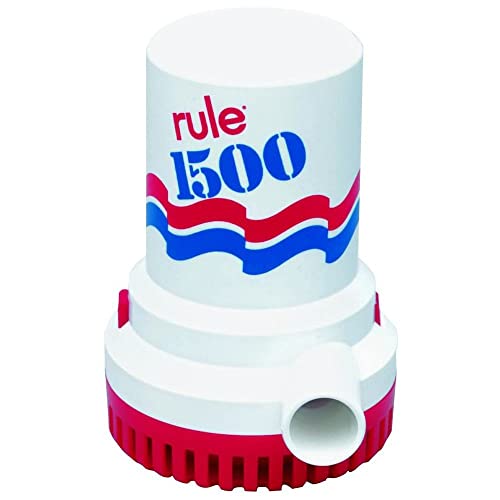
Features reference: Reliable and Efficient, with a 6-foot wire for easy installation. Designed for pressure switch compatibility and submersible use, this pump supports durable operation in marine environments.
Best for: Boats that need dependable 24V power with manageable flow and straightforward wiring. Choose this if you want a consistently reliable bilge pump with flexible mounting options. Caution: Confirm compatibility with your vessel’s electrical and switch setup before installation.
Rule 16A Marine 3700 GPH 24V Bilge Pump

Features reference: 3700-GPH capacity on a 24-Volt system, built for demanding bilge water management. Best for large boats or heavy rain scenarios where rapid water removal is essential.
Best for: Big boats or vessels with high water input where maximum drainage is required. Limitation: Higher flow often means larger physical size and power draw; ensure space and wiring can support it.
SEAFLO Automatic Submersible 750GPH 24V

Features reference: Automatic operation with an integrated float switch, high-performance capacity of 750 GPH, and easy maintenance with a removable base and snap-off strainer. This design supports hands-free water management and debris removal to protect the pump.
Best for: Small to mid-sized boats seeking convenient automatic control and reliable auto-start/stop behavior. Caution: 750 GPH may be insufficient for vessels with high water ingress during heavy rain events.
SEAFLO 2000 GPH 24V Non-Automatic

Features reference: Heavy-duty motor with stainless steel shaft and tough thermoplastic body, totally submersible and ignition-protected. This pump provides solid, high-capacity performance without automatic controls.
Best for: Boats requiring strong non-automatic 24V drainage with robust construction. Caution: Without an automatic switch, you need to manually operate or wire to a separate control system.
SEAFLO 3700 GPH 24V 01-Series Bilge Pump

Features reference: High-Capacity Performance delivering 3700 GPH on a 24-Volt system, with marine-grade construction designed to resist corrosion and salt exposure. Includes a four-year warranty profile for model line sense.
Best for: Very large boats or vessels operating in consistently harsh or coastal environments. Caution: Very high flow means higher power draw and potential noise, plan mounting and electrical load accordingly.
Buying Guide
What size bilge pump do I need?
Choose based on vessel size, hull design, and expected bilge water volume. Larger boats with multiple compartments generally require 1500–3700 GPH pumps, while smaller craft can manage with 500–750 GPH models.
Automatic vs. non-automatic: Which is right?
Automatic pumps with float switches simplify operation and prevent overflows, ideal for unattended boats. Non-automatic pumps give you manual control, useful when you want to manage water removal via a dedicated switch or external relay.
Voltage and power considerations
24-volt pumps are common for larger boats with dual-battery systems. Ensure your electrical system can safely supply the continuous current, and verify wiring and fuses match the pump’s requirements.
Durability and materials
Look for corrosion-resistant bodies and stainless steel shafts for saltwater environments. Submersible designs protect internal components, but check for ignition protection if you operate near flammable conditions.
Installation and maintenance tips
- Ensure proper mounting to reduce vibration and noise.
- Use appropriate check valves and vents to prevent backflow and air locks.
- Regularly inspect strainers and bases for debris buildup.
- Label electrical connections and use marine-grade wiring.
Practical decision factors
- For high-capacity needs on large boats, consider 2000–3700 GPH models.
- Prefer automatic operation if you travel away from the boat often or have complex bilge layouts.
- Balance flow rate with power consumption and space constraints.
Quick reference: 24V bilge pumps at a glance
- Best for heavy-duty needs: SEAFLO 3700 GPH, Rule 2000 GPH
- Best for auto operation: SEAFLO 750GPH Automatic
- Best for balanced performance: Rule 1500GPH
FAQ
- What is a typical 24V bilge pump flow rate for a mid-sized boat? Answer: Common ranges are 750–2000 GPH, depending on vessel size and bilge water volume.
- Should I choose automatic or non-automatic for a weekend boat? Answer: Automatic reduces manual effort and prevents overflows, making it generally preferable.
- Can I use a higher GPH pump on a small boat? Answer: It’s possible but not ideal; ensure mounting space, wiring, and electrical loads are suitable.
- Do 24V pumps require special wiring? Answer: Yes, use marine-grade wiring and appropriate fuses or breakers rated for the pump’s current draw.
- Are there safety concerns with submersible bilge pumps? Answer: Submersible units are designed for water exposure, but ensure proper enclosure, ventilation, and ignition protection as applicable.
- What maintenance helps a bilge pump last longer? Answer: Regularly clean strainers, check for debris, inspect seals, and verify that float switches (if present) move freely.