Best High Flow Bilge Pumps for Quick Water Evacuation on Boats
When you need fast water evacuation, a high flow bilge pump is essential. This guide compares five top options, highlighting who benefits most from each design and where to avoid common pitfalls. Ideal buyers include boat owners facing heavy bilge water, long trips in rough seas, and anyone replacing an aging pump. Below is a quick buying snapshot to start your decision.
| Product | Flow (GPH) | Outlet | Best For |
|---|---|---|---|
| SEAFLO 01 Series 2000 GPH | 2000 | 1-1/8″ | Mid-range, reliable daily use |
| SEAFLO 01 Series 4700 GPH | 4700 | 2″ | High-demand pumping, large bilges |
| SEAFLO 01 Series 1500 GPH | 1500 | 1-1/8″ | Compact spaces, steady performance |
| Amarine Made 2000 GPH | 2000 | 1-1/8″ | Non-automatic with flexible use |
| Rule 2000 GPH | 2000 | 1-1/8″ | Quiet operation, corrosion resistance |
SEAFLO 01 Series 2000 GPH Bilge Pump

Best for regular boat use where space allows a robust 2000 GPH flow. This 12V submersible pump features anti-airlock protection and a compact 1-1/8 inch outlet. It is supported by a 4-year warranty, emphasizing durability for routine bilge maintenance. Suitable for sailors who want dependable performance with straightforward wiring and a moderate current draw. Caution: ensure clearance around the intake to prevent cavitation under heavy load.
SEAFLO 01 Series 4700 GPH Bilge Pump
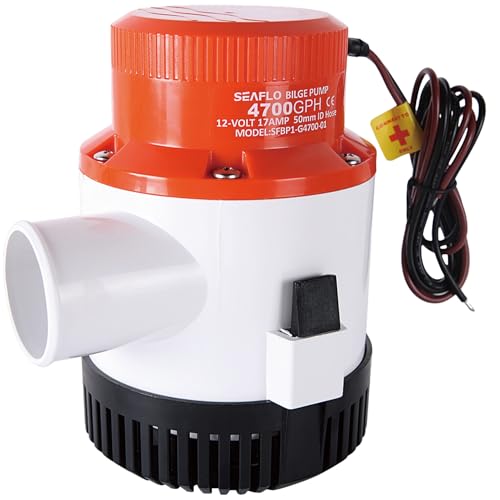
Best for boats with large bilges or demanding water evacuation needs. This 12V pump moves up to 4700 GPH and uses a 2 inch outlet for rapid water removal. It comes with anti-airlock protection and a 4-year warranty, making it ideal for high-use vessels. Benefit: faster clearance in rough conditions. Caution: higher current draw means more power consumption and potentially greater wiring requirements.
SEAFLO 01 Series 1500 GPH Bilge Pump

Best for compact spaces where a balance of power and size matters. With 1500 GPH, this pump handles typical bilge tasks efficiently and features a 1-1/8 inch outlet. It carries SEAFLO’s four-year warranty for reliability. Choose this if you need a smaller footprint without sacrificing solid evacuation capability. Limitation: may be slower in very large bilges or heavy rainfall scenarios.
Amarine Made 2000 GPH Non-Automatic Bilge Pump

Best for flexible, non-automatic setups where a float switch or external control is added. This 2000 GPH pump uses a 1-1/8 inch outlet and features a durable ABS housing. Its non-automatic design allows custom control for varied applications, such as solar-powered or backup systems. Caution: requires an independent float switch or ON/OFF/AUTO switch to function automatically. Beneficial for custom installations where automation is handled separately.
Rule 2000 GPH Bilge Pump

Best for quiet, persistent water removal with corrosion-resistant materials. The 2000 GPH submersible pump emphasizes silent operation and reliable long-term use. Its 1-1/8 inch discharge and anti-airlock features make it a strong choice for boats needing consistent performance without noise disruption. Limitation: the design relies on suitable mounting and airflow to prevent overheating during extended runs.
Buying Guide
What flow rate do you need? For small to mid-sized bilges, 1500–2000 GPH covers most scenarios. For larger boats or frequent heavy water, 4700 GPH can evacuate water quickly, but it uses more power and may require a larger space for the outlet and mounting.
What outlet size should you choose? Most marine bilge pumps use 1-1/8 inch or 2 inch outlets. A larger outlet (2 inches) speeds up evacuation but demands compatible hoses and fittings.
Automatic vs non-automatic: Automatic pumps work with a float switch to turn on when water rises. Non-automatic units require external controls. Choose based on whether you want hands-free operation or full manual control for specialized setups.
Power needs and wiring: Higher GPH pumps draw more current. Ensure your boat’s wiring and power supply can handle the current draw. Look for pumps with a built-in thermal or overload protection where possible.
Warranty and durability: A long warranty indicates manufacturer confidence in durability. Consider pumps with corrosion-resistant housings and robust seals for harsh marine environments.
Installation considerations: Check for flow direction, strainer compatibility, and mounting space. Anti-airlock features help maintain steady flow, particularly in rough seas or when the bilge is partially filled.
Maintenance and reliability: Regularly inspect hoses, clamps, and strainers. A pump that is easy to service will reduce downtime during trips or charters.
Quick Comparison Tips
- Best for heavy-duty needs: SEAFLO 4700 GPH.
- Best for mid-sized boats with reliable, automatic operation: SEAFLO 2000 GPH or Rule 2000 GPH.
- Best for compact spaces: SEAFLO 1500 GPH or Amarine Made 2000 GPH non-automatic.
- Best for customizable automation: Amarine Made 2000 GPH non-automatic paired with a float switch.
FAQ
- What is a high flow bilge pump best used for?
– High flow bilge pumps quickly evacuate large volumes of water, useful in rough seas or when bilge water accumulates rapidly. - Should I choose automatic or non-automatic pumps?
– Automatic pumps simplify operation by turning on with a float switch; non-automatic pumps offer manual control for custom setups. - What outlet size should I pair with my hoses?
– 1-1/8 inch is common for compact pumps; 2 inches is faster for large volumes but requires compatible fittings. - Is a 2000 GPH pump enough for a large boat?
– It may be sufficient for mid-sized boats; larger boats or heavy rain may benefit from 4700 GPH or higher, depending on bilge size. - Do these pumps require special maintenance?
– Regularly inspect and clean strainers, hoses, and clamps. Ensure electrical connections are secure and corrosion-resistant. - Can I use these pumps for applications other than bilge pumping?
– Some models can be repurposed for water transfer or backup drainage with appropriate controls, but verify suitability for the intended use.