Best Marine Fuel Tank Vent Options for Safe, Efficient Venting
Answering the question: for a reliable marine fuel vent, these five vent options provide corrosion resistance, proper airflow, and adaptable installation for common 5/8-inch hoses. They’re best suited for boaters who want durable venting that minimizes water ingress and vapor buildup during fueling and washdowns. The list below pairs each product with the most suitable use case, so you can compare at a glance before purchasing.
| Product | Best For |
|---|---|
| Seachoice Thru Hull Fuel Tank Vent | Through-hull venting with chrome-plated brass for corrosion resistance |
| Attwood 66419-3 Composite 90 Degree P-Trap | Preventing water ingress in exposed areas |
| Attwood Straight Fuel Tank Vent 5/8″ | Simple, straight airflow and easy hose compatibility |
| Universal 90° Keehui 316 Stainless | Stainless steel, strong marine-grade venting |
| EEYAD 316 Stainless Steel Vent | Corrosion resistance and reliable airflow in harsh environments |
Seachoice Thru Hull Fuel Tank Vent, Chrome-Plated Brass

The Seachoice thru-hull vent is designed for venting a marine fuel tank via a hose (hose not included). It uses chrome-plated brass for corrosion resistance and features two vent holes to support better airflow. This option is best for boaters who prefer a compact, chrome-finished vent with durable construction. Best for boats requiring a through-hull vent with a polished look and solid brass build. Caution: through-hull installation requires careful sealing to prevent leaks.
Attwood 66419-3 Composite 90 Degree P-Trap Fuel Tank Vent

This 90-degree composite vent includes a P-trap design and is sized for 5/8″ I.D. hose. It helps prevent water from entering the fuel tank while allowing air to vent freely during typical sea conditions and washdowns. It eliminates the need for an anti-siphon loop in the vent hose. Best for boats that need reliable water-blocking venting with simplified installation. Caution: ensure compatibility with your hose routing to maintain proper vent height.
Attwood Straight Marine Fuel Tank Vent, 5/8 Inch I.D.

Attwood’s straight vent design provides straightforward airflow for 5/8″ I.D. vent hoses. The splash-resistant polypropylene construction resists corrosion and seawater exposure, suitable for long-term marine use. Best for installations where a simple, direct vent path is possible. Caution: straight vents may be less adaptable in cramped bilge spaces; plan hose routing accordingly.
Universal 90° Keehui 316 Stainless Steel Vent

Keehui’s 316 stainless steel 90° vent is designed for 5/8″ hose connections and provides a robust, corrosion-resistant option. The vent requires an approximate 1 3/8-inch mounting hole and is suitable where stainless hardware is preferred in harsh marine environments. Best for stainless-steel-focused builds or boats exposed to salt spray. Caution: ensure the mounting hole size matches the spec to avoid leaks.
EEYAD 316 Stainless Steel Marine Fuel Tank Vent
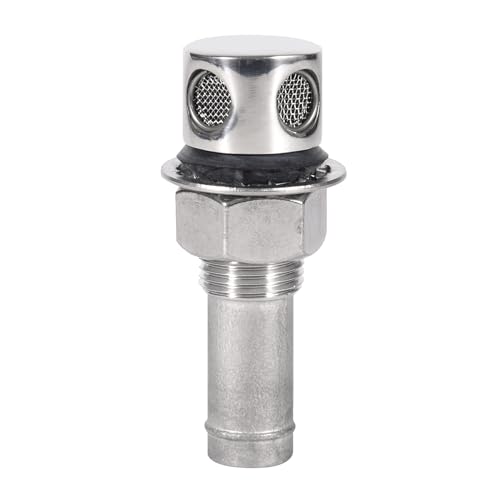
EEYAD’s 316 stainless steel vent is built for corrosion resistance and long-term durability in marine and outdoor fuel systems. It supports standard 5/8″ hose connections for easy installation. Best for marinas or boats needing strong stainless hardware in adverse conditions. Caution: verify hose compatibility with your fuel system before installation.
Buying Guide: Key Considerations for Marine Fuel Tank Vents
- Material and corrosion resistance: Stainless steel vents (316 grade) offer superior durability in saltwater environments compared with chrome-plated brass or polymer vents.
- Vent path and hose compatibility: Confirm 5/8″ I.D. hose compatibility and whether a straight or 90-degree orientation suits your hull layout.
- Water ingress prevention: P-trap designs and splash-resistant housings reduce water intrusion during washdowns and rough seas.
- Through-hull versus deck-level installation: Decide based on hull design, ease of maintenance, and potential impact on bilge space and vent routing.
- Maintenance needs: Chrome-plated brass or stainless steel may require different cleaning regimens to preserve appearance and function over time.
FAQ
- Q: Which vent is best for saltwater boats? A: Stainless steel options, such as 316-grade Keehui or EEYAD vents, offer superior corrosion resistance in marine salt environments.
- Q: Do I need a P-trap vent? A: P-trap vents help prevent water intrusion in the vent line, which is beneficial in washdown-prone vessels.
- Q: Can I use any 5/8-inch hose with these vents? A: Most listed vents support standard 5/8″ I.D. hoses; always confirm hose compatibility with the specific product.
- Q: Is a through-hull vent safer than a deck vent? A: Through-hull vents reduce exposure to washdowns but require careful sealing to prevent leaks; deck vents are easier to service.
- Q: How do I choose between straight and 90-degree vents? A: Choose based on hose routing: straight vents for direct paths, 90-degree vents for tight angles or vertical clearance constraints.
- Q: Do these vents include flame arresting features? A: Some models include stainless-steel flame arresting screens; verify product details if you require this safety feature.