Best Boat Fuel Filter Solutions for Clean, Reliable Fuel Delivery
Answering the common question “which fuel filter is best for my boat?” this guide highlights top options that protect engines from fuel contaminants and water. These picks suit different boat types and engines—from small sailboats to mid-range outboards and stern drives. The list favors filters with clear housings, easy inspection, and robust construction for harsh marine conditions. Use this overview to compare filtration micron sizes, compatibility, and maintenance needs so you can choose the right filter for your rig.
| Product | Brand | Best For | Key Benefit |
|---|---|---|---|
| Attwood 12562-6 Universal 40-Micron | Attwood | Outboard engines and simple maintenance users | Clear body for visual inspection; durable construction |
| Quicksilver 802893Q01 Water Separating | Quicksilver | Mercury/Mariner systems, Merc specs | 25 micron filtering, water separation capacity |
| CARMOCAR 3/8 NPT Brass Fittings | CARMOCAR | Universal, multiple motor brands | 10 micron filtration, 3/8 NPT ports, broad compatibility |
| Quicksilver Inline 879885Q | Quicksilver | Inline installation under cowl | 20 micron filter; translucent body for content visibility |
| T-H Marine Universal | T-H Marine | All engines, multiple line sizes | Transparent glass housing; 1/4″, 5/16″, 3/8″ |
Attwood 12562-6 Universal 40-Micron Outboard Fuel Filter

Best for budget-conscious boaters who want a straightforward, visible maintenance process. The 40-micron filtration helps catch larger debris, while the clear housing allows rapid visual checks between service intervals. This model is well-suited for outboard engines used in inland and coastal boating. A potential limitation is the 40-micron rating, which may require more frequent checks in fuel with higher particulate content.
Who it’s best for: Weekend boaters with simple maintenance routines and standard outboard engines seeking easy inspection and quick changes.
Why chosen: Clear body, sturdy build, and convenient disposal orientation fit typical maintenance workflows. Avoid this if you require ultra-fine filtration or if your fuel has abundant micro-particles that demand sub-10 micron filtration.
Quicksilver 802893Q01 Water Separating Fuel Filter
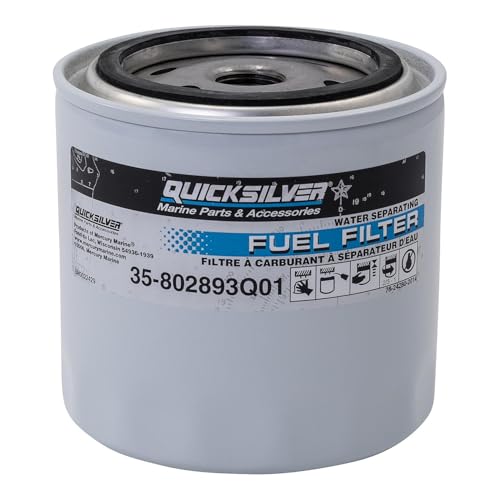
This option is best for Mercury, Mariner, and MerCruiser systems that need reliable water separation. The 25-micron core targets small particulates while the built-in water separation helps protect fuel delivery components. It’s a solid pick for engines in saltwater or marina environments where water contamination is a risk. A potential drawback is slightly higher micron filtration, which may cause a marginal pressure drop on very old or clogged systems.
Who it’s best for: Mercury/Mariner operators and boaters who want adherence to original equipment specifications with dependable water separation.
Why chosen: Engine protection through dedicated water separation aligns with OEM expectations, reducing the chance of water-related damage. Choose this if you need proven compatibility; otherwise consider a lower micron option for high-flow fuel lines.
CARMOCAR Fuel Filter Water Separator Replacement

Best for owners seeking broad compatibility across Marine outboards and stern drives due to its 3/8″ NPT ports and 10-micron filtration. The unit is designed to trap the smallest particles and emulsified water, contributing to cleaner fuel delivery. A caveat is that higher filtration efficiency can lead to slightly higher pressure drop in older fuel systems. This model is ideal for mixed-brand fleets or boats that operate in variable fuel quality areas.
Who it’s best for: Boat owners who want a versatile filter that supports multiple brands and a tighter filtration performance.
Quicksilver Inline 879885Q2 Fuel Filter

Best for installations under the engine cowl where space is available. This inline 20-micron filter targets fine particles while allowing easy replacement with standard hose clamps. The translucent body aids quick assessment of fuel quality, making it a good choice for boats with frequent refueling in variable conditions. A limitation is that 20 microns may not catch the smallest contaminants in very dirty fuel; consider pairing with a pre-filter for high-risk fuels.
Who it’s best for: Boaters who value a compact, easily serviced inline option and prefer visual fuel monitoring.
T-H Marine Universal Boat Fuel Filter

Best for versatile engine setups that require compatibility with 1/4″, 5/16″ and 3/8″ fuel lines. The transparent glass housing allows easy monitoring of fuel and filter condition. It is well-suited for inboard, outboard, and I/O setups. A consideration is that glass housings can crack if mishandled in rough seas or with heavy vibration; handle with care and inspect for cracks during routine maintenance.
Who it’s best for: Mixed-configuration boats needing a universally compatible filter with clear visibility.
Buying Guide: Practical Tips for Choosing a Boat Fuel Filter
What filtration level should you choose? Consider the fuel quality you typically encounter. Higher micron ratings trap larger particles but may require more frequent changes if fuel contains finer contaminants. Sub-10 micron options provide cleaner fuel but can impose higher pressure drops.
How important is a clear housing? A transparent housing speeds maintenance by letting you see water, debris, and fuel condition. For boats in saltwater or marina environments, a water-separating feature is highly valuable.
Which fittings and line sizes matter? Look for 1/4″, 5/16″ and 3/8″ compatibility to match common marine fuel lines. 3/8″ NPT ports reduce pressure drop on some systems, but ensure your fuel line clamps and fittings match your engine’s inlet ports.
Do you need OEM compatibility? If you operate a Mercury, MerCruiser, or Yamaha/Marlin installation, filters that align with OEM specs may simplify maintenance and spares compatibility.
What about installation location? Inline filters are convenient under the cowl, while transparent, top-loading housings suit straightforward inspection. Weight and vibration tolerance are considerations on smaller boats where mounting surface integrity matters.
Maintenance Tips
- Inspect the filter visually before trips and after refuels in dirty fuel areas.
- Replace filters on a regular schedule, or when you notice fuel pressure changes.
- Ensure proper seating of seals to prevent leaks.
- Confirm compatible fittings before swapping to avoid clogging or bypasses.
- Keep spares on board for quick filter swaps during trips.
Frequently Asked Questions
- How do I know which micron rating to use for my boat?
– Consider engine requirements, fuel quality, and the likelihood of water in fuel. Higher quality engines often benefit from finer filtration, but verify compatibility with your fuel delivery system. - What is the purpose of a water-separating fuel filter?
– It removes water from fuel to prevent corrosion, fuel pump damage, and poor engine performance. - Can I install a filter with a different micron rating than my current one?
– Yes, but ensure the system can handle pressure changes and that the new filter is compatible with your engine’s flow requirements. - Should I use a transparent filter housing?
– Transparent housings help with quick visual checks for water and particulates, beneficial in variable fuel conditions. - Are universal filters suitable for all boats?
– They provide broad compatibility, but verify port sizes and mounting compatibility with your specific engine and fuel lines.