Best on-Board Charging Systems for Boats in 2026
Looking for a reliable on-board charger for your boat’s electrical system? This guide highlights five top options that handle marine conditions, support multiple banks or voltages, and suit different boat sizes and battery types. Best for shared battery banks, best for 12V and 24V systems, and best for rugged, waterproof performance. Below, find compact comparisons and practical buying tips to choose the right charger for your vessel.
| Product | System Type | Voltage / Banks | Best For |
|---|---|---|---|
| Guest 2707A On-Board Battery Charger | Dual Bank | 12V, 2 Bank | Small to mid-size boats needing independent bank charging |
| Marinco 150BBI Inlet | Inlet | 15A AC | Mounting to hulls for quick shore-power integration |
| Marinco 150BBIW Inlet | Inlet | 15A AC | White variant for clean hull aesthetics |
| Guest 2720A On-Board Charger | Dual Bank / 12/24V | 12V / 24V, 2 Bank | Two-bank versatility for mixed systems |
| VEVOR Marine Battery Charger | Single Bank | 12V / 5A | Lithium and lead-acid friendly onboard charging |
Guest 2707A On-Board Battery Charger 8A / 12V

Features: Dual Bank system charges two batteries independently. Waterproof IP67 sealed for marine conditions. Safety features include reverse polarity, over-current, over-voltage, over-temperature, and ignition protection.
Best for: Small to mid-sized boats with two battery banks needing separate charging management. This model is a practical choice where each battery requires independent monitoring to avoid cross-charge issues.
Limitations: It charges at 8A, which may be slower for larger battery banks or high-usage vessels. Consider higher-output options if overlapping shore power windows are common.
Marinco 150BBI Marine On-Board Charger Inlet

Features: 15A 125V AC straight blade inlet in black with a low-profile cap. Mounts easily to fiberglass and aluminum hulls.
Best for: Boats needing a sturdy shore-power inlet that blends with hull aesthetics and supports quick access to power through standard 15A connections.
Limitations: Inlet is not a charger by itself; pairing with a separate charger or power supply is required to charge batteries.
Marinco 150BBIW Marine On-Board Charger Inlet

Features: 15A 125V AC straight blade inlet in white with a low-profile cap. Easy mounting to fiberglass and aluminum hulls.
Best for: Vessel owners seeking a clean white finish and similar performance to the black variant, with hull-friendly profile.
Limitations: Like the black version, this inlet does not include a built-in charger; integration with a compatible charging unit is necessary.
10 Amp Panel Mount 12V Battery Charger

Features: Input AC 120V, 60Hz; Output DC 12V, 10 Amp. Includes 24-inch long battery cables (16 AWG).
Best for: Boats that require faster single-bank charging and a compact, panel-mount form factor.
Limitations: Only a single bank setup; not suitable for multi-battery configurations without an additional charger.
Guest 2720A On-Board Battery Charger

Features: Dual voltage support for 12 V and 24 V systems. Two independent charging and monitoring banks. IP67 waterproof for harsh marine environments.
Best for: Larger boats or systems that operate both 12V and 24V regions, requiring flexible installation and robust bank management.
Limitations: Higher complexity and installation considerations due to dual-voltage support; verify compatible battery types and wiring.
VEVOR Marine Battery Charger
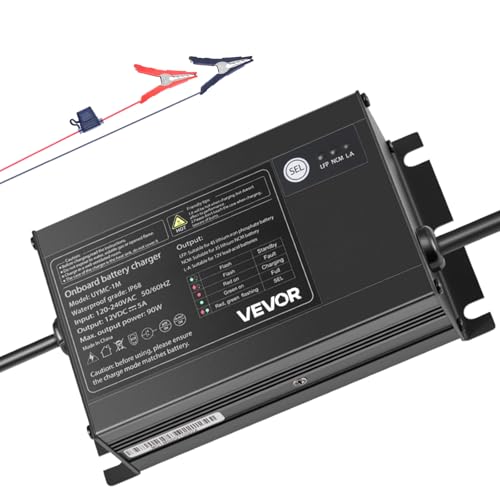
Features: 1-Bank, 5A 12V output. IP68 waterproof and dust-repellent design. Three charging modes for LiFePO4, NCM, and lead-acid batteries; supports various marine battery types.
Best for: Boats needing a compact, versatile charger that tolerates salt and water exposure, with compatibility across common battery chemistries.
Limitations: Lower amperage means slower charging for larger battery banks; upgrade if frequent power draws are high.
Buying Guide: Key Considerations For Choosing An On-Board Boat Charger
What system size do you need? For two-battery boats, a dual-bank charger like the Guest 2707A or 2720A provides independent charging. For simple, single-bank needs, a 5A or 10A panel-mount unit may suffice.
What voltages matter? If your boat uses both 12V and 24V systems, opt for a dual-voltage charger such as the Guest 2720A. If you only run 12V, a single-bank 12V charger may be more cost-effective.
How important is water resistance? Marine environments demand IP68/IP67-rated units, especially in exposed engine rooms or salt air. Inlets should also resist corrosion and keep water out when not in use.
Should you choose an inlet or a built-in charger? Inlets are useful when you want flexible shore-power connections and to separate the charging unit from the hull. Built-in chargers simplify installations on smaller vessels.
Battery compatibility matters. Ensure the charger supports your battery chemistry (lead-acid, AGM, LiFePO4, NCM) and that the amperage matches the batteries’ capacity for optimal charging without overheating.
FAQ
- What is the difference between a charger and an inlet? A charger converts AC shore power to DC to charge batteries, while an inlet provides a connection point for shore power to reach your boat’s electrical system.
- Can I use a 15A inlet with a 10A charger? Yes, but the system will be limited to the lower amperage of the two components, effectively reducing charging speed.
- Is IP67/IP68 protection enough for marine use? These ratings protect against immersion and exposure to water and dust in typical marine conditions, but proper installation and seals are still essential.
- Do I need different chargers for 12V and 24V boats? If your boat uses both, a dual-voltage charger is preferred. For single-voltage setups, a 12V or 24V dedicated charger is sufficient.
- How many banks should I choose? Two-bank chargers are common for boats with two separate batteries (house and starting). Three-bank configurations are available but less common for small to mid-sized vessels.
- Is lithium compatible with all marine chargers? Some chargers support LiFePO4 or other lithium chemistries; verify compatibility before purchase to avoid charging issues.