Best Marine Binoculars With Compass for Navigation and Observation
Answering the question for sailors, fishers, and outdoor enthusiasts: these marine binoculars combine water resistance, compass guidance, and rangefinding features to help you navigate and identify distant objects at sea. The top picks below are best for boaters who need reliable optics, quick distance estimates, and easy viewing in bright or low-light conditions. Each product is evaluated for who benefits most, with practical pros and a note on limitations.
| Product | Magnification / Objective | Special Feature | Best For |
|---|---|---|---|
| USCAMEL 10×50 Marine Binoculars | 10×50 | Built-in compass and rangefinder; BAK4 prism; illuminated compass | All-around nautical use; glasses wearers |
| Hooway 7×50 Waterproof Military Marine Binoculars | 7×50 | Internal rangefinder and compass; waterproof and floatable | Navigation in rough seas; casual boating |
| Nikon 7x50mm CF WP OceanPro Marine Binoculars | 7×50 | Global compass; automatic declination; Eco-glass coatings | Professional navigation and bright viewing |
| Bushnell Marine 7×50 Binocular | 7×50 | Built-in compass and rangefinder; nitrogen-purged | Rugged marine use; reliable waterproofing |
| AOMEKIE 10×50 Marine Binoculars | 10×50 | Illuminated rangefinder; BAK4 prism; FMC coatings | Low-light visibility; precise distance estimation |
USCAMEL 10×50 Marine Binoculars with Compass
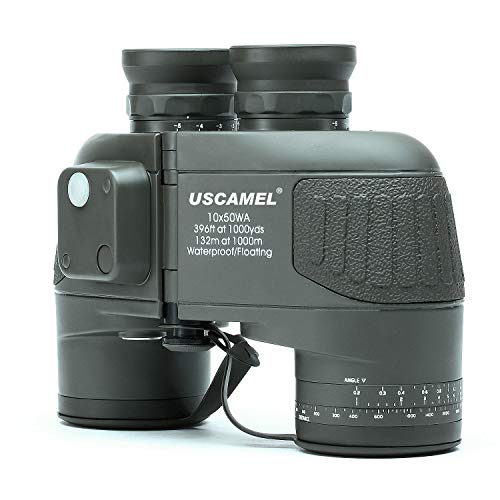
Best for: adults who need a versatile, feature-rich pair for sailing, fishing, and general observation. The 10x magnification provides detailed distant views, while the 50 mm objective lens supports brightness in challenging light. The built-in illuminated compass plus an internal rangefinder on the left eyepiece enable straightforward distance and direction estimation. The BAK4 prism and FMC coating optimize color accuracy and light transmission. A caution: the compass and rangefinder depend on batteries (LR936/AG9) for illumination, which may require replacement in extended trips.
Hooway 7×50 Marine Binoculars With Rangefinder & Compass
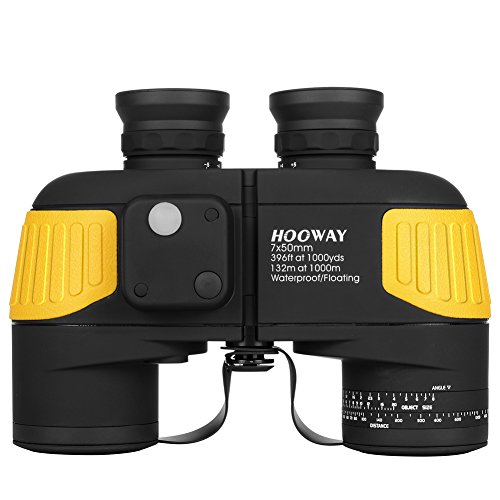
Best for: boaters who prioritize a robust, all-weather pair with an easy-to-use internal rangefinder and a large field of view. The 7x magnification reduces shake in rough seas, while the 50 mm objective lens helps brightness. The binoculars are designed to be waterproof and float, which is helpful if accidentally dropped overboard. A caveat: the 7x magnification may be less ideal for distant landmark identification compared with higher magnification options in calm conditions.
Nikon 7x50mm CF WP OceanPro Marine Binoculars

Best for: users seeking precise navigation aids with an illuminated global compass and automatic declination adjustments. The 7×50 configuration offers a balance of field of view and light capture, and Nikon’s Eco-glass coatings support clear imaging. A limitation: some users may prefer higher magnification for distant targets, as 7x may group distant details more loosely in rough seas.
Bushnell Marine 7×50 Binocular

Best for: divers and fishermen who need a sturdy, waterproof pair with built-in compass and rangefinding capability. The 7x magnification and 50 mm lens deliver bright images, and nitrogen purging helps prevent fogging. A caution: bulkier models may feel heavier during extended use, and performance depends on reliable compass calibration.
AOMEKIE 10×50 Marine Binoculars With Rangefinder

Best for: users needing strong low-light performance and distance estimation. The 10x magnification aids in identifying distant ships or buoys, while the illuminated rangefinder helps with quick measurements in open water. The optics feature high-index BAK4 prisms and FMC coatings for sharp images. A caution: higher magnification can magnify hand shake; a tripod or stable stance improves viewing stability.
AOMEKIE 10X50 Marine Binoculars With Compass

Best for: outdoor enthusiasts who require bright day viewing with distance estimation support. The 10×50 spec offers detail-rich images, a built-in rangefinder on the left eyepiece, and an illuminated compass for navigation in low-light conditions. A limitation: some users may find the higher magnification more challenging to hold steady without support.
Fujifilm Fujinon Mariner 7×50 WPC-XL

Best for: mariners who want a lightweight, floating option with a world compass and individual focus. The WPC-XL designation suggests a specialized design for marine use, with a focus on reliable navigation aid and floating capability. A caution: Fujifilm’s detailed specs in this listing are concise; verify compatibility with your planned navigation needs before purchase.
Buying Guide
Key purchase considerations for marine binoculars with compass:
- Magnification vs. field of view: Higher magnification reveals distant objects but is harder to steady at sea. Balancing 7x to 10x is common for marine use.
- Objective lens size: Larger lenses (50 mm) improve brightness but increase weight and size. 50 mm is a standard marine compromise.
- Compass and rangefinder: An illuminated compass helps in low light; a built-in rangefinder speeds distance estimates. Check battery requirements and illumination reliability.
- Prism and coatings: BAK4 prisms and FMC coatings improve brightness and color fidelity, especially over water glare.
- Waterproofing and buoyancy: Look for nitrogen-purged or waterproof designs; floatability can be a safety feature if dropped.
- Ergonomics: Foldable eyecups and eye relief matter for glasses wearers; choose comfortable, stable grips for extended use.
- Durability: Look for rugged, corrosion-resistant housings suitable for salt air and spray.
FAQ
- Q: Why is a compass important on marine binoculars?
A: It helps with quick direction finding and navigation when charts or GPS are not immediately available. - Q: Is higher magnification always better at sea?
A: Not necessarily. Higher magnification magnifies hand shake and glare; 7x to 10x is a common practical range for marine use. - Q: Do these binoculars float?
A: Some models are designed to float or be highly buoyant; check product details if buoyancy is important. - Q: How does a rangefinder help on the water?
A: It provides quick distance estimates to objects like buoys or ships, aiding decision-making and safety. - Q: Are all models fog-proof?
A: Most marine binoculars are nitrogen-purged or similarly sealed to resist fogging; verify the specification if you’ll be in humid or cold conditions. - Q: Can I use these with glasses?
A: Many models offer foldable eyecups and adjustable diopters to accommodate glasses wearers, but confirm fit before buying.