Best Marine 2-Way Radios for Safe on-Water Communication
When choosing a marine VHF radio, look for reliability, weather alerts, and ease of use in rough conditions. This guide highlights top options suited for tournament skippers, coastal navigators, and recreational boaters who want clear, dependable on-water communication. The featured models cover handhelds and fixed-mount units with key features like NOAA weather alerts, GPS, DSC, and IP ratings. The quick-reference table below helps buyers compare at a glance.
| Product | Type | Best For | Key Feature |
|---|---|---|---|
| Uniden UM385 | Fixed Mount | Coastal boats needing all-channel access | DSC, S.A.M.E Weather Alert |
| Cobra BlueBound 350 White | Handheld | Rugged portability with floating core | 6W power, IPX7, NOAA alerts |
| Retevis RM01P | Handheld | Port operations and quick coordination | IP67, floating, NOAA |
| Uniden Atlantis 275 | Handheld | Backups with large display and submersible design | Floating IPX8, NOAA alerts |
| Standard Horizon HX210 | Handheld | Entry-level, reliable floating radio | IPX7, emergency strobe, easy menu |
Uniden UM385 25 Watt Fixed Mount VHF Radio
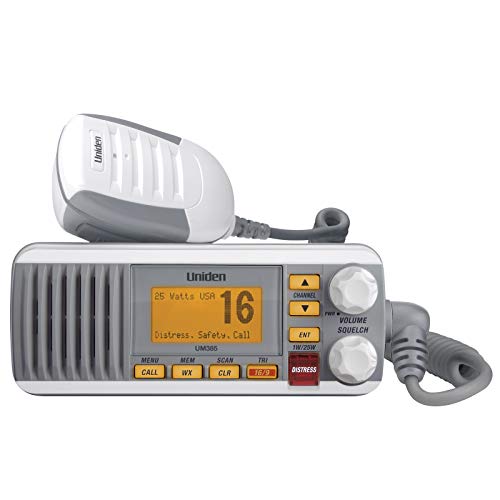
The UM385 combines DSC capability, triple-watch monitoring, and S.A.M.E weather alerts in a compact fixed-mount unit. It supports a broad set of international channels, making it suitable for boats that travel across borders. The rugged marine mic enables easy transmission from the helm, keeping the operator focused on the waters ahead.
Best for: boats that need fixed-mount reliability, emergency signaling, and weather alerts without frequent mic handling.
Caution: As a fixed-mount unit, installation requires space and some wiring work; ensure your helm has proper power and antenna setup.
Cobra BlueBound 350 White VHF Handheld

The BlueBound 350 White offers a high-visibility floating core, 6W transmit power, and a Day/Night LCD display for easy viewing. Its IPX7 waterproof rating and USB-C charging provide dependable use in varied weather and long trips. NOAA Weather Alerts help you stay ahead of changing conditions.
Best for: boaters who want a compact, buoyant handheld with strong visibility and flexible power settings for near and far range.
Limitation: As a handheld, it relies on battery life and may require frequent charging on long voyages.
Cobra BlueBound 350 Black VHF Handheld

This Black variant mirrors the White model in performance: 6W output, floating core, IPX7 waterproofing, and NOAA alerts, with a USB-C port for modern charging. The Day/Night LCD remains legible in sun or spray, and its portability makes it a go-to for quick handoffs between crew members.
Best for: crews prioritizing a low-profile handheld option with robust waterproofing and reliable alerts.
Limitation: A black color option may blend with deck gear; keep it attached to a lanyard or belt clip for quick access.
Retevis RM01P Marine Radio

The RM01P emphasizes portability and ease of use with IP67 sealing and floating capability. It’s designed for quick one-handed operation, which is helpful in busy ports or during emergencies. NOAA weather alerts ensure timely warnings in adverse conditions.
Best for: port operations or small crews needing a rugged,浮able handheld with simple controls and reliable weather alerts.
Limitation: Some users may prefer DSC features not present in this model; evaluate if DSC is a priority for your setup.
Uniden Atlantis 275 Handheld VHF
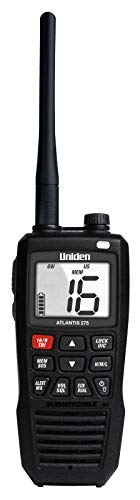
The Atlantis 275 stands out with IPX8 submersible waterproofing and the largest screen in its class. It includes an Emergency Strobe Light and built-in flashlight, plus NOAA Weather Alerts. It’s designed to stay accessible in rough seas or if dropped overboard.
Best for: boaters who want a highly visible, submersible handheld with advanced display features and emergency signaling.
Limitation: Larger display may require more pocket or deck space; ensure you have a secure place to store it when not in use.
Standard Horizon HX210 Floating Handheld

The HX210 is a compact floating handheld with IPX7 protection and a water-activated emergency strobe. It features an oversized, easy-to-read dot-matrix display and a straightforward E20 menu system, making it accessible for new and experienced users alike.
Best for: entry-level or casual skippers who want a simple, reliable floating radio with essential safety features.
Limitation: Fewer premium features compared to higher-end fixed-mount units; consider your need for GPS or DSC if required for your operations.
Buying Guide
What channel access do you need? Fixed-mount units typically provide broad channel support across regions, while handhelds cover essential channels with portability.
Do you require GPS and DSC? GPS helps with distress signaling and location sharing; DSC allows direct distress calls and selective calling. If you patrol far offshore or require automatic location data, prioritize models with GPS/DSC.
How important is weather protection? Look for IP ratings such as IPX7 or IPX8 and floating capabilities for ease of recovery if dropped.
Is portability a factor? Handhelds are ideal for deck-to-dock transfers, but fixed-mount units offer permanent power and larger displays. Choose based on how you operate on the water.
Weather alerts and NOAA compatibility are essential for safety. Ensure your radio supports real-time weather updates and can preemptively alert the crew during approaching storms.
Battery life and charging options matter on longer trips. USB-C charging and long-lasting batteries reduce downtime between uses.
Connectivity with other devices. Some models include Bluetooth, NMEA, or GPS integration; assess whether you need data exchange with other navigational equipment.
FAQ
- What is the difference between fixed-mount and handheld marine radios? Fixed-mount radios stay installed on the boat and often offer larger displays and power, while handhelds provide portability and quick access across the vessel.
- Do all marine radios have NOAA weather alerts? Most modern radios include weather alerts, but verify this feature in the product specifications before purchasing.
- Is IPX7 or IPX8 waterproof enough for marine use? Yes. IPX7 and IPX8 indicate strong water protection; IPX8 generally means deeper submersion resistance.
- Should I prioritize GPS in a VHF radio? If you rely on precise location transmission during distress or want to share position with other stations, GPS is highly beneficial.
- Can I rely on DSC alone for emergencies? DSC improves distress signaling, but hearing voice on channel 16 and having a built-in GPS or GPS data exchange increases reliability in emergencies.
- Do batteries affect performance in cold weather? Battery efficiency can decline in cold conditions; select models with batteries designed for marine environments and consider spare batteries.