Best Solar Panels for Boats and Caravans: Reliable Off-Grid Power on the Go
Answering the needs of boaters and caravan owners, these solar panels are chosen for compact spaces, exposure to harsh conditions, and dependable power in remote locations. The top picks are best for different setups: off-grid RV life, marine adventures, and mobile camping. This guide highlights five options with clear strengths and practical trade-offs, so you can pick the right one for your needs and space.
Summary of selected products at a glance:
| Product | Best For | Key Benefit | Notes |
|---|---|---|---|
| HQST 4pcs 100W (2-Pack) Monocrystalline | Caravans and boats needing multiple panels | High efficiency with 9 busbars and 25% efficiency | Two panels per kit; ideal for roof space planning |
| JJN 200W Solar Panels (2x100W) | Off-grid RVs and boats with medium space | 23% efficiency, compact frame | 10BB cells; durable frame |
| ECO-WORTHY 100W | DIY installations and versatile mounting | 25% efficiency with N-Type tech | Lightweight, easy mounting |
| Voltset 100W Kit with 20A Controller | All-in-one charging setups | Integrated charge control and data readout | Includes controller; convenient for beginners |
| HQST 100W 2-Pack Monocrystalline | Budget-minded off-grid users | Up to 25% efficiency front/back gains | Two panels; good value for power density |
HQST Solar Panel 4pcs 100 Watt 12V Monocrystalline

Best for: Caravans and boats needing higher total output from multiple panels. This kit uses 9-busbar, Grade A+ cells with a 25% efficiency potential, and a design that minimizes heat buildup. The dual-panel setup allows flexible roof coverage and can be spaced to maximize sun exposure. It’s well-suited for steady charging during lengthy trips or extended marinas.
Why chosen: The combination of higher efficiency and multi-panel configuration makes it easier to reach a reliable daily output on mobile installations with limited roof space. If shading or partial sun is common, the 9-busbar design reduces power loss compared with older 5-busbar designs.
Caution: Ensure proper wiring and mounting to manage frame weight and wind loads. The kit’s performance depends on sun availability and angle adjustments.
JJN 200 Watt Solar Panels (2x100W)
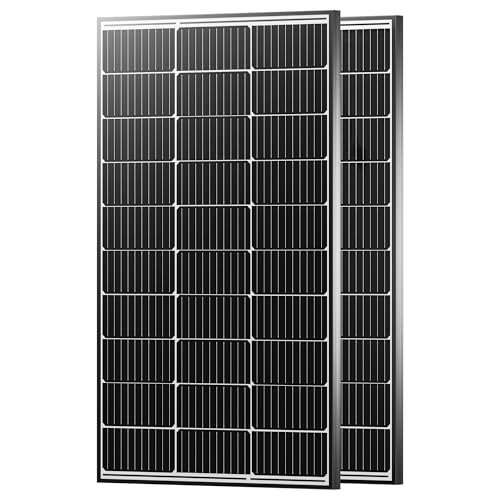
Best for: Off-grid boats and RVs that need robust, reliable power with space-efficient modules. These 100W panels use high-efficiency monocrystalline cells with a 23% conversion rate and a 10BB busbar design, ensuring stable output. The weather-ready aluminum frame and IP68 connectors help withstand marine or road-use conditions.
Why chosen: The half-cut cell design reduces shading impact and improves performance under variable light, making it suitable for morning and late-afternoon sunlight typical on decks and rooftops.
Limitations: The package focuses on panels only, so you’ll need to pair with a compatible charge controller and mounting hardware suitable for marine environments.
ECO-WORTHY 100 Watt Solar Panel

Best for: DIY enthusiasts and travelers who want a straightforward 12V charging solution. The 25% efficiency comes from N-Type technology, which improves overall sun utilization and cell performance.
Why chosen: Pre-drilled mounting holes and a relatively light frame simplify roof or trailer installs. It pairs well with standard 12V batteries for extended camping trips or boat electronics power.
Caution: Depending on mounting location, shading or angle changes can affect daily output. Verify compatibility with existing battery systems and wiring before install.
Voltset Solar Panel Kit: 100W With 20A Controller

Best for: All-in-one charging solutions where a ready-to-use controller is beneficial. The kit includes a 100W solar panel and a 20A controller with a real-time LCD readout, plus Type-C and USB outputs for versatile charging needs.
Why chosen: The integrated monitoring and protection features simplify battery management, reducing risks of overcharge and overheat. It’s ideal for RVs, caravans, boats, and other off-grid systems where simple setup matters.
Limitation: Some users may want more advanced controller features or higher wattage for larger systems; consider future expansion if you anticipate growing power needs.
Buying Guide: Key Considerations For Boat And Caravan Solar Installations
- System size and roof space: Calculate total panel wattage needed to meet typical daily consumption and ensure the chosen panels fit available space without overhang.
- Efficiency versus area: Higher efficiency panels perform better in tight spaces but may cost more. For compact boats or caravans, efficiency can be more important than raw wattage.
- Durability and mounting: Look for corrosion-resistant frames, IP ratings, and water sealing for marine environments. Pre-drilled holes ease mounting on curved surfaces.
- Shade tolerance: Panels with multiple busbars and bypass diodes perform better under partial shade; half-cut cells can help reduce power loss from shading.
- Controller compatibility: If starting from scratch, consider a kit with a charge controller to protect batteries and provide real-time monitoring.
- Battery compatibility: Ensure panels and controllers match your battery type (flooded lead-acid, AGM, GEL, or Li-ion) and charging needs.
- Future-proofing: Plan for potential system expansion with modular panels or multi-panel arrays to avoid reworking roof installations later.
Frequently Asked Questions
- Q: What size solar panel is best for a small boat? A: A compact 100W panel or a paired set (200W total) often provides a good balance between space and daily energy, depending on usage and sun exposure.
- Q: Do I need a solar charge controller with panels? A: Yes. A charge controller regulates charging to protect batteries and prevent overcharging, especially on mobile systems.
- Q: Can I install panels on a caravan roof by myself? A: Yes, with proper mounting hardware and weatherproof seals. Follow manufacturer mounting guidelines and ensure weight limits are not exceeded.
- Q: What panel technology is best for boats? A: Monocrystalline panels with good shading tolerance and robust frames are common choices for marine environments due to durability and efficiency.
- Q: How do I prevent shade from hurting panel output? A: Choose panels with bypass diodes and consider placement to minimize shade, especially on decks and awnings.