Best Marine Battery Charger Inverter Solutions for Seaworthy Power Needs
Answering the search query directly, these marine battery charger inverters combine reliable AC power with smart battery charging for boats, RVs, and off-grid marine applications. They’re best for boaters needing seamless power transfer, load support during shore power outages, and safe charging of various 12V lead-acid or lithium batteries. The top picks below are suited for different boat sizes, power needs, and installations—from compact systems to higher-demand setups.
| Product | Best For | Key Benefit |
|---|---|---|
| Victron Energy MultiPlus-II Pure Sine Wave Inverter Charger | Medium to large boats | PowerControl/PowerAssist with fast transfer |
| ECO-WORTHY 1000W Pure Sine Wave Inverter Charger | Budget-conscious setups | UPS with 20 ms transition |
| NOCO GENPRO10X3 3-Bank Charger | Versatile multi-bank charging | Independent bank charging with smart modes |
| 2 Bank Marine Battery Charger 5X2 (FirstPower Pro) | Simple two-bank systems | IP68 waterproof; 24/7 charging |
| NOCO GEN5X2 2-Bank Charger | Compact, powerful dual-bank | Efficient, compact onboard charging |
Victron Energy MultiPlus-II Pure Sine Wave Inverter Charger

The MultiPlus-II combines an inverter, battery charger, and transfer switch with PowerControl and PowerAssist options. It supports external current sensing (up to 32A) for optimized self-consumption and grid interaction. In a grid failure or when shore power disconnects, it automatically takes over within about 20 milliseconds. This makes it a strong choice for mid-to-large marine operations where uninterrupted power is essential and generator or shore power loads must be managed judiciously. Best for boaters who need seamless backup and robust control features.
Best for: Boats that require fast transfer, integrated anti-islanding, and advanced power management. Limitations: Higher upfront cost and installation complexity compared to smaller units.
ECO-WORTHY 1000W Pure Sine Wave Inverter Charger

This ECO-WORTHY unit provides a compact 1000W pure sine wave inverter with a 55A charger, offering a practical 12V to 110V solution with 20 ms UPS transition. It suits small-to-midsize marine loads (refrigeration, communication gear, lighting) and is particularly appealing for users who need a single, affordable package. Best for: Small boats or RVs that need reliable UPS power without complex configuration. Caution: Peak power is limited; avoid running high-wattage appliances simultaneously.
NOCO GENPRO10X3, 3-Bank Charger
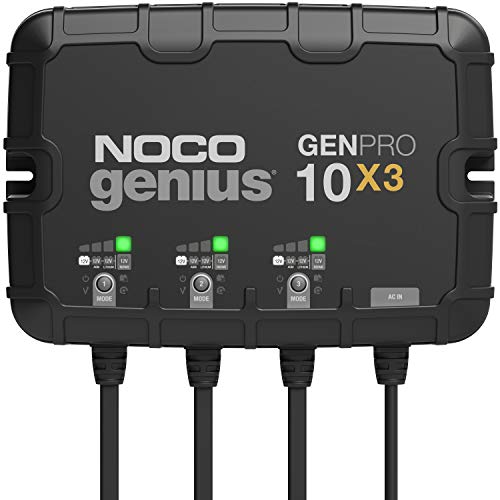
The GENPRO10X3 is a three-bank onboard charger rated at 30A total (10A per bank). It supports 12V lead-acid, AGM, and lithium chemistries with selectable modes per bank (12V, 12V AGM, 12V Lithium, and Repair). This makes it well-suited for larger boats with multiple battery banks or diverse battery chemistries. Best for: Boats requiring independent bank charging with versatile mode selection. Caution: Higher cost and installation complexity compared to simpler two-bank units.
Victron Energy MultiPlus (Standard) Power Inverter

The standard MultiPlus combines inverter and charger with PowerAssist technology. It’s designed to support loads while avoiding overloads on limited AC sources like shore power or generators. It also offers fast transfer capabilities similar to the II model, making it a reliable option for many marine setups that require robust backup power and smart charging behavior. Best for: Boats needing dependable power support and efficient load sharing. Limitation: Fewer external sensing options than the II variant.
SRGFTS SUMRY Solar Inverter Charger

All-in-one design with 3600W inverter, 120A MPPT solar controller, and 100A AC charger. It supports 24V systems and operates with various battery types, including AGM and LiFePO4. It can run off PV power with grid disconnected, but best results come with battery support. Best for: Larger off-grid or hybrid marine systems leveraging solar charging. Limitation: High capacity unit may exceed the needs of small boats.
2 Bank Marine Battery Charger 5X2 (FirstPower Pro)

This two-bank charger delivers independent 5A per bank charging and supports multiple modes (12V SLA/AGM, 12V Lithium, 12V Calcium). It’s IP68 waterproof and designed for marine use with 24/7 charging capability. Best for: Boats needing reliable two-bank charging with simple operation. Caution: Capacity is modest; not ideal for high-current demands on larger systems.
NOCO GEN5X2: 2-Bank Onboard Charger
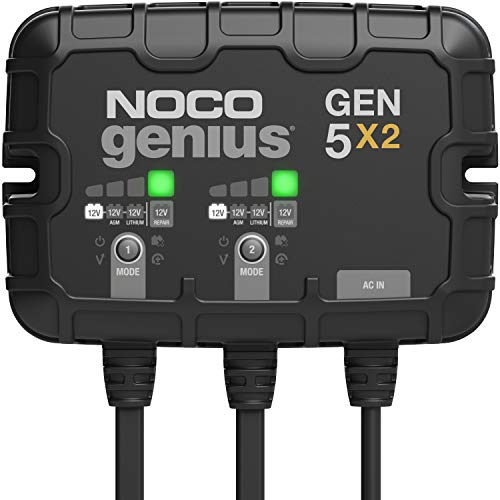
A compact dual-bank charger designed for performance in marine environments. It provides two independently charged banks with selectable charging modes, enabling clean maintenance for both lead-acid and lithium chemistries. Best for: Smaller vessels needing efficient, space-saving onboard charging. Caution: Lower total amperage compared to multi-bank high-capacity units.
Buying Guide: Key Purchase Considerations
- Power needs: Match inverter wattage (continuous and peak) to your loads. Higher-wattage appliances require a higher-rated inverter and charger combination.
- Battery chemistry: Confirm compatibility with lead-acid, AGM, or lithium batteries (LiFePO4). Some chargers support more chemistries than others.
- Bank configuration: Determine if you need single-bank, two-bank, or three-bank charging. Independent bank modes aid flexible maintenance.
- Power management features: PowerAssist and PowerControl features help prevent overloads on shore power or generators.
- Transfer speed: Fast automatic transfer (often around 20 ms) minimizes darkness or interruptions in critical loads.
- Waterproofing and ruggedness: Marine-grade units with IP ratings are preferable for saltwater environments.
- Installation complexity: Some units require more complex wiring and configuration; others are plug-and-play for simpler setups.
Frequently Asked Questions
- What is a marine inverter charger best used for?
It combines power conversion and battery charging, enabling clean AC power from 12V systems and providing backup during power outages on a boat. - Do I need PowerAssist or PowerControl features?
These features help manage limited AC sources (shore power or generator) and optimize charging during variable power availability. - Can these units work without a battery?
Some models can run directly from PV or AC sources, but most require a battery to supply sustained loads. - What battery chemistry should I choose?
Depends on your budget and performance needs. LiFePO4 offers longer life; lead-acid options are more affordable. - Is a multi-bank charger always better?
Not always; for small vessels, a two-bank or single-bank solution with robust charging modes may suffice. - What maintenance should I perform?
Regularly inspect connections, test charging modes, and monitor temperatures to prevent degradation and ensure safety.