Best Solar Panels for Pontoon Boats: Efficient Onboard Power on the Water
Answering the question of how to keep marine electronics, lighting, and trolling motors powered on a pontoon boat, these solar panel kits offer reliable, maintenance-free charging. This guide compares five top options, highlighting who each product is best for, plus practical buying considerations for watercraft use. Whether you’re outfitting a small deck boat or a larger pontoon, these systems help extend sun-powered operation without frequent battery recharges.
Overview of selected products at a glance:
| Product | Ideal For | Solar Power (Approx.) | Key Benefit |
|---|---|---|---|
| SUNER POWER 12W Charger | Small boats, trickle maintenance | 12V | Ultra-Smart MPPT for higher efficiency |
| Voltset 20W Solar Kit | General 12V batteries, trailers | 20W | Fast charging with smart protection |
| Topunive 100W Flexible Panel | Irregular hulls, decks, cabin surfaces | 100W | Very flexible mounting on uneven surfaces |
| SOLPERK 30W Kit | Compact installations, boats and RVs | 30W | Durable, high-efficiency MPPT |
| SOLPERK 100W Kit | Higher power demands, longer outings | 100W | Strong MPPT with wide battery support |
SUNER POWER 12W Solar Battery Charger & Maintainer Pro
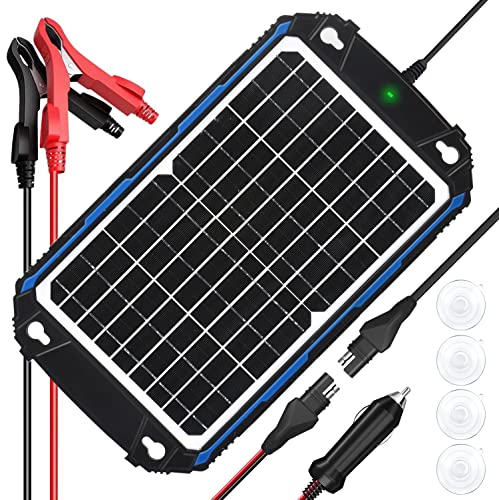
Best for small pontoon setups or emergency maintenance. Features Ultra-Smart MPPT technology delivering high tracking efficiency up to 99% and peak conversion around 98%, which improves utilization by roughly 20%–30% over many competitors. The improved three-stage charging (Bulk, Absorption, Float) supports safe, efficient recharging and longer battery life. It is fully automatic and maintenance-free, stopping charging at full charge and resuming when discharge occurs. Choose this if you need a compact, low-maintenance trickle charger for 12V batteries on calmer days or shorter trips. Caution: suitability is best for smaller battery banks; larger systems may require higher-wattage solutions.
Voltset 12V Solar Battery Charger – 20W

Best for boats and trailers needing quicker charging without oversizing. This 20W waterproof kit uses a smart MPPT controller to deliver 20–30% faster charging for 12V batteries. Its A+ monocrystalline panel maximizes power conversion, and the system includes built-in protections against overcharge, over-discharge, short circuits, and reverse polarity. It’s suitable for LiFePO4, AGM, Gel, Flooded, and Lithium Ion batteries. Choose this if you want a versatile, reliable solar charger that handles various battery chemistries with night-time load protection.
Topunive 100W Flexible Solar Panel

Best for uneven hulls and areas where rigid panels won’t fit. The 100W flexible panel is ultra-thin (about 0.11 inches) and highly adaptable, with a minimum bend radius of 17.7 inches. It weighs roughly 2 kg (4.4 lb) and includes pre-drilled mounting holes for quick installation. It uses 9BB Monocrystalline cells with up to 23% efficiency for strong power in variable sun. Choose this if you need a lightweight, bend-tolerant solution for curved decks or cabin tops; however, expect it to require proper mounting for protection against mechanical flexing on rough water.
SOLPERK 30W Solar Battery Charger + 10A MPPT Controller

Best for compact boats needing robust protection and adjustability. The 30W kit includes a high-efficiency MPPT controller with over 30% more power than standard controllers. It is fully waterproof and submersible, safeguarding the battery against overcharging, deep discharging, voltage surges, short circuits, and overheating. The kit includes a 360° adjustable bracket for optimal sun exposure on boats, ramps, or decks. Use this if you want a durable, weatherproof system with flexible mounting; note that higher-wattage may be preferable for larger battery banks or longer trips.
SOLPERK 100W Solar Battery Charger Kit

Best for higher power demands and longer boating sessions. This 100W SOLPERK kit features a high-efficiency MPPT controller with waterproof, submersible protection and extensive battery compatibility, including LiFePO4, GEL, AGM, and more. It promises up to 400 watt-hours per day under four hours of sun, supporting RVs, boats, and other 12V systems. Choose this when you need substantial off-grid charging for larger battery banks; limitation is larger footprint and mounting complexity compared to smaller kits.
Buying Guide: Key Considerations For Pontoon Solar Installations
- Power needs: Assess your typical daily consumption (lights, sound system, trolling motor, fridge) and choose a kit that can replenish that draw efficiently in your cruising conditions.
- Mounting surface: Flexible panels excel on curved or irregular surfaces, while rigid panels suit flat decks or clean rooftops. Consider weight and wind exposure for mobility on water.
- Charge controller: MPPT controllers optimize energy capture in variable sunlight, which is common on lakes and rivers. Ensure the controller matches your battery type and voltage (12V is standard for marine setups).
- Battery compatibility: Verify compatibility with lead-acid (SLA, AGM, GEL) and lithium chemistries (LiFePO4, Lithium Ion). Some kits include smart protections to prevent overcharging or deep discharge.
- Weather and durability: Marine environments demand corrosion resistance, waterproofing, and robust mounting hardware. Look for IP ratings and submersion capabilities when possible.
- Installation footprint: Consider panel size, mounting brackets, and cable routing to avoid crowding on a pontoon deck or railing. Pre-drilled holes and plug-and-play connectors simplify setup.
- Maintenance: Trickle charging systems should be largely maintenance-free, resuming charge when needed. Confirm whether the kit includes automatic shutoff features.
- Scalability: For growing power needs, plan for additional panels or a higher-wattage kit later, ensuring your charge controller can support an expanded array.
Frequently Asked Questions
- What size solar panel do I need for a pontoon boat? — It depends on daily electrical usage and sun exposure. A small boat can start with 12–20W kits for maintenance, while larger setups may require 100W or more with a compatible MPPT controller.
- Are flexible solar panels good for boats? — Yes, they work well on curved surfaces or irregular hulls where rigid panels don’t fit. They may require careful mounting to resist flexing and protect from impact.
- Do I need a dedicated solar battery charger for marine use? — A solar battery charger helps maintain battery health, but ensure it is compatible with your battery type and includes protections for overcharge and reverse polarity.
- Is MPPT better than PWM for marine solar kits? — MPPT controllers generally capture more energy, especially in variable sunlight, making them preferable for boats where shading and movement are common.
- Can solar panels power a trolling motor? — Yes, for moderate usage, but high-demand or high-speed trolling may require larger panels and a robust controller to keep up with power draw.
- What maintenance do marine solar kits require? — Regular inspection of cables, mounts, and connections helps prevent corrosion and ensures efficient charging, though many kits are designed for minimal upkeep.
By focusing on the five selected products, this guide aims to help pontoon owners match power needs with the right solar solution. Each option balances efficiency, durability, and practicality for marine use, enabling longer days on the water with reliable battery health.