Best Boat Speaker Amps for Clear, Powerful Audio on the Water
Looking for the right amp to power boat speakers? This guide highlights five marine-grade amplifiers that balance weather resistance, power output, and ease of use. Each pick targets a common buyer: new boaters seeking simple plug-and-play audio, do-it-yourself installers needing flexible configurations, and performance-minded buyers chasing strong, clean sound in harsh marine conditions. The table below compares core specs to help you decide quickly.
| Product | Channel Count | Max Power (Watts) | ||
|---|---|---|---|---|
| Pyle Hydra Marine 400W 4-Channel (PLMRA402) | 4 | 400 | Aluminum heatsink, LED indicator, RCA input | Budget-friendly, straightforward installation |
| BOSS Audio ASK904B.64 | 4 | 500 | Weather resistant, USB charging, Bluetooth remote | All-in-one setup with wireless control |
| Skar Audio RP-800.1DM | 1 (Monoblock) | 800 RMS / 1200 peak | Fully marinized, waterproof coating | Powerful single-sub or subwoofer amp |
| Pyle 800W 4-Channel Hydra (PLMRMP3B) | 4 | 800 | RCA input, 3.5mm jack, short protection | Compact, versatile for multiple devices |
| Pyle 1500W 4-Channel Marine Amplifier (PLMTR4A) | 4 | 1200 max | IP-65 waterproof, rugged design, wired inputs | Heavy-duty boat systems with higher power needs |
Note: All models listed are marine-focused and designed to withstand exposure to sun, salt, and spray. When choosing, consider the number of speakers, wiring complexity, and whether you need Bluetooth or USB connectivity for convenience on deck.
Pyle Hydra Marine 400W 4-Channel Amplifier PLMRA402

The PLMRA402 is a four-channel marine amplifier designed for straightforward stereo reproduction. It includes RCA inputs for compatibility with most head units or high-level inputs directly from speaker outputs. A robust aluminum heatsink and LED indicator help protect the amp and monitor operation. Best for sailors seeking a reliable, compact four-channel amp to power standard boat speakers. Limitation: modest 400W total output means pairing with efficient speakers is ideal for balanced sound on most boats.
BOSS Audio Systems ASK904B.64 Marine Boat System

The ASK904B.64 combines a 4-channel amplifier with features suitable for first-time installers: USB charging, Bluetooth remote, and weather resistance. It supports 4-8 ohm speakers and provides a simple route to wireless audio without a separate head unit. Best for boaters who want an all-in-one, wireless-ready setup. Caution: Bluetooth range and reliability can vary with open water conditions or interference; plan placement accordingly.
Skar Audio RP-800.1DM Mono Marine Amplifier
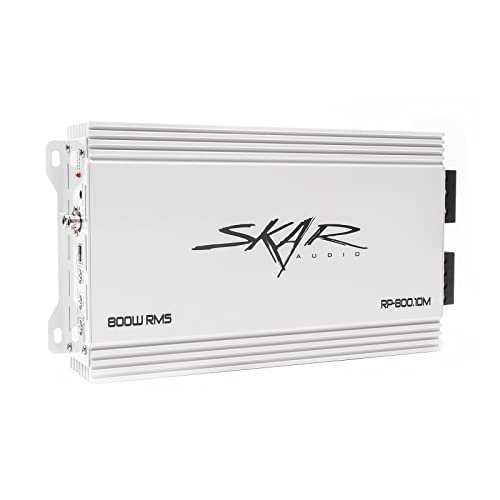
The RP-800.1DM is a high-power monoblock amplifier designed for marine subwoofers. It is fully marinized with waterproof coating and rust-proof painting, ensuring durability in harsh conditions. Best for bass-forward setups on boats where a single high-performance channel is needed. Limitation: Monoblock design means it’s not suitable for powering multiple full-range speakers simultaneously.
Pyle Hydra Marine 800W 4-Channel (PLMRMP3B)
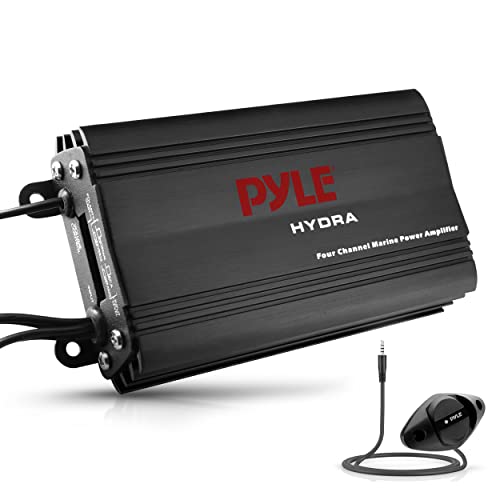
The PLMRMP3B is a four-channel marine amplifier with RCA inputs and a 3.5mm jack for easy device connections, plus a remote for volume control. Short protection helps guard your system. Best for installers who want versatile input options and a compact footprint. Consideration: The 800W rating is peak or total system output; actual listening levels should be matched to speaker efficiency for best results.
Pyle PLMTR4A 1500W 4-Channel Marine Amplifier

The PLMTR4A delivers higher power with a waterproof, weatherproof IP-65 rating. It supports wired RCA and AUX/MP3 inputs and includes an anti-thump turn-on feature to reduce transient noise. Best for boats that require robust amplification across multiple channels and reliable protection against the elements. Limitation: Higher power may demand more substantial wiring and battery capacity maintenance.
Buying Guide
What should you consider when choosing a boat speaker amp?
- Power needs: Match total amplifier wattage to speaker ratings and listening preferences. Higher power can improve headroom but requires proper wiring and charging capacity.
- Channel configuration: Four-channel amps suit most coaxial or component speaker setups. A monoblock is ideal for subwoofers or dedicated bass channels.
- Marine durability: Look for IP ratings, corrosion-resistant enclosures, and rust-proof hardware to handle sun, salt, and spray.
- Connectivity: RCA inputs are common; a 3.5mm jack or Bluetooth adds flexibility for portable devices and easier mounting options.
- Protection features: Short-circuit protection, thermal protection, and soft turn-on help protect marine electrical systems in harsh environments.
- Installation complexity: Some models offer plug-and-play compatibility with existing head units, while others require more wiring and routing attention.
Frequently Asked Questions
- Do I need an amplifier for boat speakers?
- What does “marine” mean in amplifiers?
- Should I choose a 4-channel or a mono amplifier?
- Is Bluetooth on a marine amp reliable at sea?
- What is “hitched” power vs. peak power?
- Do I need to upgrade wiring with a higher-powered amp?
Yes. An amplifier boosts speaker output and helps drive multiple speakers with clearer, louder sound, especially in open-water environments.
Marine-rated amps are built to resist moisture, salt, and temperature swings, making them more durable for boat use.
Choose 4-channel for full-range speaker setups or a mono amp for subwoofers. Some users prefer a combination of both for a balanced system.
Bluetooth can be convenient, but performance may vary with interference and distance from the source. Plan placement accordingly.
RMS (continuous) power reflects real-world performance; peak power indicates brief power surges. Aim to match RMS to speaker needs for stable sound.
Yes. Higher-powered amps often require larger gauge wire and an appropriate fuse or circuit protection to ensure safety and reliability.