Best Bilge Pump for Boat Buyer’s Guide: Top 5 Autoflow Models for 2026
Answering your search for a reliable bilge pump for boats, this guide highlights five top options that balance automatic operation, flow rates, and marine reliability. Best for small sailboats and powerboats with modest bilge needs, mid-sized yachts needing robust automatic pumps, and temporary or emergency setups. Each choice is explained with who it suits best, plus practical cautions. Use the quick comparison table to skim key specs before diving into detailed product notes.
| Product | Brand | Flow (GPH) | Outlet | Best For |
|---|---|---|---|---|
| SEAFLO 06 Series Automatic Submersible Bilge Pump | SEAFLO | 750 | 3/4″ | Small boats, automatic protection |
| Automatic Submersible Boat Bilge Water Pump 12v 1100gph | MAXZONE | 1100 | 1-1/8″ | Medium boats needing built-in float switch |
| 1100 GPH Automatic Boat Bilge Water Pump | FILTERUP | 1100 | 1-1/8″ | Versatile marine use |
| 12V Automatic Boat Bilge Pump Kit | Subtoy | 1100 | 1-1/8″ | Kit with hose and fittings |
| SEAFLO 01 Series 2000 GPH Bilge Pump | SEAFLO | 2000 | 1-1/8″ | High-volume emergency or large boats |
SEAFLO 06 Series Automatic Submersible Bilge Pump

The SEAFLO SFBP1-G750-06 pumps 750 GPH at 12V with a 3/4 inch outlet. It features an integrated automatic float switch and a 4-year warranty, delivering hands-off operation for routine bilge management. Best for small to midsize boats needing reliable, compact suction with automatic protection and a long warranty.
Who it’s best for: boaters prioritizing automatic, low-maintenance bilge protection in compact setups. Why selected: compact form factor, reliable 4-year warranty, and integrated float switch reduce wiring and add safety. Caution: 750 GPH may be limiting in heavily flooded bilges or large decks during storms.
Automatic Submersible Boat Bilge Water Pump 12v 1100gph Auto

MAXZONE’s 1100 GPH pump includes a built-in float switch, reducing the need for extra components. It runs on 12V and has a 1-1/8″ outlet. This model is best for boaters who want a ready-to-install unit with automatic control in a compact footprint.
Who it’s best for: boaters seeking a plug-and-pump solution with automatic operation without extra float switching parts. Why selected: built-in float switch simplifies wiring and installation. Caution: ensure electrical supply and wiring match the 3.8A current rating for safe operation.
1100 GPH Automatic Boat Bilge Water Pump Kit

This 1100 GPH pump ships as a kit with a 6 ft hose, two clamps, and a thru-hull fitting, designed for easy installation on a wide range of boats. Built for automatic operation with a built-in sensor system, it keeps bilge water under control with minimal manual intervention.
Who it’s best for: boatowners who want a complete package for quick setup. Why selected: includes necessary plumbing hardware for faster installation. Caution: verify hose compatibility with your hull fittings and ensure proper watertight sealing around the thru-hull.
12V Automatic Boat Bilge Pump Kit with Built-In Float Switch
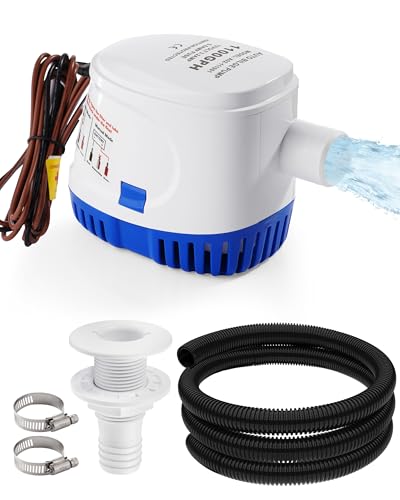
Subtoy’s 1100 GPH pump kit combines a built-in float switch with a complete installation package. The 1-1/8″ outlet and 12V operation suit mid-sized boats that require automatic bilge management plus ready-to-install hardware.
Who it’s best for: boaters seeking a balanced, all-in-one kit for automatic bilge pumping. Why selected: dependable 1100 GPH flow and included hoses/clamps provide a straightforward install. Caution: ensure the kit’s adapter dimensions fit your through-hull fittings and deck layout.
SEAFLO 01 Series 2000 GPH Bilge Pump

The SEAFLO 01 Series delivers up to 2000 GPH at 12V with a 1-1/8 inch outlet. It features anti-airlock protection and a long warranty. Best for boats with significant bilge water or when rapid evacuation is critical.
Who it’s best for: larger boats or emergency-ready systems requiring high flow. Why selected: high capacity and airlock protection support rapid dewatering. Caution: higher current draw (up to 14A) means electrical capacity and wiring must handle the load.
Buying Guide: Key Considerations For Choosing A Bilge Pump
What network of needs should you assess? Start with your boat size, typical water intrusion risks, and the availability of space for installation. Consider automatic vs manual operation, power requirements, and the reliability of float switch mechanisms.
- Flow rate needs: For small craft, 750–1100 GPH often suffices; larger boats or heavier inflows benefit from 1500–2000 GPH or more.
- Outlet and fittings: Ensure the outlet diameter matches your hoses and through-hull fittings. Common sizes are 1-1/8 inch and 3/4 inch.
- Electrical considerations: Verify voltage (12V is standard) and current draw. Plan for fused circuits and proper marine wiring.
- Automatic vs manual: Automatic pumps with built-in or external float switches reduce the need for monitoring; manual pumps require user action.
- Warranty and durability: Marine-grade materials and corrosion resistance extend service life in saltwater environments.
- Installation kit: Some models include hoses, clamps, and fittings; others require separate purchases. Assess included components before buying.
- Space and accessibility: Choose a compact unit if bilge space is tight, while ensuring sufficient vertical clearance for the impeller and float switch.
Practical Tips For Installation And Use
- Prefer pumps with self-limiting current and thermal protection for prolonged operation.
- Place the pump as close to the bilge water source as possible to minimize suction losses.
- Test the pump regularly in dry conditions and after installation to verify automatic activation.
- Seal all connections around hoses and thru-hulls to prevent leaks and corrosion.
- Maintain the bilge area clean to avoid clogging the intake with debris.
Frequently Asked Questions
- What is a bilge pump and why do I need one?
A bilge pump removes water from a boat’s bilge to prevent flooding and maintain buoyancy. Automatic pumps improve safety by activating when water rises. - What flow rate should I choose for a small boat?
For small to mid-size boats, 750–1100 GPH is typically adequate, depending on water intrusion risk and bilge size. - Do I need a built-in float switch?
Built-in float switches simplify installation and enable automatic operation without extra parts. - Can I reuse existing hoses with a new bilge pump?
Ensure hose diameter and fittings match the pump outlet and through-hull connectors to avoid leaks and reduced flow. - Is a higher GPH always better?
Not always. Higher GPH pumps may draw more power and create unnecessary stress if your bilge volume is small. Choose a rate that matches typical water intrusion. - What maintenance is recommended?
Regularly check for debris, test auto operation, and inspect seals and wiring for corrosion after exposure to saltwater.