Best Trickler Chargers for Boats: Reliable Marine Battery Maintenance Options
For boat owners, a dependable trickle charger is essential to keep marine batteries healthy between trips. This guide highlights five top NOCO models that are well-suited for 6V and 12V lead-acid and lithium batteries, including AGM, gel, VRLA, and LiFePO4. Each entry explains who it’s best for, why it’s selected, and any limitations to consider. Ideal buyers include weekend boaters seeking automatic maintenance, professionals needing multi-bank capability, and DIY installers prioritizing space-saving designs.
Summary table of selected products:
| Product | Best For | Key Benefit | Limitations |
|---|---|---|---|
| NOCO GENIUS1 | Single-battery setups | Compact all-in-one charger and desulfator | 6V/12V only; basic bank count |
| NOCO GEN5X2 | Two-battery systems | Two independent banks with multiple modes | Higher cost than single-bank models |
| NOCO GEN2 | General 12V maintenance | Reliable 2A per unit with thermal sensing | Limited to standard 6V/12V operation |
| NOCO GENIUS5 | Mid-size power and maintenance | More power in a compact form | Still a single-bank option |
| NOCO GENIUS10 | Higher-power, larger systems | More total charging power with advanced features | Bulkier footprint |
NOCO GENIUS1: 1A 6V/12V Smart Battery Charger

Best for solo, compact setups. The NOCO GENIUS1 functions as a charger, maintainer, and desulfator with overcharge protection and temperature compensation. It supports 6V and 12V lead-acid families and LiFePO4 batteries. The integrated thermal sensor automatically adjusts charging based on ambient temperature, helping prevent overcharging in heat and undercharging in cold environments.
Who it’s best for: boaters with a single battery or a small, space-constrained electrical system. Why selected: its small footprint and all-in-one features simplify maintenance without sacrificing safety. Limitation: one bank only means millwork or small boats are ideal; larger systems should consider multi-bank options.
NOCO GEN5X2: 2-Bank, 10A Onboard Charger
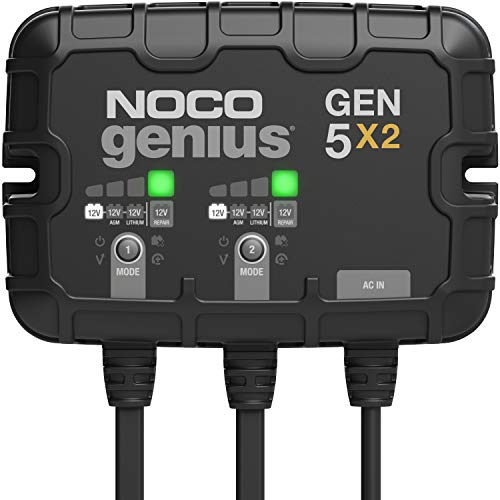
Better for dual-battery marine systems. The GEN5X2 provides two independent banks with a combined 10A capacity (5A per bank). It offers selectable charging modes for 12V, including 12V AGM and 12V Lithium, along with a 12V Repair Mode. This model is suited for boats with starter and deep-cycle batteries needing simultaneous, precise charging and maintenance.
Who it’s best for: boaters with two battery banks and a need for tailored charging per bank. Why selected: independent bank control improves versatility in mixed battery chemistries. Caution: more complex setup; ensure mounting and wiring meet your vessel’s space and safety requirements.
NOCO GEN2D: 2A 12V Onboard Charger
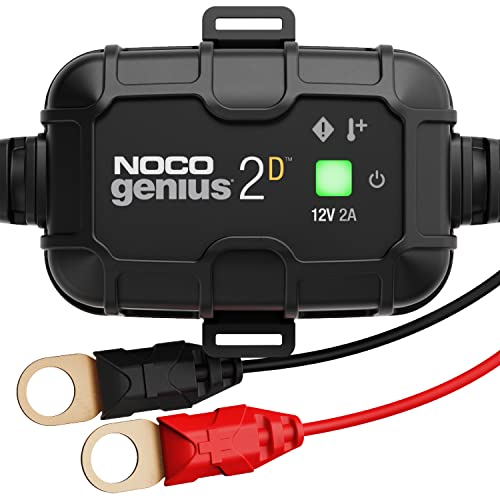
Direct-mount reliability for under-the-hood battery charging. The GEN2D offers a 2A charger suitable for maintaining 12V lead-acid batteries and compatible LiFePO4 options. It is designed for in-situ installation with a durable snap-fit mounting bracket, making it a practical choice for permanent engine bay or cabin setups.
Who it’s best for: installers needing a fixed, under-hood solution for ongoing maintenance. Why selected: straightforward integration with a direct-mount design. Limitation: not ideal for multi-battery banks; single-battery maintenance is its strength.
NOCO GEN2: 2A 6V/12V Smart Charger

The GEN2 combines a compact profile with versatile charging for 6V and 12V lead-acid and lithium batteries. It includes an integrated thermal sensor for temperature-compensated charging and acts as a maintainer and trickle charger, making it a versatile option for typical small-to-mid-sized boats.
Who it’s best for: boat owners needing reliable maintenance for one or two batteries over the season. Why selected: well-balanced features, compact size, and broad chemistry compatibility. Limitation: lacks multi-bank independence; best for single or dual-battery setups.
NOCO GENIUS5: 5A 6V/12V Charger
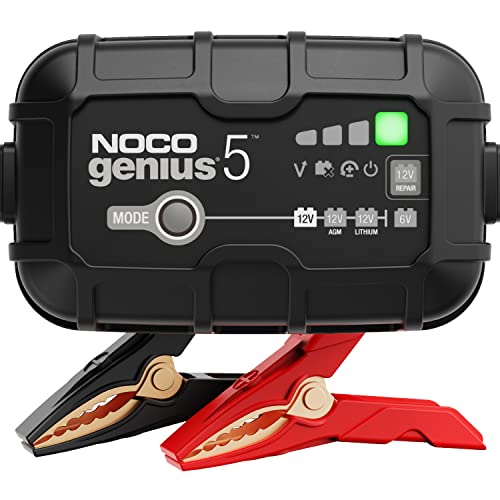
Mid-range power with broad battery compatibility. The GENIUS5 delivers 5A total charging with support for 6V and 12V lead-acid and lithium batteries, including flooded, maintenance-free, deep-cycle, and marine applications. It functions as a charger, maintainer, trickle charger, and desulfator with temperature compensation to optimize battery health.
Who it’s best for: boaters needing stronger charging than a single-bank unit but not a full multi-bank system. Why selected: a good balance of power and feature set for mid-size boats. Limitation: still a single-bank design, so large systems may require additional units for parallel charging.
NOCO GENIUS2X2: 4A 2-Bank Charger

Two-bank charging with higher total output. The GENIUS2X2 provides 4A across two banks (2A per bank) and supports 6V/12V batteries, including LiFePO4. This model enables simultaneous maintenance of two batteries with temperature-aware charging and desulfation features.
Who it’s best for: users with two batteries requiring coordinated charging. Why selected: banked design increases flexibility for mixed configurations. Limitation: may require more complex wiring and mounting compared to single-bank units.
Buying Guide
What to consider when choosing a trickle charger for your boat:
- Battery type compatibility: Ensure the charger supports your battery chemistries (lead-acid, AGM, Gel, VRLA, LiFePO4).
- Bank configuration: Decide between single-bank, two-bank, or multi-bank options based on your boat’s battery layout and electrical needs.
- Power output: Higher amperage provides faster charging but may require more space and larger electrical access. Match to your battery capacity.
- Temperature compensation: Temperature sensors help prevent overcharging in heat and undercharging in cold conditions.
- Installation and mounting: Consider whether you need a surface-mounted unit, a direct-mount onboard charger, or a compact, portable solution.
- Protection features: Look for overcharge protection, desulfation capability, and automatic maintenance modes.
- Future-proofing: If you anticipate expanding your battery bank, choose a unit with multi-bank support or easy scalability.
Practical buyer questions
- What is the difference between a charger and a maintainer? A charger actively charges a depleted battery, while a maintainer keeps a fully charged battery at a safe level for storage and long-term maintenance.
- Can I use these chargers with lithium batteries?
- Yes, many NOCO models support LiFePO4 and other lithium chemistries, but verify the exact model’s compatibility.
- Do these units require professional installation?
- Single-bank units are often simple to install, while multi-bank or direct-mount units may benefit from professional installation depending on your boat’s wiring.
- Will a higher amperage charger harm a small battery?
- No, when designed with proper automatic sensing and temperature compensation, the charger adjusts to protect the battery.
- Are these chargers waterproof or marine-rated?
- Some models are designed for marine environments; review each product’s IP rating and installation guidance for exposure and moisture considerations.
FAQ
- What is trickle charging? A low, steady charging rate intended to maintain battery charge during storage or inactivity.
- Can I leave a smart charger connected all season? Yes, most NOCO models include maintenance modes that prevent overcharging when connected long-term.
- Do these chargers restart automatically if the battery fails to accept a charge? Many models feature automatic desulfation and recovery modes; consult product specifics for each model.
- Should I choose one charger for all batteries or multiple banks? Multiple banks allow independent charging for different battery types or locations; single-bank units suffice for smaller boats.
- What is temperature compensation? A feature that adapts charging voltage based on ambient temperature to optimize performance and battery life.