Best Fire Extinguishers for Boats: Top Marine Picks for Safety and Compliance
Answering a boater’s search for reliable marine fire extinguishers, these five models are among the most suitable choices for boats. They cover common marine fire classes (A, B, C) and offer corrosion resistance and durable construction. Best for small to mid-sized vessels, these options balance quick action, portability, and compatibility with onboard safety gear. This guide helps you compare models by construction, discharge performance, and suitability for different fire scenarios on watercraft.
| Product | Why It Stands Out | Best For |
|---|---|---|
| Kidde Fire Extinguisher for Boats, 5BC | All-metal construction and corrosion-resistant components | Compact boats needing reliable Class B/C coverage |
| Kidde Mariner 5 Fire Extinguisher | Fast discharge, aluminum/stainless build, strong range | Owners seeking quick action in tight spaces |
| First Alert Marine1 Fire Extinguisher | UL rated and Coast Guard–approved with metal valve | Vessels requiring durable, multi-purpose extinguisher |
| Kidde Fire Extinguisher for Boats, 1A10BC | Extended corrosion resistance and 100 PSI operating pressure | Boats needing broader Class A/B/C coverage |
| Kidde Fire Extinguisher for Boats, 10BC | Strong Class B/C capability with robust build | Medium to larger boats with frequent fire risk |
Kidde Fire Extinguisher for Boats, 5BC
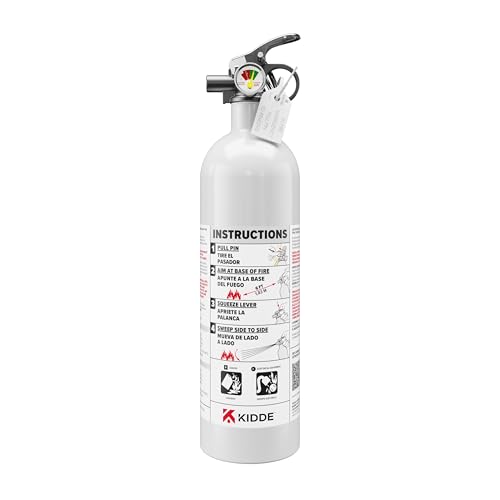
Features include marine-focused performance with Class B (flammable liquids and gases) and Class C (electrical) fires. Built with corrosion-resistant aluminum and stainless-steel components, it uses an all-metal valve assembly and a rust-resistant stainless-steel lever, ensuring durability in saltwater environments.
Best for: Small to mid-sized boats that need reliable, ready-to-use coverage for common onboard fires. This model is chosen for its rugged construction and straightforward operation.
Caution: As a single-use extinguisher, replacement is required after discharge or inspection intervals per local regulations.
Kidde Mariner 5 Fire Extinguisher for Boats, 5BC

Designed for rapid response on boats, this extinguisher covers Class B and C fires with a discharge time of 8–12 seconds and a discharge range of 4–6 feet. It uses aluminum and stainless steel components for corrosion resistance and maintains 100 PSI operating pressure for dependable performance.
Best for: Larger cockpit areas or boats that require quicker discharge to manage a sudden marine fire. Choose this if you need faster response and a compact reach.
Caution: The short-range discharge might be insufficient for very large compartments without a second unit nearby.
First Alert Marine1 Fire Extinguisher

This unit is UL rated 1-A:10-B:C and features durable all-metal construction with a commercial-grade valve and trigger. It is Coast Guard–approved when used with a mounting bracket, making it a straightforward, dependable choice for maritime use.
Best for: Boat owners seeking a proven, Coast Guard–appropriate extinguisher with strong metal components and a simple, multipurpose capability.
Caution: USCG approval applies when mounted with the included bracket; standalone use without bracket may affect compliance status.
Kidde Fire Extinguisher for Boats, 1A10BC

Combats common marine fires involving trash, wood, paper (Class A) as well as flammable liquids and gases (Class B) and electrical equipment (Class C). It features corrosion-resistant aluminum and stainless-steel components with a 100 PSI operating pressure and an 8–12 second discharge time.
Best for: Boats that need broader coverage across A, B, and C fire classes in a single compact unit. A versatile choice for mixed-use vessels.
Caution: Heavier duty coverage can come with a slightly larger form factor; ensure space for mounting in tight areas.
Kidde Fire Extinguisher for Boats, 10BC
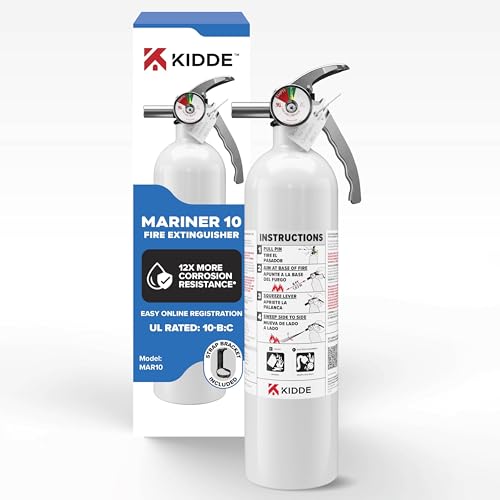
Combats marine fires with a focus on flammable liquids, gases (Class B) and electrical equipment (Class C). Built with durable aluminum and stainless-steel components, it offers an 8–12 second discharge and a 6–8 foot range at 100 PSI, delivering solid performance for mid to larger boats.
Best for: Boats with regular exposure to B and C class risks and enough space for the slightly larger unit. Consider for greater safety margins on bigger vessels.
Caution: Price and size should be weighed against the boat’s available installation space and the crew’s training level for rapid activation.
Buying Guide
What fire classes should a boat extinguisher cover?
Marine extinguishers typically target Class A (ordinary combustibles), B (flammable liquids), and C (electrical). For boats, combinations like 1A:10BC or 5BC are common due to space constraints and damage risks at sea.
What construction matters on a boat extinguisher?
Durable all-metal valves and corrosion-resistant bodies (aluminum or stainless steel) are preferred for saltwater environments. A robust trigger and securing bracket improve reliability and mounting options on deck or cabin walls.
How important is discharge time and range?
Faster discharge (8–12 seconds) and a longer reach (4–8 feet) enable quicker control of a developing fire. Choose models with discharge specs that suit the boat’s size and compartment layout.
What about Coast Guard and regulatory considerations?
Coast Guard–approved or USCG-compliant units simplify compliance. Always use the mounting bracket if required and follow local regulations for inspection and replacement cycles.
Single-use vs rechargeable options
Many marine extinguishers are single-use and must be replaced after discharge. Rechargeable models exist, but require professional service. For simplicity and timely replacement, single-use units are common on smaller boats.
FAQ
- What size extinguisher is typically best for a small boat?
Most small boats benefit from 2.5–5 BC rated units or a combination such as 1A:10BC, depending on space and fire risk.
- Can I mount any extinguisher on a boat?
Most marine extinguishers come with brackets; ensure mounting location is accessible, stable, and not blocked by seating or equipment.
- Are Coast Guard approvals necessary for marine extinguishers?
Coast Guard approval is highly recommended and often required when evaluating compliance for certain vessels and mounting setups.
- How often should a marine extinguisher be inspected?
Regular inspection per local regulations is advised, including checking pressure, seals, and mounting integrity.
- What should I do after using a marine extinguisher?
Do not reuse; replace with a new unit or have it professionally recharged if applicable, and inspect for any damage to mounting hardware.
- Is a larger extinguisher always better on a boat?
Not always; size should match vessel size, compartment layout, and crew training. Larger units may be harder to maneuver in tight spaces.