Best Deep Cell Marine Battery Options for Boats and RVs in 2026
When choosing a deep cycle marine battery, focus on stability, cycle life, and suitability for both starting power and long-duration appliance use. This guide highlights five top options that balance deep-cycle performance with reliable starting power, ideal for boaters and full-time RV enthusiasts. The best picks target different needs: high-cranking power for larger engines, extended deep-cycle capability for trolling motors, and lightweight LiFePO4 alternatives for ease of installation. The table below helps you compare core specs at a glance.
| Product | Type | Best For | Key Strength |
|---|---|---|---|
| Interstate Marine/RV 12V 100Ah AGM | Dual-purpose AGM | Boat and RV dual-use (starting + deep cycle) | 2x-3x longer life vs conventional AGM |
| Newport 12V 50Ah Deep Cycle AGM | Deep-cycle AGM | Lightweight trolling motor setups | Sealed and leak-proof |
| Weize 12V 100Ah AGM | Deep-cycle AGM | General marine/RV power storage | Low self-discharge, maintenance-free |
| SUPER EMPOWER 12V 100Ah LiFePO4 | LiFePO4 with BMS | Long life, high-cycle storage | Up to 15,000+ cycles |
| UPLUS 12V 92Ah AGM | Dual-purpose AGM | Compact dual starter/deep cycle | 800CCA for engine starts |
Interstate Marine/RV Battery 12V 100Ah AGM

Best for: boat and RV owners who need a single unit to crank the engine and power a trolling motor. This dual-purpose AGM battery is designed to deliver high cranking power while also providing strong deep-cycle performance for accessories and trolling motors, even when the engine is off.
- 2X-3X longer life than conventional alloy AGM or flooded batteries.
- Thick plates support repeated discharge and recharge without rapid degradation.
- Pure lead, non-alloy construction for consistent performance in rugged conditions.
Caution: This is a dual-power unit. If you only need deep-cycle storage for extensive off-grid use, a dedicated deep-cycle battery might offer more cycles at a lower weight.
Newport 12V 50Ah Deep Cycle AGM Battery

Best for: anglers and small-boat setups needing a lighter weight, leak-proof power source for trolling motors and accessory circuits.
- Lightweight at about 32 pounds, aiding easy installation.
- Sealed AGM design reduces maintenance and leakage risk.
- Designed for trolling motors and run-time reliability on the water.
Limitation: Lower capacity compared to larger 100Ah models, so plan for shorter runs or add a second unit for extended days on the water.
Weize 12V 100Ah AGM Deep Cycle Battery

Best for: RVs and boats requiring maintenance-free, long-storage capability with low self-discharge.
- Maintenance-free AGM with low self-discharge (1-3% per month).
- Solid discharge current up to 1100A for short bursts.
- Versatile for marine, solar, trolling motors, and off-grid use.
Note: Temperature sensitivity matters—charging and discharging are most efficient near mid-range temperatures; extreme cold or heat can affect capacity and cycle life.
SUPER EMPOWER LiFePO4 12V 100Ah Battery

Best for: users prioritizing long cycle life and lightweight power storage for RVs, boats, and solar projects.
- Up to 15,000 cycles at 60% DoD; 10-year lifespan on typical use.
- Internal BMS protects against overcharge, over-discharge, and temperature extremes.
- Drop-in replacement for lead-acid with a substantially lighter weight (about 21.6 pounds).
Limitation: Not suitable for engine starting or cranking; intended for auxiliary house power and energy storage rather than starting power.
UPLUS 12V 92Ah AGM Dual-Purpose Battery
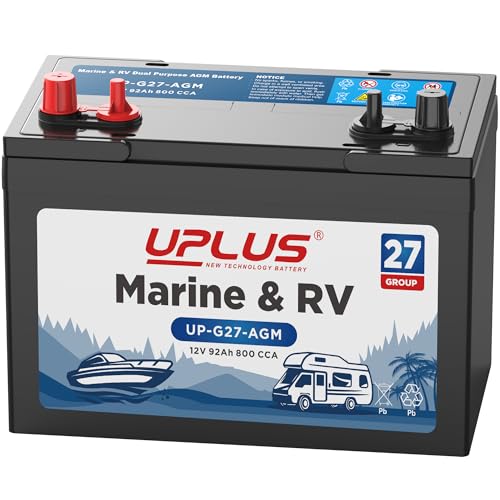
Best for: boaters who need a compact, space-saving dual-purpose unit that can start engines and power deep-cycle loads.
- 800CCA for solid engine starting power, even in smaller or mid-sized engines.
- Space-saving design combines starting and deep-cycle functions in one battery.
- Dimensions and weight require checking fitment in smaller battery boxes before purchase.
Tip: Choose this if you want to simplify wiring and save space, but verify that its size fits your boat’s battery compartment to avoid fit issues.
Buying Guide: Deep-Cycle Marine Battery Essentials
What should you consider when choosing a deep-cycle marine battery? Start with the intended use: dual-purpose batteries work well for small to mid-sized boats and RVs with limited space, while dedicated deep-cycle or LiFePO4 options excel in long-term energy storage and weight savings. Key factors include capacity (Ah), cold-cranking amp (CCA) for starting power, cycle life, maintenance needs, and safety features like a built-in BMS for LiFePO4 models or AGM’s leak resistance.
Type matters: AGM batteries offer maintenance-free operation and good vibration resistance, making them a common marine choice. LiFePO4 batteries provide exceptional cycle life and lighter weight but require a compatible BMS and proper charging profiles. For boats with battery compartments, size and weight often determine the best fit, along with whether you need a true dual-purpose unit or a pure deep-cycle design.
Charging and maintenance: Ensure your charger is compatible with the battery type. AGM and flooded lead-acid use different charging voltages than LiFePO4. Temperature tolerance is another practical factor; extreme temperatures can reduce capacity and shorten life, so plan accordingly for your boating environment.
Durability and reliability: Look for thick plate construction in deep-cycle AGM models to support repeated discharges, and consider batteries designed for rugged marine conditions. For RV use, confirm that the battery size fits your compartment and that the weight does not impact mounting and balance.
FAQs
- What’s the difference between a dual-purpose and a deep-cycle battery?
Dual-purpose batteries provide both starting power and deep-cycle capability, suitable for boats with limited space. Deep-cycle batteries emphasize long run times for appliances and trolling motors, with weaker starting power. - Are LiFePO4 batteries worth the extra cost for marine use?
They offer dramatically longer cycle life, lighter weight, and stable performance, but require a compatible BMS and charging setup. - Can I mix battery types on a single boat or RV?
Mixing different chemistries is generally not recommended due to mismatched charging and discharge characteristics, which can shorten life and reduce performance. - How important is weight when choosing a marine battery?
Weight affects handling, installation, and boat balance. LiFePO4 is notably lighter than lead-acid for the same capacity. - What should I check before fitting a battery in a tight space?
Measure dimensions, verify terminal positions, ensure venting (if applicable), and confirm that the battery box can accommodate the weight and size safely. - Do I need a special charger for LiFePO4 batteries?
Yes. LiFePO4 requires a charger that supports lithium chemistries and proper charging voltages to optimize life and performance.