Best 24V Marine Battery Solutions for Boats and RVs
Answer: For a 24V marine setup, LiFePO4 batteries offer longer life, lighter weight, and safer operation than traditional lead-acid options. Look for a built-in 100A BMS, cold-weather protection, and enough capacity to run trolling motors, RV systems, and off-grid electronics. This guide highlights five top 24V 100Ah options, each suited for marine use, RVs, and solar off-grid setups. The right choice depends on weight, cycle life, cold-weather performance, and expansion potential.
Buyer’s quick summary table
| Product | Best For | Key Feature |
|---|---|---|
| Rvpozwer 24V 100Ah | Lightweight boats and compact cabins | Built-in 100A BMS, 2560Wh |
| Dyness 24V 100Ah | Expandable systems | 4P2S expansion to 20.48kWh |
| XZNY 24V 100Ah | Cold climates and compact fits | Low temp protection, small footprint |
| HAYAEnergy 24V 100Ah | General marine and RV storage | Low-temp protection, 1280Wh |
| Cymoye 24V 100Ah | Ultra-compact setups | Small size, 20.48kWh expandability |
Rvpozwer 24V 100Ah LiFePO4 Battery
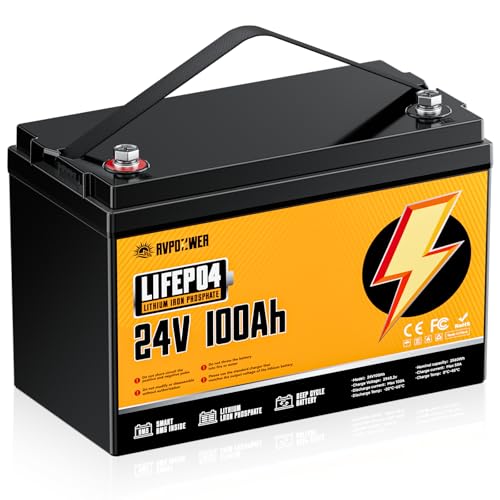
This 24V, 100AhLiFePO4 battery provides 2560Wh and up to 20,000 deep cycles. Its built-in 100A BMS protects against overcharge, over-discharge, short circuits, and temperature extremes. It weighs about 41.9 lbs and is compact for easy installation in boats, RVs, or solar systems. Best for smaller boats, trolling-motor setups, or compact marine spaces where weight savings matter.
Best for: boaters and RVers needing long life in a lightweight, space-efficient package. Caution: ensure proper mounting to manage heat and vibration in marine environments.
Dyness 24V 100Ah LiFePO4 Battery

Dyness offers an A+ grade cell construction with a smart 100A BMS and robust cold-weather protection. It supports expansion to a 51.2V, 400Ah bank via 4P2S connections, enabling larger off-grid or marine systems. Best for expanding marine or RV power systems over time.
Best for: users planning future system expansion or higher energy needs. Caution: make sure your balance charging and wiring scheme supports multi-unit banks.
XZNY Compact 24V 100Ah Battery

XZNY emphasizes a compact design with 100A BMS and targeted low-temperature protection. It’s notably smaller than typical 24V packs, reducing space needs on boats or RV compartments. Best for tight spaces or retrofits where size matters.
Best for: tight installs and cold-weather use. Caution: verify clearances and ensure compatibility with your battery tray and box height.
HAYAEnergy 24V 100Ah Battery

HAYAEnergy features a 100A BMS with low-temperature protection, CE/ SGS/ UN38.3 verifications, and 1280Wh usable energy. It’s a solid all-around option for marine, RV, or off-grid storage. Best for: buyers needing reliable cold-weather performance and safety certifications.
Caution: real-world energy density may vary with temperature and discharge rate; monitor temperature during operation.
Cymoye 24V 100Ah LiFePO4 Battery

Cymoye promotes a compact 13.38 x 7.48 x 9.84 inch form factor with a 100A BMS and up to 20.48kWh via 4P2S expansion. This makes it suitable for small to mid-size marine systems or RV infrastructure where space is at a premium.
Best for: compact installations with expansion potential. Caution: verify mounting space and wiring compatibility with your system setup.
Buying Guide: How to Choose a 24V Marine Battery
What to consider when selecting a 24V LiFePO4 battery for marine use:
- Capacity and energy needs: Match watt-hours (Wh) to motor, electronics, and life off-grid. Higher cycles often come with stable capacity over time.
- Built-in BMS features: Look for protection against overcharge, over-discharge, short circuit, and temperature extremes. Temperature-aware BMS helps in cold climates.
- Weight and size: Lighter, compact packs ease installation on boats and RVs, but ensure mounting integrity against vibration and movement.
- Expansion potential: If you foresee growing energy needs, choose systems that support series/parallel expansion (e.g., 4P2S configurations).
- Temperatures and environment: Cold-weather protection is critical for marine and coastal usage. Verify operating and storage temperature ranges.
- Certifications and safety: Certifications (CE, SGS, UN38.3) can indicate safety standards; applicable for regulatory compliance and transport.
Frequently Asked Questions
- What does a 24V battery power on a boat or camper?
They commonly power trolling motors, RV house systems, inverters, lighting, and other auxiliary electronics. - Why choose LiFePO4 over lead-acid for marine use?
LiFePO4 offers longer cycle life, lighter weight, faster charging, and better safety in harsh environments. - What is a BMS and why is it important?
A Battery Management System protects cells from overcharge, over-discharge, overheating, and short circuits, extending life and safety. - Can I expand a 24V battery bank later?
Yes, many systems support series/parallel expansion. Check manufacturer guidelines for safe configuration. - Is low-temperature protection necessary for marine use?
Yes, in cold climates it helps prevent charging issues and preserves battery longevity. - What should I measure before buying a 24V battery?
Check the physical dimensions, tray compatibility, weight, voltage, and maximum discharge current to match your motor and loads.