Best Trickle Chargers for Boat Batteries: Reliable Marine Battery Care
Answering the needs of boat owners who want simple, reliable battery maintenance, these trickle chargers maximize battery life while protecting against overcharge. The best options are compact, weather-tolerant, and compatible with common marine batteries. They suit seasonal boaters, weekend anglers, and liveaboard setups that require steady, low-current charging to keep batteries healthy between outings.
Summary table of selected products:
| Product | Best For | Key Benefit | Notes |
|---|---|---|---|
| NOCO GENIUS1 | Small boats, emergency chargers | Smart, temperature-compensated charging | Supports 6V/12V, LiFePO4 |
| 2-Pack NEXPEAK | Multiple batteries, larger setups | Four-in-one with LCD status | Includes desulfation, visual feedback |
| NOCO GEN2D | Under-hood mounting, on-board charging | Direct-mount design | 12V lead-acid focus |
| NOCO GEN5X2 | Two battery banks, larger boats | Two independently charged banks | 10A total, robust for marine environments |
| NOCO GEN5 | All-around high power | High current, compact | Strong options for larger boats |
NOCO GENIUS1: 1A 6V/12V Smart Battery Charger

The GENIUS1 is a compact, all-in-one charger that functions as a maintainer, trickle charger, and desulfator. It supports 6V and 12V lead-acid batteries (including AGM, Gel, SLA, and VRLA) as well as LiFePO4 cells. An integrated thermal sensor adjusts charging to ambient temperature, helping prevent overcharging in heat and undercharging in cold weather. This unit is best for small boats, portable applications, and users who need a lightweight, reliable trickle option with overcharge protection.
- Best for: Small to mid-size boats needing a simple, automatic trickle charger with temperature compensation.
- Why selected: Combines charging, maintenance, and desulfation in a single, compact unit.
- Caution: Not ideal for high-current needs or large deep-cycle systems requiring multi-bank charging.
2-Pack Smart Fully Automatic 6V 12V Battery Charger Maintainer (NEXPEAK)
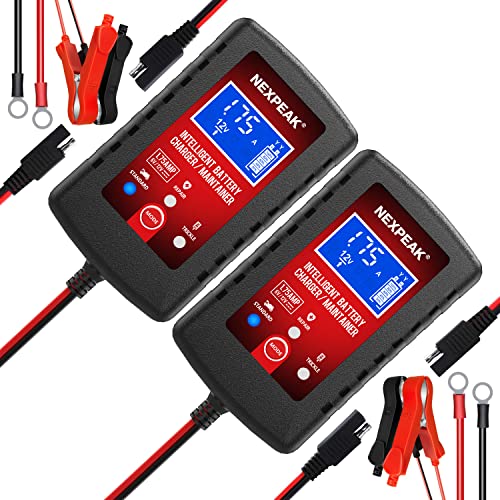
This 2-pack provides a versatile, four-in-one charging solution: charger, maintainer, trickle charger, and desulfator. It supports a wide range of 6V and 12V lead-acid batteries, including flooded, AGM, Gel, and VRLA, suitable for cars, boats, motorcycles, lawn equipment, and more. An LCD screen shows charging status, percentage, and voltage for clear visibility. A 7-stage program includes desulfation and floating maintenance for extended battery life.
- Best for: Boat owners who want visible charging progress and a 4-in-1 unit for multiple batteries.
- Why selected: Visual feedback helps monitor maintenance cycles; 7-stage charging supports battery rehab and longevity.
- Caution: LCD readability may vary in direct sunlight; ensure proper mounting for outdoor use.
NOCO GEN2D: 2A 12V Onboard Battery Charger
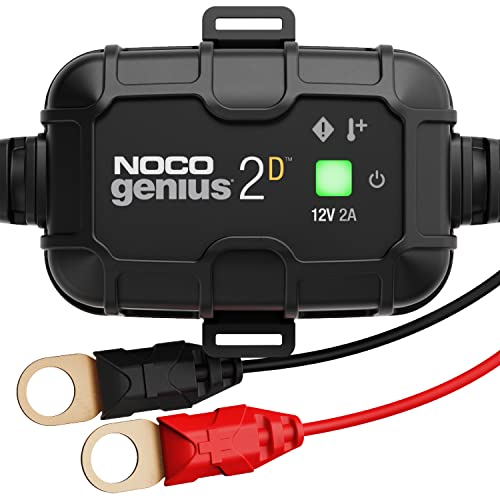
The GEN2D is designed for direct mounting near the battery in marine or vehicle applications. It offers a straightforward 2A charge for 12V lead-acid batteries and includes desulfation and temperature compensation. It’s best for boats with engine compartments or interiors where an onboard, hard-mounted charger is preferred for reliability and easy maintenance access.
- Best for: Boats needing a permanent, space-saving onboard charging solution.
- Why selected: Direct-mount design reduces clutter and simplifies wiring for marine installations.
- Caution: Mounting requires appropriate surface and fasteners; ensure compatibility with boat materials.
NOCO GEN5X2: 2-Bank, 10A Onboard Charger
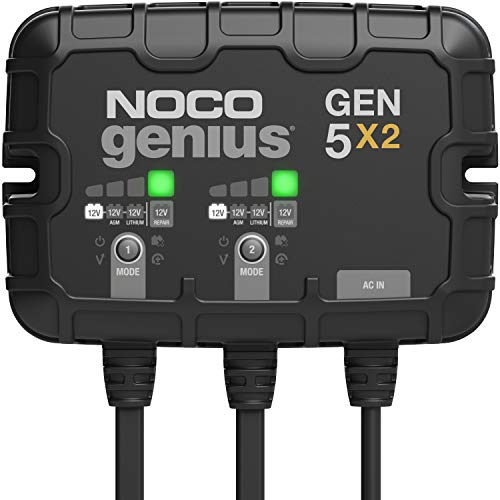
The GEN5X2 delivers two independently charged banks totaling 10A (5A per bank). It supports multiple modes for each bank, including 12V, 12V AGM, 12V Lithium, and a Repair Mode, enabling simultaneous maintenance of diverse battery types on larger boats or fleets. Best for boats with separate starting and deep-cycle batteries, or vessels with two battery bays requiring dedicated charging control.
- Best for: Boats with dual-battery systems needing separate, precise charging per bank.
- Why selected: Independent banks prevent cross-interference and optimize charging for mixed battery chemistries.
- Caution: Higher current output may require more robust mounting and wiring pathways.
NOCO GENIUS2X2: 4A 2-Bank Smart Charger

The GENIUS2X2 provides two banks with a total of 4A charging (2A per bank). It covers 6V/12V lead-acid and lithium batteries, including flooded, AGM, and LiFePO4. Force Mode lets users override sensing to recharge deeply discharged batteries. It suits boats with multiple smaller batteries and users who need dependable, park-and-charge capability across banks.
- Best for: Two-battery boats that require independent, reliable charging in tight spaces.
- Why selected: Balanced power with protection and a practical Force Mode for hard-to-reach or low-voltage cells.
- Caution: Not a replacement for high-current marine charging on large batteries or deep-cycle systems requiring faster replenishment.
NOCO GENIUS5: 5A 6V/12V Smart Charger
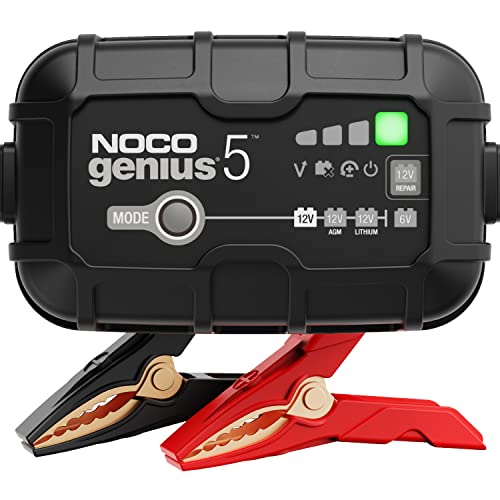
The GENIUS5 is a higher-power, compact onboard charger designed for larger boats with multiple batteries. It provides 5A total charging with two halves of the charge distributed as needed between banks or batteries. It maintains lead-acid and lithium-ion batteries with precision, featuring a temperature-compensated algorithm that helps prevent overheating and undercharging in varying climates.
- Best for: Boats that need more charging power in a compact form factor and cover multiple battery types.
- Why selected: Higher current in a compact footprint enables faster maintenance without bulky equipment.
- Caution: Higher amperage requires appropriate wiring and mounting considerations to ensure safe operation.
Buying Guide: How to Choose the Right Trickle Charger for Your Boat
- Battery type compatibility: Verify 6V/12V capability and compatibility with lead-acid (AGM, Gel, Flooded) and LiFePO4 batteries.
- Current needs: For small boats, 1-2A units are often sufficient; larger boats or dual-battery setups may require 4-10A total across banks.
- Numbers of banks: One-bank vs two-bank units; two-bank units are better for dual-battery systems or separate starting/deep-cycle batteries.
- Mounting and installation: Consider onboard or near-battery mounting options. Direct-mount designs save space but require proper surface suitability.
- Temperature compensation: Look for units with thermal sensors to prevent overcharging in heat and undercharging in cold weather.
- Desulfation and maintenance features: Desulfation and float maintenance extend battery life, especially for infrequently used boats.
- Independence of banks: Independent bank control helps manage mixed chemistries and prevents cross-charging between batteries.
Frequently Asked Questions
- What is a trickle charger best used for on a boat?
Best used for maintaining battery charge during storage or downtime, preventing self-discharge and sulfation without overcharging.
- Can I use a 12V charger on 6V batteries?
Only if the charger explicitly supports both 6V and 12V operation; otherwise, use the correct voltage to avoid damage.
- Should I choose a single-bank or two-bank charger for a boat?
Choose two-bank if you have two separate batteries (starting and deep-cycle) or need independent charging control.
- What does temperature compensation do in these chargers?
It adjusts charging voltage based on ambient temperature to prevent overcharging in heat and undercharging in cold conditions.
- Are desulfators essential for boat batteries?
Desulfation helps revive some older or idle batteries; it can be beneficial for longevity but is not a guarantee of restoring all batteries.
- Do onboard chargers require professional installation?
Mounting and wiring should follow the manufacturer’s instructions; consider professional help if routing wires through a boat’s hull or electrical panel.