Best 12 Volt Solar Battery Chargers for Marine Use in 2026
Answer: These 12-volt solar battery chargers are designed to trickle-charge and maintain boat, RV, and other marine batteries with minimal attention. They are best for boaters needing reliable maintenance between outings, RV owners seeking off-grid charging, and travelers who store equipment for long periods. The following five selections balance MPPT efficiency, waterproofing, and user-friendly features to suit marine environments. The table below highlights key details for quick comparison.
| Product | Best For | Key Benefit | Notes |
|---|---|---|---|
| SUNER POWER Waterproof 12W | Small craft and dinghies | Ultra-Smart MPPT; automatic maintenance | Compact, easy installation |
| Voltset 20W Solar Charger | Frequent travelers with varied boats | 20W high efficiency; universal 12V compatibility | Multi-battery compatibility |
| POWOXI Upgraded 7.5W | Emergency kits and compact setups | Smart protection; rugged build | Lower wattage; lightweight |
| SOLPERK 20W Kit | Versatile marine setups | High cell efficiency; durable build | Wide battery compatibility |
| SUNER POWER 50W PRO | Larger vessels and frequent offshore use | Powerful MPPT; strong durability | Higher output for training or longer stored batteries |
SUNER POWER Waterproof 12W 12V Solar Battery Charger & Maintainer Pro

The SUNER POWER 12W unit uses Ultra-Smart MPPT technology to maximize charging efficiency. It delivers high tracking efficiency up to 99% and peak conversion around 98%, aiming for a 20–30% utilization improvement over basic controllers. Its three-stage charging (Bulk, Absorption, Float) is designed to safely recharge 12V batteries and extend life. Best for small boats, personal watercraft, and as a backup maintainer for marine batteries. Caution: the 12W rating may limit charging speed on larger batteries or long storage periods.
Voltset 12V Solar Battery Charger – 20W Kit

The Voltset 20W kit offers a higher output with smart MPPT tracking and a universal 12V battery compatibility range, including LiFePO4, AGM, Gel, Flooded, and Lithium Ion variants. It’s ideal for purchased-for-use on cars, RVs, boats, and trailers, delivering faster charging and better efficiency in exposed marine conditions. A built-in protection system guards against overcharge, over-discharge, short circuits, and reverse polarity. Best for larger marine batteries or frequent use; may be less ideal for ultra-lightweight setups due to the higher wattage.
POWOXI Upgraded 7.5W Trickle Charger
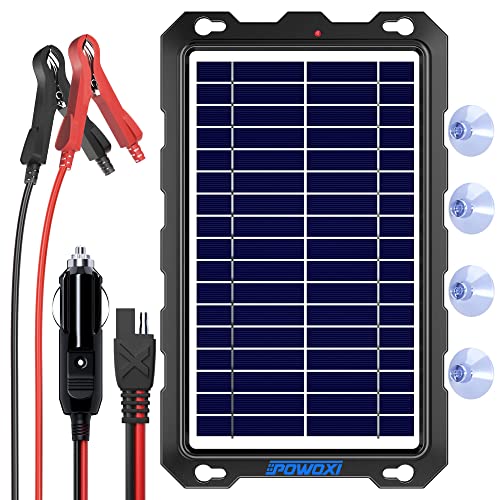
POWOXI provides a compact 7.5W solar charging option with an intelligent charge controller and a smart protection system. It uses high-transparency glass for durability and weather resistance, making it suitable for small boats, motorcycles, and portable marine applications where space is at a premium. It avoids overvoltage and short circuits with built-in safeguards. Best for emergency or backup charging; limitation is its lower wattage, which can slow charging on larger marine batteries.
SOLPERK Solar Panel Kit 20W with MPPT
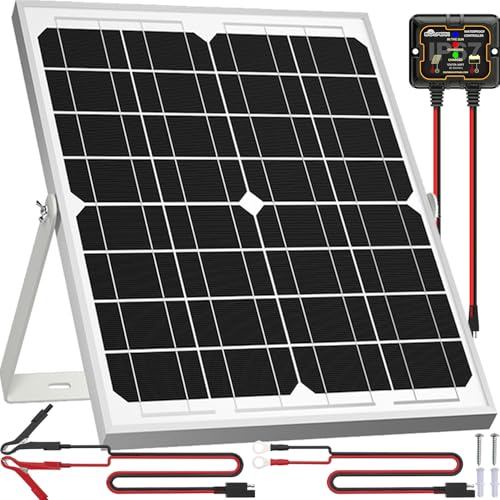
SOLPERK’s 20W kit combines a 20W monocrystalline panel with an advanced MPPT controller and a durable build designed for marine environments. It supports charging and maintaining a variety of 12V batteries, including LiFePO4, Lithium Ion, AGM, and more. The panel’s low-iron tempered glass and rugged frame withstand harsh weather, while the controller provides a smart three-stage charging process. Best for boats, RVs, trailers, and other outdoor installations; caution: higher wind and wave exposure can create mounting challenges.
SUNER POWER Waterproof 50W PRO

The SUNER POWER 50W PRO kit provides robust power with Ultra-Smart MPPT technology, offering up to 99% tracking efficiency and 98% peak conversion. Its improved three-stage charging helps keep larger 12V batteries in peak condition, and it resumes charging automatically when discharge occurs. Best for larger vessels, frequent users, or when stored batteries sit for longer periods. Limitation: higher cost and larger footprint require more space and secure mounting.
Buying Guide
- What size battery needs charging? Choose wattage based on battery capacity (Ah). Smaller boats may do well with 12–20W, while larger batteries or longer storage periods benefit from 30–50W kits.
- Do you need MPPT or PWM? MPPT controllers optimize power under variable sun, especially in marine settings with partial shade, while PWM is simpler and often cheaper.
- How weatherproof is the panel? Look for waterproof or weatherproof designs with protective enclosures and corrosion-resistant frames for marine use.
- Battery chemistry compatibility? Verify support for LiFePO4, AGM, Gel, Flooded, and Lithium-Ion to avoid compatibility issues.
- Installation and space considerations? Ensure the panel size fits your mounting area on deck or rigging, with appropriate mounting hardware and cable lengths.
- Maintenance and monitoring? Prefer models with automatic resumes after discharge and built-in protections against overcharge and short circuits.
- Portability vs. permanence? Smaller kits offer portability for emergency charging; larger kits suit permanent mounts on vessels.
FAQ
- Do these chargers work on all 12V batteries? Yes, most models are designed to work with a range of 12V chemistries, but always check compatibility for LiFePO4 or AGM types.
- What is MPPT and why is it beneficial for marine use? MPPT optimizes the electrical power harvested from the panel, increasing charging efficiency in variable sunlight conditions common at sea.
- Will these panels drain my battery when not in use? Most include smart controllers that stop charging when full and resume when discharge occurs, avoiding unnecessary drain.
- Can I install these on a boat or RV without professional help? Many units install with standard battery terminals or cigarette lighter plugs, but follow manufacturer guidelines and local regulations for watercraft.
- Are higher-wattage kits more expensive to operate? Higher wattage can charge faster but requires more space and may be unnecessary for small batteries or light use.
- How long will a solar panel last in marine conditions? Panels are built with durable glass and frames; expect a long service life with proper mounting and cleaning, though environmental exposure may vary.