Best Boat Heat Exchangers: Top Onboard Heating Solutions
Boatowners rely on reliable heat exchange equipment to maintain comfortable cabin climates, preheat engine compartments, or optimize overall energy use. The following picks highlight water-to-air and plate heat exchangers designed for marine or boat applications, balancing durability, efficiency, and installation practicality. The selections emphasize robust construction, corrosion resistance, and versatile connection options to fit a range of onboard heating and cooling needs.
| Product | Brand | Approx. Size / Type | Key Advantage |
|---|---|---|---|
| 20×20 Heat Exchanger Water To Air | GPOAS | 20 x 20 in; 1″ copper ports; water-to-air | Sturdy 306 steel case with multiple copper tubes and fins for efficient heat transfer |
| VEVOR Heat Exchanger Water to Air, 16″x16″ | VEVOR | 16 x 16 in; 3-row copper ports | High-temperature tolerance and corrosion resistance with epoxy-coated fins |
| BestEquip Heat Exchanger 3″x7.5″ 60 Plates | BestEquip | 60 plate brazed; 316L stainless | Very high thermal efficiency and compact footprint |
| ALORAIR 4″x12″ 30 Plates Heat Exchanger | ALORAIR | 4 x 12 in; 30 plates; 1″ MPT | Slim, robust plate design with excellent heat transfer |
| Water to Air Heat Exchanger 12×12 | AB | 12 x 12 in; 1″ ports | Balanced performance with durable shell and brazed joints |
Note: The selections prioritize marine-ready design features, such as durable casings, brazed joints, corrosion resistance, and flexible porting that align with boat installations and compact engine rooms.
GPOAS 20×20 Water-To-Air Heat Exchanger

The GPOAS unit features a 20×20 steel case reinforced with 12 aluminum fins per inch and three rows of 3/8″ copper tubes. Base brazed edges and contact points enhance reliability under pressure and temperature fluctuations common in marine environments. The four thickened MNPT ports simplify plenum installation, saving cabin floor space while preserving performance. Its design allows direct heat transfer from a hot water source to air, reducing energy usage on boats with compatible hot-water systems. Installation is straightforward, and its durable construction supports long-term marine service.
VEVOR 16 x 16 Water To Air Heat Exchanger

VEVOR’s exchanger emphasizes corrosion resistance and strong heat transfer, featuring epoxy-coated fins and copper-tube construction. It accepts demanding operating ranges, suitable for outdoor installations on boats where exposure to temperature swings is common. The unit’s 3-row 3/8″ copper tubes and 12 fins per inch deliver reliable thermal performance, while its copper brazing at joints ensures leak resistance. This combination supports efficient heating or cooling via onboard water sources or heat pumps, making it a versatile choice for many vessel sizes.
BestEquip 60 Plate Brazed Plate Heat Exchanger

BestEquip’s 60-plate model uses 316L stainless steel plates brazed together to create a robust, leak-resistant unit capable of handling high pressures and temperatures. Its turbulent-flow design enhances heat transfer efficiency, helping boats maximize heat exchange without increasing energy draw. The four thick BSP FPT ports assist with flexible installations, enabling straightforward integration with existing marine systems or new tank-to-air setups. This option suits compact engine rooms demanding high efficiency with a compact footprint.
ALORAIR 4×12 30 Plates Heat Exchanger
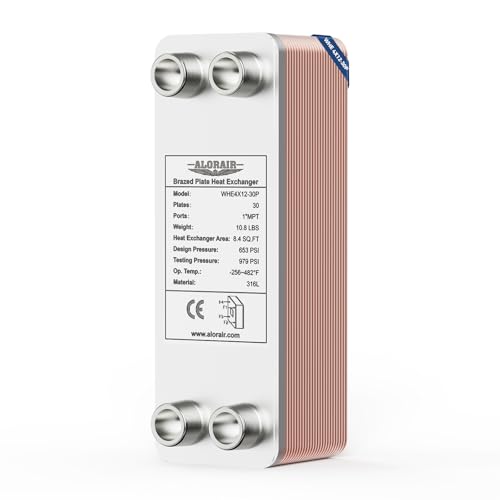
ALORAIR presents a compact 30-plate brazed stainless steel heat exchanger using 316L stainless plates with copper brazing. The fishbone corrugated design improves turbulence and contact efficiency, boosting heat transfer by a claimed 99% relative to baseline designs. Its smooth threads facilitate quick disassembly and reassembly, aiding routine maintenance aboard a boat. The ultra-thin stainless-steel plates contribute to energy savings and easier installation in tight spaces, making it a practical choice for modern marina cabins or compact engine rooms.
AB Water To Air Heat Exchanger 12×12

AB’s 12×12 water-to-air exchanger combines a steel shell with base-brazed edges and copper-aluminum conduction paths, designed for steady performance in marine settings. The unit emphasizes exceptional heat transfer via a configuration that balances fins and copper tubes, delivering reliable operation across typical boating temperature ranges. Epoxy-coated fins add durability against wear and corrosion, extending service life in salt or brackish environments while maintaining efficient heat exchange for cabin or engine-room climate control.
Buying Guide: Key Considerations For Marine Heat Exchangers
- Material and corrosion resistance: Marine environments demand stainless steel, copper, or epoxy-coated components. Look for 316L stainless plates or copper brazed joints to minimize corrosion and leaks.
- Port size and connections: Ensure the unit’s ports (1″ MNPT or BSP options) align with your plumbing and hose fittings. Accessible ports simplify installation in cramped engine rooms.
- Heat transfer efficiency: Plate heat exchangers generally offer higher efficiency than simple shell-and-coil designs. Consider turbulent-flow patterns and fin density (e.g., 12 fins per inch) to maximize heat exchange within available space.
- Pressure and temperature ratings: Onboard systems experience variable pressures; choose units rated for your expected maximum pressure and temperature range to avoid leaks or failure.
- Maintenance and ease of service: Look for brazed joints and modular components that are easier to inspect, clean, and replace. Epoxy-coated fins can extend life but may require inspection for coating integrity.
- System compatibility: Match the exchanger type (water-to-air vs. water-to-water) to your heating/cooling source (boilers, solar, or other heat sources) and to your boat’s climate control strategy.
- Size vs. space constraints: Boats have tight spaces. A compact, high-efficiency exchanger may outperform a larger unit if space is a critical constraint.
- Warranty and support: Marine-grade equipment benefits from solid manufacturer support and a clear warranty covering corrosion and leaks in saltwater environments.
In marine installations, selecting a heat exchanger is a balance between space, efficiency, and durability. Each option listed above provides distinct strengths, from compact plate units with high transfer efficiency to robust welded or brazed designs suited for long-term saltwater exposure. When integrating into a boat’s climate system, consider how the exchanger interacts with your hot-water source, propulsion or auxiliary heating, and cabin ventilation needs to achieve reliable, energy-efficient comfort at sea.