Best on Board Chargers for Boats: Top 5 Marine Battery Chargers for 12V Systems
If you need reliable on-board charging for 12V boat battery banks, this guide highlights five top options chosen for different vessel needs. The right charger keeps your marine batteries charged, balanced, and ready for long trips or seasons at sea. The best picks here suit boaters who want independent bank charging, rugged waterproofing, and modes tailored for SLA/AGM, lithium, and calcium chemistries. This is ideal for anglers, weekend boaters, live-aboards, and anyone maintaining multiple battery banks. Below, a quick product comparison helps you choose the right fit.
| Product | Type | Banks | ||
|---|---|---|---|---|
| Smart 2 Bank Marine Battery Charger | 2 bank, 12V | 2 | 5A | IP67 |
| Guest 2707A On-Board Charger | 2 bank, 12V | 2 | 4A | IP67 |
| 3 Bank Marine Battery Charger 15A | 3 bank, 12V | 3 | 5A | IP68 |
| 3 Bank Marine Battery Charger 30A | 3 bank, 12V | 3 | 10A | IP68 |
| SOARFLY 2 Bank Marine Battery Charger | 2 bank, 12V | 2 | 5A | IP68 |
Smart 2 Bank Marine Battery Charger

This charger provides two independent 12V banks with up to 5A per bank. It supports 12V SLA/AGM, lithium, and calcium modes, with automatic switching between full charging and float charging. It is designed to work with marine, boat, starter, and deep-cycle batteries. Ideal for boaters who need a compact, all-in-one solution that can condition dead batteries and maintain healthy banks during periods of inactivity.
Best for: boaters with two battery banks who want a simple, versatile charger that can handle mixed chemistries. It is a practical pick for smaller pontoons or inshore boats without large electrical systems.
Limitations: If you operate multiple high-demand systems simultaneously, you may outgrow this unit’s 10A total output. Manual mode is available but requires pressing MODE for access.
Guest 2707A On-Board Battery Charger

The Guest 2707A is a two-bank, 12V charger with an IP67 waterproof rating. It supports independent charging for two batteries and includes comprehensive safety protections: reverse polarity, over-current, over-voltage, over-temperature, and ignition protection. This unit emphasizes marine-grade reliability and is well-suited for boats that run two separate battery banks for starting and auxiliary needs.
Best for: skippers who value robust safety features and straightforward dual-bank charging for two separate batteries in a rugged marine environment.
Limitations: The max charging rate per bank isn’t as high as larger three-bank or 30A models, so large deep-cycle or lithium-only systems may require a higher-output unit.
3 Bank Marine Battery Charger 15A

This 3-bank charger delivers up to 5A per bank with IP68 waterproofing. It supports lead-acid, AGM, lithium, and calcium chemistries and enables three batteries to charge simultaneously. Each bank can independently select a mode, and Force Mode enables charging of deeply discharged batteries by holding MODE for 5 seconds. It’s built for continuous operation on boats and is designed to withstand harsh marine conditions.
Best for: boaters with three battery banks looking for balanced charging and full-time on-board upkeep for multiple battery chemistries. It suits cruising boats or larger day boats with substantial electrical needs.
Limitations: A higher-capacity setup means more complex installation and potentially higher upfront cost. Ensure your boat’s electrical system can support 360W total output.
3 Bank Marine Battery Charger 30A
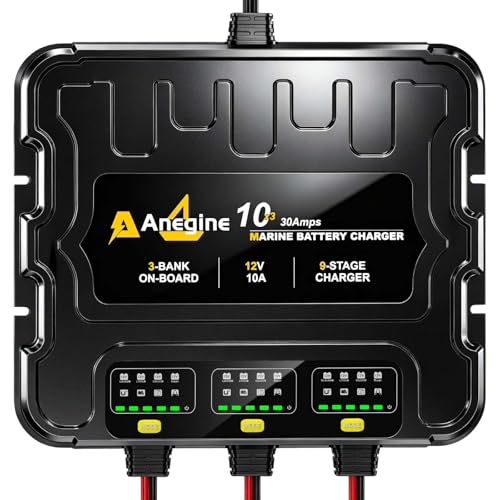
This model offers 3 banks with up to 10A per bank, delivering a maximum of 360W. It uses independent bank control to ensure each battery receives the correct charge. It is designed for diverse battery types, including LiFePO4, calcium, AGM, and lead-acid, with IP68 waterproofing for extended exposure to water and moisture. The Force Mode allows reviving deeply discharged batteries.
Best for: larger boats with three banks and a need for higher per-bank current. It’s a strong option when multiple high-demand batteries must stay charged in parallel, including lithium systems.
Limitation: The higher output requires careful setup and space considerations aboard, and the increased complexity might not be necessary for smaller vessels with fewer batteries.
SOARFLY 2 Bank Marine Battery Charger

SOARFLY’s 2-bank charger provides 5A per bank, totaling 10A, and supports three charging modes for SLA/AGM, lithium LiFePO4, and calcium batteries. It also features a Force Mode to recharge dead batteries by holding the mode button for 5 seconds. This setup is well-suited for boats that need flexible battery chemistries in a compact form factor.
Best for: boat owners who need dual-bank versatility with mode-switching between common marine chemistries and a straightforward revival function for dead batteries.
Limitation: For larger boats with more than two critical banks or higher daily draw, this unit may feel undersized compared to 3-bank or 10A-per-bank options.
Upgraded 3 Bank Marine Battery Charger 10X3

This three-bank charger delivers 10A per bank for robust 12V charging with IP68 waterproofing. It supports SLA/AGM, lithium LiFePO4, and calcium chemistries, with independent bank control and automatic mode switching. Force Mode helps revive deeply discharged batteries, making it a strong option for saltwater or irregular usage cycles.
Best for: boats needing consistent multi-bank performance with ample per-bank current for a mix of battery types, including lithium-heavy setups.
Limitation: Higher power output can demand more complex wiring and secure mounting, so installation planning is essential.
Buying Guide: How To Choose The Right On-Board Boat Battery Charger
- Number of Banks: Match the charger to the number of battery banks on your boat. More banks require higher total current or more independent channels.
- Battery Type Support: Confirm compatibility with your chemistries (SLA/AGM, LiFePO4, calcium). Some units optimize charging for mixed chemistries.
- Current Per Bank: Consider your battery size and usage. Higher per-bank current can shorten charging times but may require beefier wiring.
- Waterproofing and Durability: Look for IP68 rating if exposure to water, salt spray, and splash is common. Rugged housings extend life in harsh marine environments.
- Force Mode: A useful feature to revive deeply discharged batteries, especially after long storage or heavy use.
- Ease of Use: Independent bank mode selection and clear indicators simplify operations on the water.
- Installation Considerations: Ensure mounting space, cable runs, and fuse sizing align with the charger’s electrical requirements.
- Safety Protections: Features like reverse polarity, over-current, and over-temperature protection help protect both batteries and vessels.
Frequently Asked Questions
- What is an onboard battery charger’s primary purpose for boats?
It maintains and restores charge to multiple 12V battery banks, ensuring starting power and auxiliary systems stay reliable on the water. - Can I charge different battery chemistries at the same time?
Yes, many multi-bank chargers offer separate modes for SLA/AGM, lithium, and calcium, allowing simultaneous charging of different chemistries. - What does IP68 waterproof rating mean for a marine charger?
It indicates the unit is fully protected against dust and can withstand prolonged immersion in water, suitable for marine environments. - Is Force Mode important?
It helps revive dead or deeply discharged batteries, which can extend battery life during inactivity or storage. - How do I know how many amps per bank I need?
Match per-bank current to the battery’s capacity and chemistry; lithium batteries often benefit from higher-per-bank current for faster charging, while lead-acid batteries may tolerate lower currents for longer life.