Best Gas Trolling Motor for Kayak: Find Power on the Water
Answer: A gas trolling motor can deliver strong thrust and long run times for anglers, expedition paddlers, or rescue craft that need sustained power. This guide highlights five gas-powered options suited for kayaks and small boats, with clear pros, best-use scenarios, and practical cautions. The picks favor portability, reliability, and efficient heat management to keep you moving comfortably all day. The top buyers are anglers who need quick acceleration, adventurers exploring choppy water, and operators seeking backup propulsion for inflatables or canoes.
Summary of Selected Products
| Product | Power | Weight Range | Best For | Key Benefit |
|---|---|---|---|---|
| Tiozuiu 52cc 2 Stroke Outboard | 2.3HP | Lightweight | Kayak & small boats needing quick start | Fast start, solid runtime, effective cooling |
| YIYIBYUS 2.3HP 52CC | 2.3HP | Lightweight | Inflatable boats and kayaks | High efficiency with non-contact ignition |
| HinLIaDa 2.3HP 52CC | 2.3HP | Lightweight | Inflatable and small boats | Easy steering and high RPM range |
| JooWing 2.3HP 52CC | 2.3HP | Lightweight | Kayaks and inflatables | Ergonomic grip and quick refueling |
| Gosangom 3.5HP | 3.5HP | Moderate | Rubber boats and larger inflatables | Stronger thrust and overall efficiency |
Tiozuiu 52cc 2 Stroke Outboard Motor

Key features: 2-stroke, 2.3HP engine; speeds up to 8500 rpm; 40–70 minutes runtime per full tank. Cooling holes and air cooling promote heat dissipation for extended use. CDI ignition plus a hand-pull start offer a quick, reliable start.
Best for: Anglers and day-trippers who need brisk forward movement with straightforward starting. The engine’s compact build fits lightweight kayaks and small boats.
Caution: As a two-stroke engine, fuel mixing and exhaust management require attention to maintenance and proper lubrication.
YIYIBYUS 2.3HP 52CC Outboard Motor

Key features: 52cc, 2-stroke engine with non-contact electronic ignition; idle 2800–3200 rpm; operating 4500–8500 rpm; 850 ml fuel tank. Aluminum and PP construction for corrosion resistance and durability.
Best for: Kayaks and inflatables where smooth operation and consistent performance matter. The ignition system is designed to reduce maintenance needs.
Caution: Fuel mix ratio is specified at 25:1; keep to the recommended ratio to avoid engine damage.
HinLIaDa 2-Stroke 2.3HP Outboard
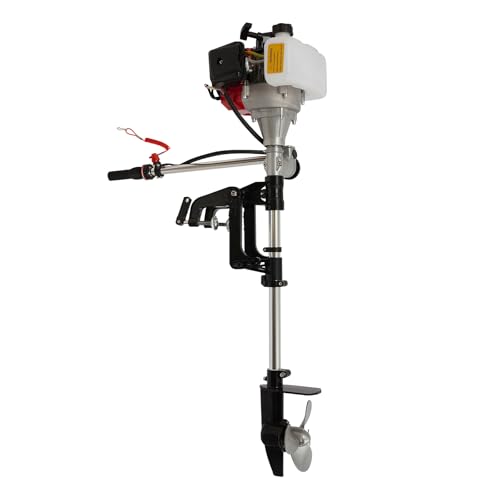
Key features: 2-stroke, 2.3HP; 4500–8500 rpm range; aluminum and PP construction; notable steering angle over 120° for easy handling.
Best for: Small inflatables and inflatable boats where agile steering and light weight are priorities.
Caution: Ensure proper mixing and cooling to prevent overheating during extended runs.
JooWing 2.3 HP 52CC Outboard
Key features: 52CC 2-stroke engine; up to 8500 rpm; 0.22 gal fuel tank; ergonomic non-slip handle; external fuel tank for quick refueling; lightweight and compact.
Best for: Kayaks and dinghies used for fishing or short cruises where quick handling and fast fuel top-ups are advantageous.
Caution: The external fuel tank means you’ll need to manage fuel sources during longer trips to avoid interruptions.
Gosangom 2-stroke 3.5HP Outboard

Key features: 3.5HP 2-stroke engine; water-cooled CDI system; short shaft; 36 x 14.17 x 5.9 inches; weighs 21.6 lbs; fuel economy with 0.3 gal/h consumption.
Best for: Rubber boats and larger inflatable kayaks that benefit from stronger thrust and longer continuous operation. Suitable for shallow-water setups where quick response matters.
Caution: Heavier than smaller 2.3HP models; ensure boat transom and mounting hardware are compatible with a short shaft motor.
Buying Guide: Gas Trolling Motors For Kayaks And Small Boats
- What propulsion power do you need? If you regularly fight wind or current, a higher horsepower (like 3.5HP) provides stronger thrust, but adds weight and consumption. For calm lakes, a 2.3HP model is often sufficient.
- Motor type and maintenance: Two-stroke engines deliver high power-to-weight but require fuel mixing and more frequent maintenance. Four-stroke options are generally cleaner and steadier but heavier. Choose based on maintenance preference and use-case.
- Fuel capacity and runtime: Larger tanks extend run time but add weight. Plan for typical trip lengths and carry extra fuel if needed for longer outings.
- Engineering for durability: Look for heat dissipation features (air cooling, cooling holes) and corrosion-resistant materials if you kayak in saltwater or brackish conditions.
- Steering and mounting: A wide steering angle improves maneuverability in tight spaces. Check if the motor design includes robust mounting hardware suitable for your boat’s transom size and hull material.
- Portability: Lighter motors are easier to transport and mount on compact kayaks. Heavier models may require assistance or a sturdier setup for safe handling.
- Safety and compliance: Follow local regulations for gasoline-powered watercraft, including fuel storage and safe operation near others, wildlife, and watercraft.
Frequently Asked Questions
- Are gas trolling motors suitable for kayaks? Yes, especially when you need more power for moving through wind, waves, or current. Ensure your kayak can safely support the motor’s weight and mounting requirements.
- What maintenance is needed for 2-stroke gas outboards? Regular fuel mixing at the correct ratio, cooling checks, and spark/ignition system checks help maintain reliable starts and performance.
- How long can a 2.3HP gas motor run on a full tank? Typical runtimes range from 40 to 70 minutes, depending on load, speed, and fuel capacity.
- What should I consider when choosing between 2.3HP and 3.5HP? Consider payload, water conditions, and distance. Higher horsepower provides stronger thrust but adds weight and fuel use, which may reduce run time.
- Is saltwater use a concern with these motors? Look for corrosion-resistant construction and consider rinsing and dry-storage after saltwater use to extend life.
- Can I mount any of these on a kayak? Most kayaks designed for gas motors require a compatible transom mounting setup and a short or mid shaft configuration; verify compatibility before purchase.