Best Blue Sea Marine Fuse Blocks for Boat Wiring
Best Blue Sea marine fuse blocks simplify safe, organized power distribution on boats. This guide compares top Blue Sea ST blade and fuse blocks to help boaters choose the right block for their DC systems. Each option fits different crew needs—from compact 6‑circuit panels for small vessels to higher‑capacity 12‑circuit blocks for bigger setups. The buyer should consider total amperage, number of circuits, environmental resistance, and ease of maintenance. The table below highlights the five most relevant Blue Sea options for typical marine electrical jobs.
| Product | Circuit Count | Key Benefit | Best For |
|---|---|---|---|
| Blue Sea Systems ST Blade Fuse Block 6 Way (5025) | 6 | Integrated negative bus and cover | Smaller boats needing six circuits with clear labeling |
| Blue Sea Systems ST Blade Fuse Block 12 Circuit with Ground and Cover (5026) | 12 | Grounded design with large capacity | Mid‑sized systems requiring more circuits |
| Blue Sea Systems ST Blade Fuse Block 12 Circuit with Cover (5029) | 12 | Durable cover and high‑load capacity | Vessels needing protection against moisture |
| Blue Sea Systems 5056 ST-Blade Water-Resistant 4 Circuit Fuse Block | 4 | Water‑resistant design for wet environments | Open‑cockpit or exposed installations |
| Blue Sea Systems 5005 ANL Fuse Block with Insulating Cover | Varies by fuse size | Heavy‑duty main fuse protection | Systems up to 32V DC with high current needs |
Each product in this selection emphasizes reliability, simple wiring, and clear circuit management. The condenser details below help you choose based on vessel size, electrical load, and environmental exposure.
Blue Sea ST Blade 6‑Way Fuse Block (5025)
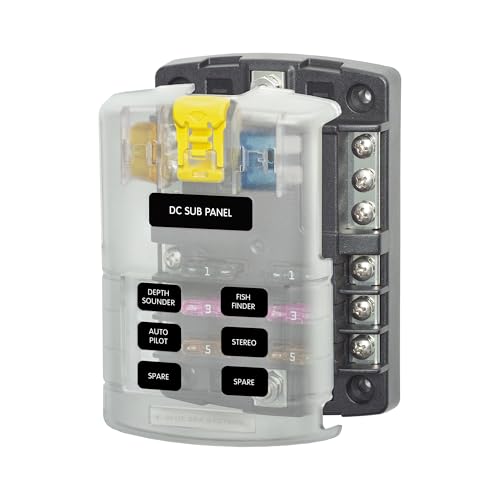
Six fused circuits with an integrated negative bus provide a compact power distribution option. The block is rated for up to 100 amps total capacity and supports up to 30 amps per circuit when paired with standard ATO/ATC blade fuses. The insulated cover features a secure push‑button latch, spare fuse storage, and recessed label areas for straightforward circuit identification and maintenance. Best for small boats or limited panels where space matters. Caution: ensure the total load does not exceed 100 A to avoid overheating.
Blue Sea ST Blade 12‑Circuit with Ground (5026)

Twelve circuits with an integrated negative bus combine capacity and organization for mid‑size boats. With a 100 A maximum capacity and 30 A per circuit, this block suits higher‑demand DC systems. The clear cover with a latch and dedicated label areas aids maintenance. Best for boats needing more circuits without adding multiple blocks. Limitation: larger footprint than the 6‑way version, requiring available mounting space.
Blue Sea ST Blade 12‑Circuit with Cover (5029)

This 12‑circuit block includes a protective cover and supports up to 100 A total with 30 A per circuit. It is designed for 24‑hour circuits and uses standard electrical interfaces. The mounting hardware and layout support straightforward replacement in existing boats. Best for users who want a robust, moisture‑resistant option with visible labeling. Caution: ensure compatibility with your existing mounting holes and bus terminals.
Blue Sea 5056 ST‑Blade Water‑Resistant 4 Circuit (5056)

Four circuits with a water‑resistant design offer protection in open or wet environments. It accepts ATO/ATC fast‑acting fuses and low‑profile circuit breakers, making wiring straightforward with standard tools. Best for open helm stations or decks exposed to spray. Limitation: fewer circuits than larger blocks; suitable for smaller electrical systems.
Blue Sea 5005 ANL Fuse Block with Insulating Cover

ANL fuse block designed for high‑current protection with an insulating cover. It accepts 5/16″ ring terminals and is suitable for systems up to 32 V DC. The swing‑out design allows fuse replacement without removing fasteners, facilitating maintenance on high‑power circuits. Best for large vessels or heavy DC loads. Limitation: larger current fuses require careful handling and installation space.
Buying Guide
What should you consider when choosing a Blue Sea fuse block?
- Circuit count: Match the number of loads to the block’s capacity. For small boats, 4–6 circuits may suffice; larger vessels benefit from 12‑circuit blocks.
- Total amperage: Ensure the block’s maximum capacity covers your anticipated load with room for surge currents.
- Environmental protection: Choose water‑resistant or weatherproof designs for open or wet environments; consider a cover with a secure latch for easy maintenance.
- Negative/ground handling: Some models include a built‑in negative bus—this simplifies wiring and labeling for easier troubleshooting.
- Compatibility: Confirm that fuses and accessories (ATO/ATC types, fast‑acting fuses, or circuit breakers) align with your system requirements.
- Mounting and accessibility: Ensure there is sufficient space for installation and future maintenance, including fuse replacement.
FAQ
- Q: Do Blue Sea fuse blocks support both ATO and ATC fuses? A: Yes, many models are designed to accept standard ATO and ATC blade fuses, with the appropriate bus and wiring configurations.
- Q: What is the advantage of a built‑in negative bus? A: A built‑in negative bus simplifies grounding and circuit identification, reducing wiring complexity.
- Q: Are water‑resistant models necessary for all boats? A: Not always, but they are recommended for open‑deck or exposed locations where moisture is common.
- Q: Can I replace a fuse without disconnecting the entire system? A: Most designs allow fuse replacement with minimal disconnection, though follow standard safety procedures.
- Q: How do I choose between a 6‑way and a 12‑circuit block? A: Assess your total number of loads and future expansion plans; select a block with a comfortable margin to prevent crowding and heat buildup.
- Q: Do these blocks require special tools for installation? A: Standard hand tools are typically sufficient; some models may include specific torque recommendations for terminals.