Best Wireless Anemometers for Boats: Accurate Wind and Airflow Readouts on the Water
If you’re shopping for a wireless anemometer for boats, you want a device that delivers accurate wind speeds, temperature, and relevant airflow metrics without weighing you down. This guide highlights five top options that balance precision, ease of use, and waterproofing for marine use. Each pick is best for different boaters—from casual weekend sailors to serious skippers managing marina conditions.
The following table offers a quick side‑by‑side look at the five shortlisted models. It helps you compare measurement range, connectivity, and key features at a glance.
| Product | Connectivity | Best For | Strong Point | Limitation |
|---|---|---|---|---|
| BTMETER BT-100APP | Bluetooth | Casual and connected sailors | Multi‑parameter readouts on one LCD | Bluetooth range limits standalone use |
| Bonvoisin Hotwire Anemometer | Manual display | In‑duct or HVAC style measurements | Long probe with bendable tip | Requires direct viewing of display |
| LYCEBELL Wireless ANEMO | Bluetooth App | Boat operators who record logs | Real‑time app data and analysis | App dependence for full benefits |
| BTMETER Hot Wire Anemometer BT-5000Y | USB‑C rechargeable | Duct work and HVAC diagnostics | Retractable thermal probe | Bulkier form factor |
| Infurider Digital Wireless Anemometer | App via Bluetooth | Tech‑savvy boaters | TXT/EXCEL data download and analysis | App‑centered workflow |
BTMETER BT-100APP Anemometer With Bluetooth

The BT-100APP combines wind speed, wind chill, temperature, and battery status in one handheld unit. It supports multiple wind‑speed units (m/s, km/h, ft/min, knots, mph) and provides a responsive LCD readout. Best for sailors who want a compact device that works with or without a connected app, and for those tracking wind conditions alongside temperature and battery life. The device includes two temperature sensors and eight vanes, increasing sensitivity to low air flows, which is useful in marina conditions, light‑air sailing, or dockside testing. A practical caution: rely on the LCD display when the app is offline or out of range, and be aware of potential (±5%) wind speed accuracy in gusty conditions.
Bonvoisin Hotwire Anemometer For HVAC And Airflow
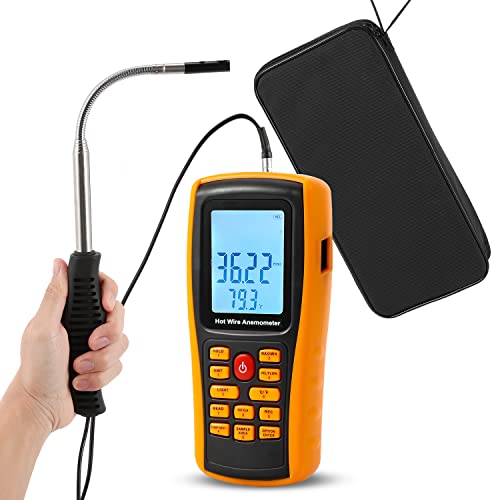
This handheld unit covers Air Velocity, Airflow (CFM/CMM), and Temperature with backlit display for low light environments. It’s tailored for HVAC tasks and in‑duct measurements, offering wind chill values and max/min readings. The 2 m probe length with a bendable tip improves measurement in tight spaces. It is a strong pick for boaters who also manage cabin or engine room ventilation and need a robust, backlit instrument. A limitation to note: the device relies on direct line‑of‑sight for the display when not connected to an app, and the backlight auto‑shuts off after a timeout in some modes.
LYCEBELL Wireless APP Anemometer 100‑APP

The LYCEBELL model emphasizes app connectivity and data recording. It measures wind speed (0.3–30 m/s, 0.67–67.1 mph) and wind temperature, with high precision sensors and a hold function. The companion app enables real‑time data transmission to your phone, useful for logging weather on longer passages or in RV/boat setups where you want to visualize trends over time. Best for boaters who want to analyze wind data after a trip and prefer digital storage. Choose this if you rely on mobile analytics; avoid if you need a standalone device with no app dependency.
BTMETER Hot Wire Anemometer BT-5000Y
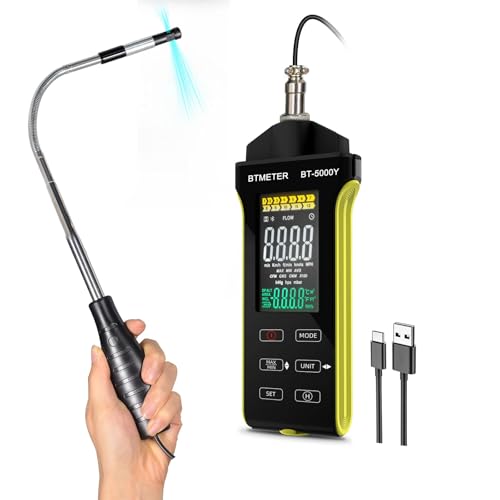
This 3‑in‑1 digital meter fetches wind speed, airflow (CFM/CMM), and temperature with a retractable thermal probe designed for tight spaces such as vents and ductwork. The 600 mAh rechargeable battery and USB‑C charging support extended field use, a practical benefit for longer sailing trips or in remote marinas. Best for boaters performing routine air diagnostics and system balancing. A caution: the long‑reaching probe is excellent in ducts but may be awkward for very small cockpit spaces without a stable mounting plan.
Vanlison 5‑In‑1 Hot Wire Anemometer

The Vanlison unit measures Wind Speed, Air Flow (CFM/CMM), and Temperature with five‑in‑one precision. It provides MAX/MIN tracking and a bright backlight for low‑light conditions. It’s designed for HVAC tasks and duct balancing, making it a strong choice for boaters who need quick, dependable readings in engine rooms or cabins. A note: depending on your setup, the handheld size may require periodic recalibration to maintain consistency across readings.
INFURIDER Digital Wireless Anemometer With APP

The INFURIDER model offers Bluetooth app connectivity, with wind speed, wind flow, and wind temperature measurements. It supports data logging to TXT/EXCEL formats via the app and includes a large backlit display. This is best for boaters who want to integrate wind data with smartphone records and perform post‑trip analysis. Choose this if you value structured data export; avoid if you prefer a purely standalone device with no app reliance.
Buying Guide: What To Check Before You Buy
- Purpose and use case: Are you mainly testing cabin airflow, engine room ventilation, or outdoor wind speeds for sailing? Pick a model whose primary strengths align with your activity.
- Display and visibility: Backlit displays help in low light. For deployments on deck at dawn or dusk, a readable display matters more than a feature in bright sun.
- Connectivity: Bluetooth and mobile app features are valuable for logging, sharing, and analysis. If you prefer a standalone unit, choose a model with strong internal data handling.
- Measurement range and accuracy: Look for units that cover typical marine wind speeds and offer clear unit options (m/s, mph, knots). Note stated accuracy (often ±5%) and temperature readings (±1–2°C).
- Probes and ergonomics: A long, bendable or extendable probe helps reach vents and tight spaces. Ensure the probe is durable and easy to clean.
- Power and battery life: Rechargeable options reduce waste; consider auto power‑off features to save energy on long passages.
- Durability and weather resistance: For boating, consider splash resistance and any IP ratings if exposed to spray or rain.
- Data handling: If you need to export data, verify supported formats (TXT, CSV, Excel) and how data is stored (on device vs. app).
Frequently Asked Questions
- What is an ambient wind speed range I should expect on a small boat? Answer: Typical handheld anemometers measure from about 0.3 m/s to 30 m/s (roughly 0.7 mph to 67 mph) with variations by model.
- Do I need Bluetooth for a boat wind meter? Answer: Bluetooth is useful for logging and real‑time data on a phone, but a standalone display is sufficient if you don’t want to rely on an app.
- Can these devices measure temperature as well? Answer: Yes, many models measure temperature and sometimes wind chill, which helps assess comfort and equipment performance.
- Are advanced air flow metrics like CFM/CMM important for boating? Answer: They’re more relevant for ventilation analysis in engine rooms and cabins; for deck wind assessment, wind speed and wind direction are usually enough.
- How should I choose between a retractable probe and a fixed probe? Answer: A retractable or bendable probe is better for tight spaces like ducts and vents; fixed probes are simpler and more rugged for general use.
- Is app data export essential? Answer: If you routinely analyze trends or maintain records, app data export to CSV or Excel can be highly beneficial.