Best Marine Battery Kill Switches for Safe Power Isolation
If you need reliable battery isolation for boats, cars, RVs, or marine equipment, a marine battery kill switch can stop parasitic drains and prevent electrical fires. This guide compares five widely available options, highlighting who each is best for and common limitations. Ideal buyers include boat owners seeking corrosion-resistant switches, DIY installers prioritizing space, and those who want quick on/off control with clear safety features.
Summary of selected products:
| Product | |||
|---|---|---|---|
| Nilight 90015A Battery Switch | 275 A Continuous | ||
| Joinfworld Side Post Battery Disconnect | 275 A Continuous | ||
| Joinfworld Top Post Battery Disconnect | 250 A Continuous | ||
| Blue Sea Systems m-Series 6006 | Not specified here | ||
| Spurtar 200A Battery Disconnect | 200 A Continuous |
Nilight 90015A Battery Switch: Heavy-Duty Isolation

The Nilight 90015A provides a robust ABS housing and a rear cover to insulate terminals, reducing short-circuit risk. It supports DC 12V systems with 275 A continuous, 455 A intermittent, and 1250 A momentary ratings, making it suitable for boats and vehicles that require strong, reliable power isolation. Best for: boaters and RV owners who want a sealed, heavy-duty switch that can stand alone or be locked with other switches for multi-circuit systems. Caution: ensure correct wiring to avoid accidental contact with exposed terminals during maintenance.
Joinfworld Side Post Battery Disconnect

This side-post design uses M10 copper studs and includes copper conductive sheets, offering strong electrical conductivity and space efficiency. Ratings include 275 A continuous, 455 A intermittent, and 1250 A cranking. Best for: installers prioritizing a compact, side-post solution with solid conductivity and straightforward mounting. Better for: installations where space is limited behind the panel. Limitation: may require precise post sizing to fit existing hardware.
Joinfworld Top Post Battery Disconnect

The top-post variant provides on/off control with 12-48 V operation and a 250 A continuous rating, plus 1000 A cranking. It comes with a negative clamp and tapered post for easier installation on the negative terminal, simplifying wiring. Best for: tighter engine bays where top-post access matters. Caution: lower continuous rating versus some other options means it’s best for moderate-use boats or vehicles rather than high-draw systems.
Blue Sea Systems m-Series 6006

This compact, knob-style switch is designed for tight spaces and panel versatility. It offers surface, rear, or front mounting options and includes a removable knob to prevent accidental current flow during service. Best for: small panels and installations where safe handling and space efficiency are priorities. Limitation: the data here does not specify continuous current ratings; confirm compatibility with your electrical system before purchase.
Blue Sea Systems 4‑Position Mini Selector

This 4-position mini selector adds an emergency combine feature to draw from two batteries during starting or essential radio use. It supports flexible mounting (surface, flush, or rear) for diverse panel designs. Best for: systems needing a simple, quick power-path switch with a fail-safe combining option. Limitation: not a high-current unit; suitable for moderate battery banks rather than heavy industrial loads.
Spurtar Battery Disconnect Switch

Spurtar offers a 200 A continuous, 1000 A intermittent rating for 12-48 V systems with a robust housing and clear on/off indication. Best for: users needing a high-current isolator for vehicles, boats, or RVs with demanding electrical loads. Limitation: the continuous rating is lower than some heavy-duty marine switches, so avoid very high-draw setups for prolonged use.
RVMARINEPAT 300A Boat Battery Disconnect

This model uses tinned copper inner studs and a flame-retardant plastic housing for safer operation in damp environments. It features a 2 x 3/8″ stud size and an ignition-protected design that withstands higher surge ratings. Best for: marine settings requiring ignition protection and corrosion-resistant components. Caution: ensure adequate space for the wiring inside the housing due to its large internal partition design.
MOTOFLEX On/Off Battery Disconnect
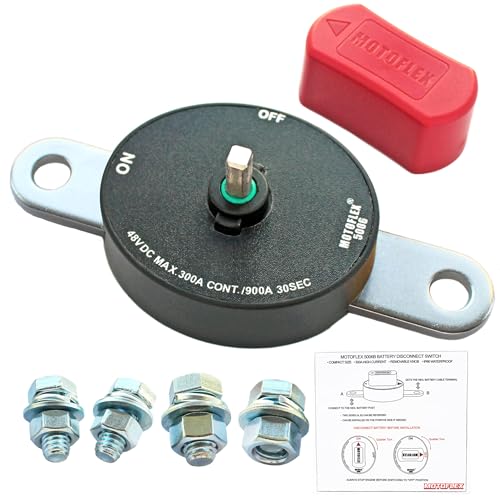
This GM-side-post disconnect is designed for 12-48 V systems, with a compact height of 1-1/2 inches and corrosion-resistant, marine-grade terminals. It’s suitable for negative-side installation but can be used positively if clearance requires it. Best for: installations where space is tight and a negative-side disconnect simplifies wiring. Limitation: continuous rating sits around 300 A with higher cranking amps, so plan according to your engine or accessory load.
Buying Guide: Key Considerations for Marine Battery Kill Switches
- Voltage and current ratings: Match the switch to your system’s voltage (12-24-48 V) and expected continuous and peak currents to avoid overheating or poor isolation.
- Mounting style: Side post, top post, or compact knob designs affect installation space and accessibility in tight engine bays.
- Material and safety: Look for corrosion-resistant housings, corrosion-resistant terminals, and ignition protection if used near fuel sources or in moist environments.
- Ease of installation: Consider included hardware (clamps, mounting brackets, copper sheets) and whether negative or positive-side mounting is simpler for your setup.
- Safety features: Removable knobs or secure covers help prevent accidental power draw during servicing or when not in use.
- Maintenance and durability: ABS or flame-retardant plastics enhance durability; ensure terminals are insulated to minimize short circuits.
- Spin-off considerations: If you need to draw power from multiple batteries, look for a model with a combining or dual-battery feature.
FAQ
- What is a marine battery kill switch used for? It disconnects electrical power to a vehicle or boat to prevent parasitic drain and reduce the risk of fires or short circuits when not in use.
- Should I install on the negative or positive terminal? Negative-side installation is common and often simpler, but follow your vehicle’s wiring diagram and clearance constraints.
- What rating do I need for a boat battery switch? Choose a switch with a continuous rating that meets or exceeds the system’s typical draw, plus a suitable surge/cranking rating for starting power.
- Are ignition-protected switches important for boats? Yes, ignition-protected switches resist ignition in cranking conditions and are safer for marine environments.
- Can I lock switches together for multi-circuit protection? Some models are designed to lock with others, enabling centralized control of multiple circuits.
- Do these switches require professional installation? Some are straightforward for DIY wiring with basic tools, but consult a marine electrician for complex multi-circuit setups.