Best 1000-Watt Marine Amp: Top 5 Options for Boats and Off-Road Vehicles
Answering the need for robust, marine-grade amplification, this guide covers five 1000-watt or higher-rated marine amplifiers that excel in boats, pontoons, and rugged outdoor vehicles. Designed for salt air, splashes, and variable mounting spaces, these amps help you push clear, powerful sound. The best pick depends on your space, power needs, and whether you want multi-channel flexibility or a high-power mono amp for subwoofers. Below is a quick, comparison-friendly snapshot to jump-start your decision.
| Product | Channel Count | Approx. Power | Best For |
|---|---|---|---|
| Skar Audio RP-150.4ABM | 4-channel | 150W x4 @ 4Ω; 250W x4 @ 2Ω | Balanced four-channel marine sound |
| STINGER MT-600.4M | 4-channel | Up to 250W x4 @ 2Ω | Compact, water-resistant performance |
| Pyle PLMRA430BT | 4-channel | Bridgeable to 2-channel; 1000W+ typical rating | Bluetooth-enabled flexibility |
| Pyle PLMRA420 | 4-channel | Bridgeable; high/low crossovers | RCA inputs and marine durability |
| Stinger MT-1000.1M | Mono | Up to 650W @ 2Ω; 1700W bridged | Powerful subwoofer amp for bass |
Skar Audio RP-150.4ABM 1,000 Watt Full-Range Class A/B 4-Channel Marine Amplifier
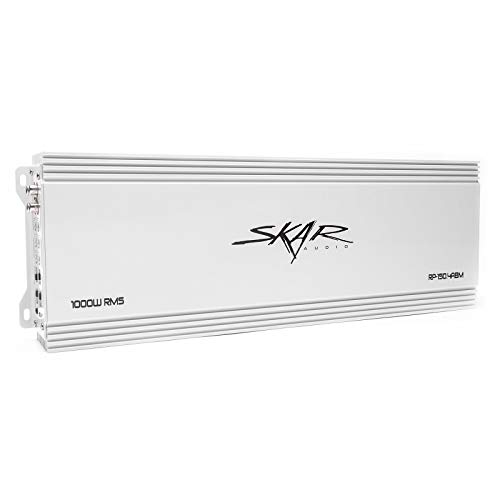
The RP-150.4ABM is a 4-channel Class A/B marine amplifier delivering 250W per channel at 2 ohms and 150W per channel at 4 ohms. This model is best for boaters who want solid four-channel performance with reliable, marine-grade construction. It suits multi-speaker setups on deck or cabin areas where a balanced, clear sound is required. A limitation is that the per-channel power rating is moderate at higher impedance, so use with proper matching speakers for best efficiency.
Stinger MT-600.4M Compact Marine Class D 4-Channel 1000W RMS

The MT-600.4M uses Class D design with a compact footprint (6.10″ L x 9.29″ W x 2.09″ H) and water-resistant protection. It delivers up to 250W x 4 @ 2 ohms or 150W x 4 @ 4 ohms, making it a strong choice where space is limited yet high-volume, clear sound is needed. Best for smaller boats or pontoons where a four-channel amp must coexist with limited mounting space. Consider its lower maximum output at higher impedance when planning large speaker arrays.
Pyle PLMRA430BT 4-Channel Bluetooth Marine Amplifier

The PLMRA430BT integrates 4-channel bridgeable capability with 2.1 Bluetooth, offering wireless pairing and long-range compatibility. It includes a crossover network for flexible speaker management and a marine-grade IP-01 rating for weather resistance. This model is best for boaters who want wireless convenience and a flexible 4-channel setup for diverse speaker configurations. A potential limitation is that the IP-01 rating is relatively basic compared to higher IP ratings; ensure mounting away from direct exposure when possible.
Pyle Hydra Marine Amplifier PLMRA420 1000W 4-Channel

The PLMRA420 offers four-channel bridgeable capability with high/low crossover networks and premium RCA inputs. It includes a heavy-duty aluminum heatsink for thermal protection and LED indicators. This model is well-suited for users who want a reliable four-channel amp with easy integration into a marine audio system. A potential trade-off is that some users may need additional power wiring or fusing to reach maximum performance in demanding setups.
Stinger MT-1000.1M Compact Marine Mono Amplifier

This mono amp delivers significant bass power for subwoofers with up to 650W @ 2Ω, 300W @ 4Ω, and 1700W bridged. It is best for dedicated subwoofer applications where deep, punchy bass is a priority. Choose this if your system relies on a single high-output sub for a boat’s soundstage. Limitation: when bridged into high power, thermal management and proper ventilation become critical in compact installations.
Buying Guide: Key Purchase Considerations
- Power needs: Determine total speaker wattage and impedance. Multi-channel amps are best for four speakers; mono amps excel with a single sub or stacked pairs.
- Marine durability: Look for sealed enclosures, conformal coatings, corrosion resistance, and salt-fog tolerance. Higher IP ratings offer more protection in harsh environments.
- Speaker compatibility: Match amplifier power at your speaker impedance (4Ω vs 2Ω). Underpowering can cause distortion; overpowering can damage speakers if not controlled by proper gain settings.
- Space and mounting: Consider the amp’s dimensions. Class D models save space and run cooler, but ensure adequate ventilation in enclosed compartments.
- Connectivity: Bluetooth and RCA inputs aid integration with existing receivers. Bridgeable options increase configuration flexibility for complex systems.
- Protection features: Look for thermal, short-circuit, and overload protections to protect both amp and boat electrical systems.
Frequently Asked Questions
- What does 1000W mean for marine amps? Answer: It represents the amplifier’s rated power output under specific conditions, often at a given speaker impedance. Real-world output depends on load, supply voltage, and how the amp is configured.
- Which amp is best for a boat with four speakers? Answer: A four-channel marine amp like the Skar RP-150.4ABM, STINGER MT-600.4M, or Pyle PLMRA430BT is well-suited for balanced, multi-speaker setups.
- Should I choose a mono or four-channel amp for bass? Answer: If you have a dedicated subwoofer, a mono amplifier (like the MT-1000.1M) is typically ideal for delivering concentrated bass power.
- What is a marine-grade rating? Answer: It indicates the amplifier is designed to withstand exposure to moisture, corrosion, and salt air typical of marine environments. Higher ratings usually offer stronger protection.
- Do I need crossovers? Answer: Yes, crossovers help manage which frequencies go to which speakers, improving sound clarity and protecting smaller speakers from bass.
- How important is mounting space? Answer: Very important. A compact, well-ventilated install reduces heat buildup and preserves amplifier longevity in closed boat compartments.