Best Boat Battery Chargers for 12V Systems in 2026
Looking for a reliable boat battery charger to keep your marine batteries charged and maintained? This guide highlights five top options that fit typical boat setups, from compact single-bank units to robust multi-bank chargers. Each pick is suited for different boat sizes, battery chemistries, and maintenance needs. Read on to compare and decide which charger best matches your vessel’s power demands and storage environment.
Summary table of selected products
| Product | Banks | Max Total Amps | Special Note | |
|---|---|---|---|---|
| NOCO Genius GEN5X2 | 2 | 10 A | Smaller boats with mixed battery types | 5 A per bank; multiple charging modes |
| NOCO Genius GEN5X3 | 3 | 15 A | Medium boats with several battery banks | 5 A per bank; versatile modes |
| NOCO Genius GEN5X1 | 1 | 5 A | Small boats or single-battery setups | 5 A per bank; compact |
| Upgraded 3 Bank Marine Charger 10X3 (FirstPower Pro) | 3 | 30 A | Three batteries with 10 A each on 12V | IP68 waterproof; force mode |
| 2 Bank Marine Battery Charger 5X2 (FirstPower Pro) | 2 | 10 A | Two-battery setups needing 24/7 maintenance | IP68 waterproof; force mode |
NOCO Genius GEN5X2: 2-Bank 10A Onboard Charger
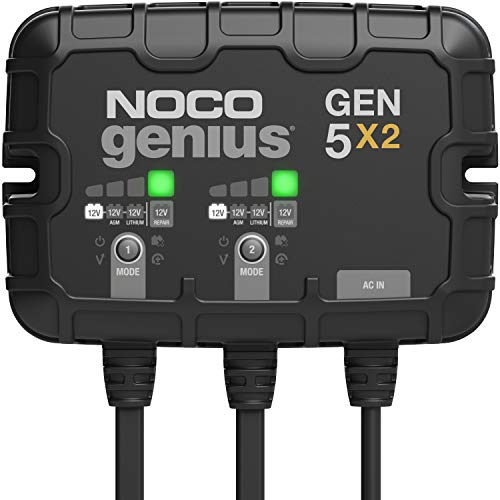
The GEN5X2 provides two independent charging channels with a total of 10 amps (5 A per bank). It’s designed to work with both lead-acid and lithium batteries and includes temperature compensation to optimize charging in variable marine conditions. Best for boats with two batteries or two battery banks that require separate charging profiles.
Who this is best for: boat owners with two distinct battery systems (starter and deep-cycle, or different chemistries). Why chosen: compact, versatile modes for 12V AGM, 12V Lithium, andRepair Mode for upkeep. Caution: ensure proper thermal placement to prevent overheating in small compartments.
NOCO Genius GEN5X3: 3-Bank 15A Onboard Charger
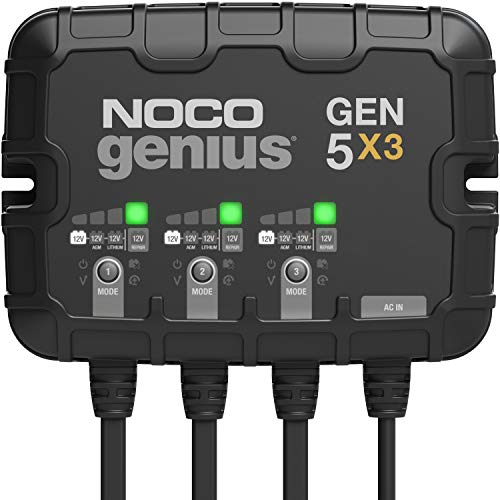
The GEN5X3 delivers 15 amps split across three banks (5 A per bank), enabling simultaneous charging of three batteries. It supports 12V, AGM, and Lithium modes with a dedicated Repair Mode. This unit is well-suited for boats with multiple battery banks needing independent charging profiles.
Who this is best for: mid-size boats with three separate batteries (engine, house, and auxiliary). Why chosen: flexible per-bank modes and robust performance in marine environments. Caution: larger size and higher power draw require adequate mounting space and ventilation.
Upgraded 3 Bank Marine Charger 10X3 by FirstPower Pro

This 3-bank charger provides 10 A per bank for a total of 30 A, making it a strong choice for boats with three independent 12V battery systems. It supports SLA/AGM, Lithium (LiFePO4), and Calcium chemistries, and includes a Force Mode to charge deeply discharged cells. Best for larger boats needing robust simultaneous charging across three batteries.
Who this is best for: owners with three batteries spread across critical systems. Why chosen: high total amperage per bank and IP68 sealing for wet environments. Caution: the advanced features may require careful setup to prevent misaligned mode selections.
2 Bank Marine Charger 5X2 by FirstPower Pro

This 2-bank charger delivers 10 amps total (5 A per bank) and is designed for 12V lead-acid and lithium-ion batteries. It’s IP68 waterproof and supports charging 24/7, making it well-suited for boats that require steady maintenance on multiple banks. Best for smaller crews or boats with two key battery systems.
Who this is best for: boats that need a reliable two-bank maintenance solution. Why chosen: compact, waterproof, and capable of simultaneous charging. Caution: not ideal if you frequently need more than 10 A total across banks.
Buying Guide: Key Considerations For Choosing A Boat Battery Charger
What battery chemistry will you charge? Most marine chargers support lead-acid, AGM, and Lithium (LiFePO4). If your boat uses a mix, seek a charger with selectable modes per bank and a dedicated Lithium profile.
How many batteries and banks do you need? Determine the number of 12V batteries you maintain and whether you require independent charging per bank or a common charge path. More banks offer greater flexibility but require space and more wiring.
What is the charging capacity you need? Match total amperage to your battery bank sizes. For example, larger banks benefit from 10 A per bank or more. Consider future upgrades when selecting a charger.
Protection and diagnostics: Look for overcharge protection, temperature compensation, and repair modes. These features help maximize battery life and prevent damage in marine environments.
Durability and installation: IP68 or higher waterproof rating is desirable for onboard installation. Ensure the unit fits in your mounting space and that wiring routes are secure and accessible for maintenance.
Ease of use: Independent per-bank controls and clear indicators simplify operation, especially when managing different battery types aboard a boat.
FAQ
Do I need a separate charger for Lithium batteries?
Not always. Some multi-bank chargers include dedicated Lithium charging profiles per bank. Verify the model supports LiFePO4 before purchasing.
Is 12V the only voltage used on boats?
Most small to mid-size boats use 12V systems, but some larger vessels may use 24V or combined setups. Choose a charger compatible with your system voltage.
What does IP68 rating mean for a marine charger?
IP68 indicates the unit is dustproof and protected against immersion in water beyond 1 meter, which is important for exposed or wet installation areas.
Can I use a charger while batteries are connected to a running engine?
Yes, many onboard chargers are designed to operate with batteries connected, but follow the manufacturer’s installation and safety guidelines.
What maintenance does a marine charger require?
Regular inspection of wiring, connectors, and seals; ensure vents are clear; and occasionally check mode settings to ensure proper charge profiles.