Best Low Profile Bilge Pumps for Tight Spaces in Boats
Answering the needs of boaters who require reliable, compact bilge pumps that fit in cramped bilge compartments. This guide highlights five low profile bilge pumps that excel in tight spaces, with usage notes on who benefits most from each model. Ideal buyers include small-boat owners, kayakers, or anyone installing a pump in a narrow bilge where space is at a premium. The table below summarizes key specs to compare at a glance.
| Product | Brand | Flow (GPH) | Automatic | Low Profile |
|---|---|---|---|---|
| Rule LP900S | Rule | 900 | Yes | Yes (2.4″ high) |
| SEAFLO 14A Series | SEAFLO | 1100 | Yes | Yes (narrow) |
| SEAFLO 14B Series | SEAFLO | 1100 | Yes | Yes (narrow) |
| Whale Supersub Smart 1100 | Whale | 1100 | Yes | Yes (low profile) |
| SAILINGFLO 1100 GPH | SAILINGFLO | 1100 | Yes | Yes (low profile) |
Rule LP900S LoPro 900 GPH Automatic Bilge Pump

The Rule LP900S is designed for ultra-tight bilge spaces with a 2.4″ (6 cm) height. It’s best for small boats, kayaks, or areas where conventional pumps won’t fit. This model offers automatic operation with two selectable water levels and periodic checks to ensure continuous protection. The 180° rotating discharge and multiple ports make installation flexible in various orientations. Best for owners needing a compact, automated option that still moves a robust amount of water. Some installations may require careful alignment of fittings to avoid backflow or fitment issues in extremely constrained spaces.
Who it’s best for and why selected
- Best for compact boats and tight bilges where height is the primary constraint.
- Choose this if you need automatic operation with flexible discharge routing.
SEAFLO 14A Series 12V 1100 GPH Low Profile

The SEAFLO 14A blends a low-profile design with automatic water-sensing operation. With 1100 GPH and multiple discharge sizes, it fits tight spaces while delivering dependable removal in both fresh and saltwater environments. Its water-sensing feature activates at a defined height and stops at a lower level, leaving the bilge relatively dry. The pump is suitable for installations where a compact but powerful unit is required. A potential limitation is that the sensor sensitivity may vary with debris in the bilge; regular cleaning helps maintain performance.
Who it’s best for and why selected
- Best for boats needing automatic sensing in slim profiles without sacrificing flow.
- Choose this if you want flexibility in discharge fittings and reliable auto operation.
SEAFLO 14B Series 12V 1100 GPH Low Profile

The SEAFLO 14B mirrors the 14A in power and low-profile design but features a timer-sensing automatic operation. It runs checks every 2.5 minutes and activates when water is detected, helping maintain a nearly dry bilge. The compact form factor suits awkward installations, and the shared 3/4″ to 1-1/8″ discharge options support versatile plumbing. A caution is that timer-based cycling may be less responsive to rapid water increases in extremely dynamic bilges; ensure installation matches typical boat usage patterns.
Who it’s best for and why selected
- Best for boats that benefit from periodic checks in addition to sensing water presence.
- Choose this if you want predictable cycling that can fit very tight spaces.
Whale Supersub Smart 1100 (12V)

The Whale Supersub Smart 1100 is a long-standing low-profile option with automatic operation and an air-lock reduction feature for reliable performance in cramped bilges. Ideal for boats that require consistent, hands-off operation and space-conscious design. It accepts both fresh and saltwater environments and includes a non-return valve for backflow prevention. One limitation is that some installations may require compatible mounting hardware to fit current bilge configurations.
Who it’s best for and why selected
- Best for owners seeking a proven, compact solution with automatic control and anti-backflow features.
- Choose this if you want a simple plug-and-play option with broad water compatibility.
SAILINGFLO 1100 GPH Low Profile Auto Bilge Pump
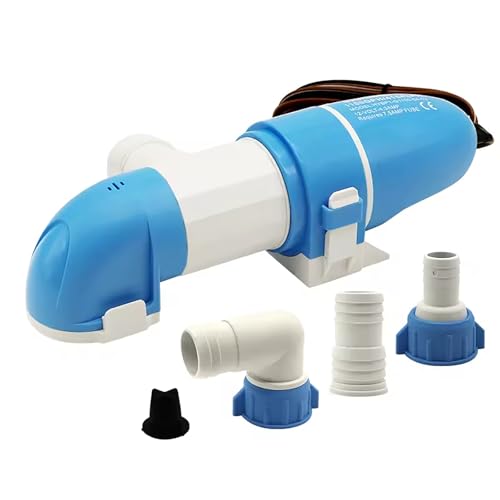
The SAILINGFLO 1100 GPH pump combines a compact profile with 360° adjustable outlet options and check valves. Automatic water-sensing ensures activation at 2.36 inches and shutoff at 0.4 inches, keeping the bilge nearly dry. Its narrow design makes it suitable for tight spaces under 24 meters (79 feet) and in irregular compartments. A potential limitation is that the 360° discharge option may require extra support hardware to secure in certain installations.
Who it’s best for and why selected
- Best for installations needing a highly adaptable discharge path.
- Choose this if you want a balance of size, sensing automation, and robust flow.
Buying Guide: Key Considerations For Low Profile Bilge Pumps
- Size and space: Measure bilge height and available clearance to ensure the pump fits without obstruction.
- Flow rate: Higher GPH moves more water quickly but may draw more power. Match with boat size and typical bilge volume.
- Automatic sensing vs. non-automatic: Auto pumps reduce manual checks but consider sensor reliability in debris-filled bilges.
- Discharge options: Look for multi-port or 360° outlets to adapt to various hoses and orientations.
- Power and wiring: Confirm 12V compatibility and any ignition-protection features if installed near fuel tanks.
- Installation ease: Rotating discharge and flexible fittings simplify mounting in awkward spaces.
- Durability: Corrosion resistance and backflow prevention reduce maintenance and potential leaks.
- Maintenance: Access for cleaning and switch-off for manual overrides when testing is required.
FAQ
- What is considered a low-profile bilge pump?
A low-profile bilge pump is designed to fit in tight bilge spaces with a reduced height, typically around 2.0–2.4 inches to allow installation where standard pumps won’t fit. - Do automatic bilge pumps require manual testing?
Most automatic pumps activate with water sensing and require occasional inspection to ensure sensors stay clear of debris and functioning properly. - What outlet sizes are common for these pumps?
Common sizes include 3/4″, 1″, and 1-1/8″ discharge ports, with some models offering multiple ports for flexible hose routing. - Is a rotating discharge important?
Yes. A rotating discharge (often 180°) enables easier routing and mounting in awkward compartments or limited spaces. - Can these pumps work in saltwater boats?
Many are rated for both fresh and saltwater use; always verify material compatibility and corrosion resistance for marine environments. - What should I check during installation?
Ensure secure mounting, proper hose connections, correct orientation for gravity drain, and that the bilge remains dry under typical conditions.