Best Weather Station for Boat: Top Picks for Safe, Accurate Coastal Readouts
Plan ahead with a reliable marine weather station designed for boats. These devices deliver real-time air and sea-relevant data, including wind speed and direction, barometric pressure, temperature, humidity, rain, and forecasts. They’re best for boaters who need portable, easy-to-read conditions while on the water, docking, or moored. The following selections combine rugged outdoor sensors with clear indoor displays and easy setup. This guide highlights who each product is best for and why it stands out for boating use.
| Product | Best For | Key Benefit |
|---|---|---|
| AIRAIN TECH 10-in-1 Wireless Weather Station (NO WiFi) | Weekender and day sailors needing independent, offline readings | All-in-one sensor suite with wind, rain, dew point, and moon phase |
| Ambient Weather WS-2902 WiFi Smart Weather Station | Home and boaters who want remote access and smart home integration | Comprehensive, hyper-local data with remote alerts |
| Tempest Weather Station | Users seeking hyper-local, rapidly updating forecasts | Wireless sensor network with fast updates and app-driven insights |
| Sainlogic WiFi Smart Weather Station 14-in-1 | Tech-savvy boaters who want long-term data storage | AI-driven forecasts and 2-year data export |
| Newentor Weather Station | Multiple-location monitoring on boats or marinas | Multi-sensor support with 3 remote sensors and forecast |
Airthain Tech 10-in-1 Wireless Weather Station (No WiFi)

The AIRAIN TECH system provides a high-precision Swiss temperature and humidity sensor with a wide outdoor range (-40°F to 140°F). It can function offline, which is useful aboard vessels without constant internet access. It also features wind speed and direction, a rain gauge, moon phase, and barometric pressure. This model is best for boaters who prefer an all-in-one setup that doesn’t rely on WiFi, enabling dependable readings during remote charters or on open water.
Best for: Short trips and offshore sailors who prioritize offline data reliability. It’s a strong choice when internet connectivity is limited or unavailable on the vessel.
Why selected: Combines essential weather elements with a clear display and alerting for chilly wind and dew point shifts, aiding safety planning for passengers of all ages.
Caution: The device’s accuracy hinges on proper placement and calibration; ensure outdoor sensor is mounted where it gets proper exposure to wind and rain without obstructions.
Ambient Weather WS-2902 WiFi Smart Weather Station
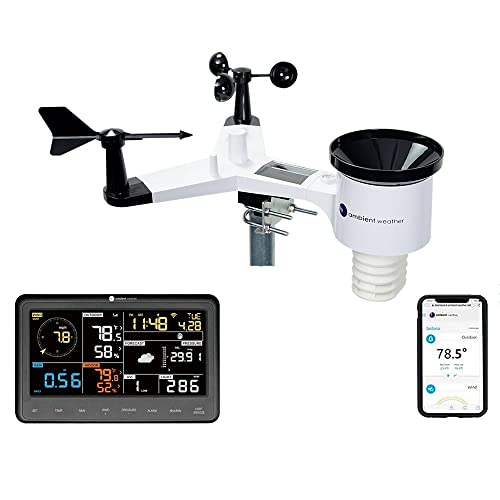
This station delivers a complete weather package with an Osprey Sensor Array and a bright LCD display. It captures wind speed and direction, temperature, humidity, rainfall, UV, and solar radiation. The WiFi capability enables remote access and smart home integration via IFTTT, Google Home, and Alexa. It’s ideal for boaters who prefer live data accessible from shore or a cabin dashboard and want automation based on weather events.
Best for: Boat owners who live near marinas or frequently check weather from shore using smart home integrations.
Why selected: Its wireless array makes sensor placement flexible on deck, on a mast, or near a cockpit, giving a thorough, real-time picture of local conditions.
Caution: Requires a stable WiFi connection for remote features; local readings are still available without internet, but some conveniences rely on network access.
Tempest Weather Station
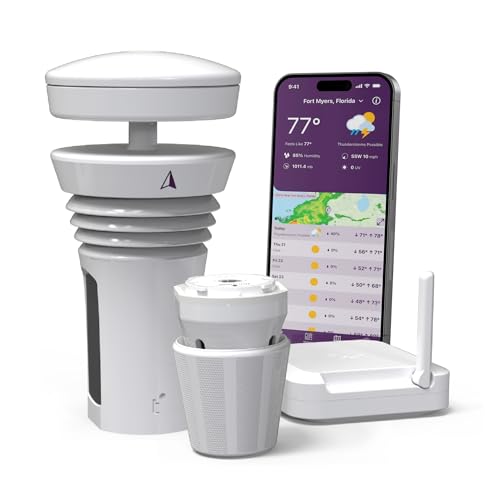
The Tempest Weather Station centers on a built-in wind meter, rain gauge, and a robust app ecosystem. It handles temperature, humidity, barometric pressure, wind speed and direction, dew point, solar radiation, UV index, lightning strikes, and rainfall. The wireless outdoor sensor can transmit over long distances, keeping the data current with updates every three seconds. This setup is well-suited for boats that need rapid, hyper-local updates and a digital record of weather changes during trips into variable seas.
Best for: Technically inclined sailors who want frequent, high-resolution data with app-based access.
Why selected: Its rapid update cadence helps detect sudden weather shifts near the coast or in open water, improving decision-making for crossings or docking.
Caution: The system relies on a strong wireless link; signal loss can reduce update speed or data continuity over very long boat trips.
Sainlogic WiFi Smart Weather Station 14-in-1

The Sainlogic system combines WiFi-enabled access with 14-in-1 sensing, offering 24/7 AI-powered forecasts via Weatherseed. The 8.5-inch display provides a well-organized view of temperature, humidity, wind, dew point, barometric pressure, rain, UV, and solar radiation. It stores up to two years of data and supports export in Excel format, which is excellent for long-range voyage planning and historical comparison. This device is best for boaters who value data longevity and deep analysis for voyage planning.
Best for: Data-driven skippers who want long-term historical trends and AI forecasts.
Why selected: The long-term data export and assistant-style forecast can support route planning and storm-avoidance decisions on multi-day passages.
Caution: Limited to 2.4 GHz WiFi; ensure a stable network if you rely on remote access and exports.
Newentor Weather Station Wireless Indoor Outdoor Thermometer

Newentor offers a 7.5-inch LCD color display with indoor/outdoor temperature, humidity, clock, barometric pressure, and forecast. It supports up to three remote sensors for multiple locations, allowing a crewmember to monitor conditions at the helm, cabin, or dockside. The forecast window covers 12–24 hours and includes a moon phase indicator. This option suits boaters who need a versatile setup that can monitor several points on a vessel or marina.
Best for: Boats with multiple crew zones or those who require a multi-location view on one screen.
Why selected: The 3-sensor support provides flexibility for larger boats or several decks, with a straightforward, color-coded display for quick reads.
Caution: The forecast calibration is location-specific; verify alignment with your usual marina or cruising route to improve accuracy.
Buying Guide: What To Consider When Choosing a Boat Weather Station
- Coverage: Do you need wind, rain, temperature, barometer, UV, and moon phase? Prioritize stations with wind meters for boating safety.
- Connectivity: Is offline operation acceptable, or do you want remote alerts and smart-home integration?
- Display: Look for a large, legible screen that’s readable in bright sun and dim cabins. Consider display brightness and contrast controls.
- Sensor placement: Outdoor sensors should be mounted where exposure to wind and weather is representative, not blocked by sails or rigging.
- Data retention: If you plan route planning or voyage records, choose a model with history export (Excel or similar).
- Power and reliability: Solar-assisted sensors extend battery life; verify the ease of power management aboard.
- Price versus features: Balance essential boating data with the cost of advanced features like AI forecasts or IFTTT automation.
FAQ
- What’s the minimum weather data I should have on a boat? Response: Wind speed and direction, temperature, humidity, and barometric pressure are essential; rain and dew point add practical safety context.
- Is WiFi necessary for a boat weather station? Response: No, some models work offline, but WiFi-enabled units offer remote alerts and integration with smart devices.
- How should I place outdoor sensors on a boat? Response: Mount in an open area away from hatches and sails, with shielding from direct sun and spray where feasible.
- Can I export weather data for voyage planning? Response: Some models offer data export to Excel or similar formats for long-term analysis.
- Which station is best for multi-location monitoring on larger boats? Response: Units supporting multiple remote sensors (3–4 sensors) provide better coverage across decks or docks.
- Do I need a subscription for forecasts? Response: Many devices include AI-based forecasts without a subscription, though some apps offer optional premium forecasts.