Best Flotation Foam Blocks for Boats
For boat flotation and nonstructural buoyancy projects, these expanding polyurethane foams are the top choice. They are best for adding buoyancy, filling voids, insulating and reducing sound, with a focus on marine-friendly 94% closed-cell formulations. The selections below suit boaters, DIY boat builders, and marine repair enthusiasts seeking reliable, lightweight foam that can be poured in place and shaped after curing.
Buyer briefing: The following table compares five recommended products, highlighting their density, typical use, and where each is most effective. This helps you choose by application, whether you’re refloating a small craft, filling gaps under decks, or insulating storage compartments.
| Product | Density | Kit Size | Best For |
|---|---|---|---|
| TotalBoat 2 Lb Density Expanding Foam Kit | 2 lb | 2 Gallon Kit | General boat flotation, insulation, and void filling |
| TotalBoat Flotation Foam – 2 Part 2 Qt Kit | 2 lb | 2 Quart Kit | Filling under decks, multiple thin layers, lightweight buoyancy |
| Fiberglass Supply Depot 2 Lb Density – 1 Gallon Kit | 2 lb | 1 Gallon Kit | Void filling, nonstructural flotation, insulation |
| Fiberglass Supply Depot 2 Lb Density – 2 Gallon Kit | 2 lb | 2 Gallon Kit | Higher-volume buoyancy, voids and larger cavities |
| Lifeboat 2 Lb Density – 2 Gallon Kit | 2 lb | 2 Gallon Kit | Boat buoyancy, filling gaps, insulation and soundproofing |
TotalBoat 2 Lb Density Expanding Foam Kit

Density: 2 lb. Kit contains two parts for a pourable polyurethane foam that expands and cures quickly. Uses include buoyancy, insulation, soundproofing, and void filling in nonstructural marine applications. The foam is 94% closed-cell, resists water absorption, and can be coated with common resins after curing. Best for boat owners seeking a versatile, quick-setting foam for decks, compartments, or interior cavities. Limitations include nonstructural use only and the need for careful, layered pours to avoid overexpansion.
Best for: Boat owners needing reliable buoyancy and insulation in nonstructural areas, especially when a fast-curing foam is advantageous. Choose this if you need a 2-gallon kit for mid-size repairs and layered builds.
2 Quart Kit Marine Flotation Foam (Oycevila)

Density and use: 2 lb density polyurethane expanding foam intended for marine flotation and void filling. The kit expands to fill cavities and provides buoyancy, while also offering insulating properties for boats and marine structures. Best for: small to medium voids in watercraft where a lightweight, closed-cell foam is suitable. Caution: check cure thickness and follow layering guidance to avoid excessive expansion in tight spaces.
TotalBoat Flotation Foam – 2 Part Expanding Foam (2 Quart Kit)

Density: 2 lb. This 2-quart kit uses a simple 1:1 mix ratio and cures in about 5 minutes at moderate temperatures. It yields a 94% closed-cell structure, making it resistant to water, gas, oil, and solvents. Best for: rapid buoyancy and light-duty insulation projects in boats where quick handling is desired. Limitation: practical for smaller volumes or layered applications rather than large bulk fills.
TotalBoat 6 Lb Density Expanding Foam Kit
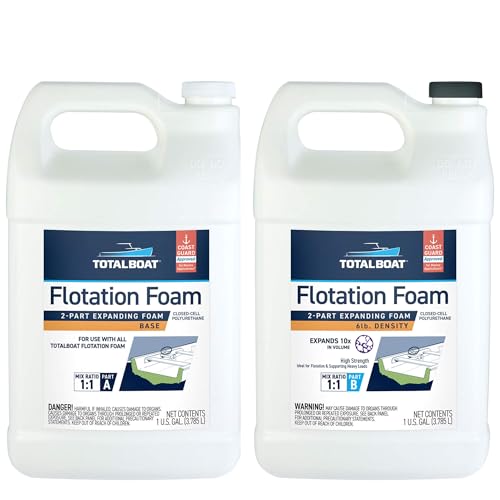
Density: 6 lb. This high-density foam cures very hard and rigid, offering high compressive strength suitable for structural reinforcement, casting, carving, and flotation. It achieves a 94% closed-cell foam and is compatible with common resins. Best for: projects requiring solid, structural buoyancy or custom parts. Limitation: heavier and less flexible, not ideal for soft-bodied gaps that require more give.
Fiberglass Supply Depot 2 Lb Density – 2 Gallon Kit

Density: 2 lb. This two-gallon kit yields up to 10 cubic feet of buoyant foam when fully cured. It is suitable for nonstructural void filling, deck areas, and lightweight buoyancy under stowaway compartments. Best for: larger boats or more extensive flotation projects where more material is needed. Caution: ensure proper venting and mixing to avoid insufficient expansion or voids.
Fiberglass Supply Depot 2 Lb Density – 1 Gallon Kit

Density: 2 lb. One-gallon kit for nonstructural flotation and void filling. Expands to fill cavities and improve buoyancy while remaining lightweight. Best for: smaller boats or limited spaces where a compact kit is advantageous. Limitation: may require more frequent applications to achieve desired buoyancy in larger areas.
Lifeboat Polyurethane Pour Foam – 2lb Density (2 Gallon Kit)

Density: 2 lb. Extended-time formula for boat buoyancy, filling, deep pours, soundproofing, and insulation. The foam expands to a rigid, closed-cell structure and is designed for marine flotation. Best for: deeper pours and larger voids where a longer working time is beneficial. Caution: confirm proper mixing and curing conditions to avoid under-expansion in tight cavities.
Buying Guide
What type of flotation foam should I buy?
- Nonstructural flotation vs. structural reinforcement: For buoyancy and void filling, 2 lb density foams are standard. For structural support or artistic casting, higher densities like 6 lb offer more rigidity.
- Kit size and project scope: Larger boats or multiple compartments benefit from 2-gallon or 2-quart kits, depending on the volume you need to fill.
- Open vs. closed cell: Look for 94% closed-cell foam for water resistance and better buoyancy in marine environments.
How should I apply flotation foam safely?
- Mix ratio: Most marine foams use a 1:1 ratio of Part A to Part B. Follow the product’s instructions for temperature and curing time.
- Ventilation and curing: Apply in a well-ventilated area. Allow full cure before exposing to moisture or load.
- Layering: For large voids, pour in layers to control expansion and achieve even buoyancy.
What are common limitations to watch for?
- Nonstructural limitations: Many foams are intended for buoyancy only, not structural support. Do not rely on them for hull reinforcement unless specified by the manufacturer.
- Material handling: Some kits can expand rapidly; use containment and plan pours carefully to prevent overfill in tight spaces.
Frequently Asked Questions
- What density is best for boat flotation?—2 lb density foams are common and suitable for most nonstructural buoyancy needs; higher densities provide more rigidity for specific applications.
- Can I coat the foam with resin?—Yes. Cured foam is typically compatible with polyester, epoxy, or vinyl ester resins, depending on the product.
- Is it suitable for insulating compartments?—Yes. Many foams include insulating properties that help stabilize temperatures in storage areas on boats.
- How long does curing take?—Most quick-curing foams set within minutes, while extended-time formulas may take longer but offer more working time.
- Are these foams waterproof after curing?—Yes, by design, the closed-cell structure resists water absorption, preserving buoyancy in marine environments.
- Can I reuse or recycle leftover foam?—Leftover foam typically cures into a solid block. Follow local disposal regulations for curing agents and containers.