Best Lightweight Outboard Motors for Small Boats and Kayaks
When you need portable, easy-to-carry propulsion for dinghies, inflatables, kayaks, or compact fishing boats, a lightweight outboard motor is essential. This guide highlights five compact models that balance power with portability, ideal for small craft operators, casual anglers, and travelers who value fuel efficiency and simple operation. Each option is best suited for short trips, shallow-water use, and easy storage. Below is a quick summary table to compare core details and intended buyers.
| Product | Weight / Size | Best For | Notable Benefit |
|---|---|---|---|
| Gosangom 3.5HP Outboard | 21.6 lbs; 36 x 14.17 x 5.9 inches | Lightweight aluminum design with fuel efficiency | |
| Baotree 4HP 4-Stroke | Approximately 24-26 kg | Car-topped inflatables, small dinghies | Full F-N-R gearbox and easy portability |
| Newport Vessels Newport NV-Series 36lb | Compact 36 lb-thrust trolling motor | Kayaks, canoes, small boats in salt or freshwater | Quiet operation, corrosion-resistant for real conditions |
| FXEIPOL 9 HP 224cc | Standard small engine footprint for 9 HP class | Inflatables, canoes, kayaks needing more power | CDI ignition, durable aluminum build |
| YaggeBike 4-Stroke 4HP | Lightweight portable, air-cooled | Inflatable boats, dinghies, small fishing craft | Easy start and cooling system for longevity |
In the sections that follow, each product is analyzed for ease of use, best-use scenarios, and practical trade-offs. Use these details to choose a motor that matches your boat size, typical trips, and maintenance preferences.
Gosangom 3.5HP Outboard Motor

This 3.5 HP model is built with lightweight aluminum alloy and a spray-painted finish for corrosion resistance in both salt and fresh water. It features a 2-stroke engine delivering up to 3.5 horsepower and up to 5000 rpm. A compact 6.7-inch three-blade propeller minimizes water resistance, providing stronger push for small boats. The motor weighs 21.6 lbs, making it highly portable for frequent trips and takes up little storage space. Fuel economy is highlighted with a 0.3 gal/h consumption rate, appealing to budget-conscious boaters.
Best for small rubber boats, inflatable boats, and kayaks where portability is paramount. Choose this if you prioritize light weight and fuel efficiency over extended high-speed operation. Caution: As a two-stroke design, ongoing maintenance and fuel mix accuracy are important for longevity.
4HP 4-Stroke 52CC Outboard Motor

This 4-stroke, 52cc outboard offers a balanced blend of power and reliability. Weighing a bit more than ultra-light models, it features a full aluminum-plus-plastic construction, a 5000 rpm maximum, and a 360-degree steering function with clutch control. The unit is easy to operate with a simple manual start and a detailed English manual. It’s compact enough to be carried on-the-go and designed for quiet operation relative to two-stroke engines. Heat dissipation holes help prevent overheating during extended use.
Best for camping or day trips with inflatable boats where a quiet, easy-start engine is beneficial. Better for users who want simple maintenance and a steady, moderate pace. Limitation: Heavier than the smallest models, which may affect portability for some travelers.
Baotree 4-Stroke Outboard Motor

This 4-stroke unit emphasizes eco-friendly operation and easy portability. It uses a direct gasoline system without oil mixing and offers a compact form factor ideal for inflatables and small dinghies. A 360-degree steering setup with full F-N-R gear enables versatile maneuvering in tight spaces. The unit is designed for straightforward starting via manual pull and includes a robust heat-dissipation design to help sustain performance over longer use. It is particularly suitable for those who value quiet operation and straightforward handling.
Best for inflatable boats and small sailboats where compact storage and predictable fuel use matter. Choose this if you need reliable gear with simple operation. Caution: Some users may prefer a lighter unit for the smallest craft, as this model sits at a mid-range weight within the lightweight category.
Newport Vessels NV-Series 36lb Thrust

The Newport NV-Series is a transom-mount electric trolling motor designed for lightweight propulsion. With 36 pounds of thrust and a 30-inch shaft, it targets small craft like kayaks, canoes, and inflatables. It’s built for saltwater and freshwater use, with corrosion-resistant construction. The motor emphasizes energy efficiency with a two-blade propeller that extends battery life, making it well-suited for longer quiet outings. The product includes practical features such as a telescoping tiller and a lever-lock bracket for quick positioning.
Best for paddlers and small boat users who want a quiet electric option with reliable battery life. Better for anglers who fish in water with light vegetation. Caution: It is an electric motor, so performance depends on battery capacity and condition.
FXEIPOL 9 HP Outboard Motor
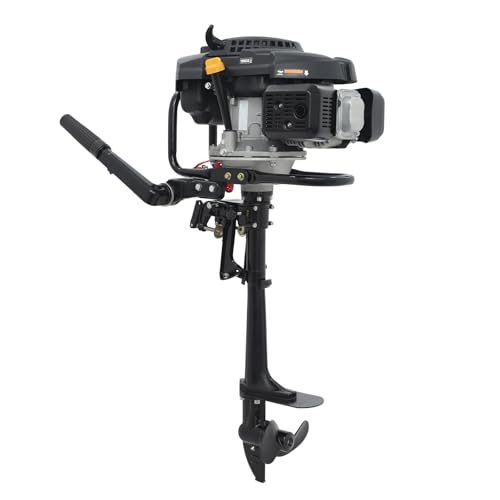
This FXEIPOL model delivers higher horsepower in a compact form for inflatable boats, canoes, and kayaks needing more thrust. It features a 224cc displacement for robust power, achieving speeds around 11.81 mph at peak performance. The engine uses a CDI ignition system and an aluminum build designed for durability. Tilt functionality and a 180-degree reverse engage provide flexible maneuvering in various water conditions. The engine is designed to be airplane-quiet for its class, making long day trips more comfortable.
Best for boats requiring more power without moving to a large, heavy engine. Choose this if you need stronger speed for demanding conditions, such as choppy waters or higher payloads. Caution: Heavier and more complex than the smallest 3–4 HP units, it may be overkill for ultra-light craft or lazy daily use.
Buying Guide: Key Considerations For Lightweight Outboard Motors
- Boat size and weight capacity: Match motor horsepower and weight to your craft. Smaller inflatables and kayaks benefit from 3–6 HP ranges and light-weight builds.
- Propulsion type: Gas-powered two-stroke motors offer high power-to-weight but require fuel mixing and more maintenance. Four-stroke engines provide smoother operation and fuel efficiency but can be heavier.
- Fuel efficiency and range: Lightweight models often emphasize economy. Check gallons per hour (or equivalent) and consider fuel availability for planned trips.
- Portability and storage: Look for compact dimensions and carry-friendly designs, such as easy-start systems and ergonomic handles.
- Mounting and compatibility: Ensure shaft length and mounting compatibility with your boat’s transom or clamp system. Short shafts suit smaller craft; long shafts fit deeper transoms.
- Cooling system: Air-cooled vs water-cooled designs affect engine longevity in extended use. Water cooling generally offers better thermals in longer trips.
- Starting mechanism and controls: Manual pull start vs CDI ignition and 360-degree steering influence ease of use, especially for beginners.
- Noise and emissions: Four-stroke engines typically run quieter and emit fewer pollutants, beneficial for sensitive water environments.
FAQ
- What power level is best for a small inflatable boat? — Generally 3–6 HP is suitable for small inflatables and kayaks, offering adequate speed without overloading the craft.
- Are four-stroke outboard motors better than two-stroke for beginners? — Yes, four-stroke engines tend to be quieter, cleaner, and easier to operate, though they may weigh more.
- Is electric trolling motor enough for a kayak? — For light paddling and calm water, a trolling motor with sufficient thrust (around 30–36 lb) can be effective and quiet.
- Should I choose a short shaft or long shaft motor? — Short shafts fit small transoms and high-mounted mounting points; long shafts are better for deeper transoms or boats with higher gunwales to prevent cavitation.
- What maintenance is needed for lightweight outboards? — Regular fuel/oil checks (for two-stroke), spark plug inspection, cooling system checks, and keeping exhaust ports clear are typical maintenance tasks.
- Do lightweight motors perform well in saltwater? — Yes, models with corrosion-resistant aluminum alloys and proper protective coatings perform better in saltwater environments.