Best Bus Bar for Boat Wiring: Top 5 Marine Power Distribution Blocks
Answering the question “which bus bar is best for boat wiring?” this guide highlights five robust 12V distribution blocks designed for marine, automotive, and solar setups. These units help organize wiring, reduce shorts, and improve reliability for compact power systems. The top picks are best for boaters seeking durable terminals, easy installation, and clear labeling. They’re suited for different load levels, from small navigation systems to larger house battery banks. The table below compares key specs to help you choose quickly.
| Product | Main Use | Max Current | Voltage Range | |
|---|---|---|---|---|
| RVBOATPAT Marine Bus Bar 12V 150A | Boat, automotive, solar | 150A | 12–48V DC | Includes positive and ground bars |
| RVBOATPAT 12V Bus Bar 150A (Second Model) | Boat, solar, automotive | 150A AC; 200A DC | Up to 48V DC / 300V AC | Dual bus design with bottom buckle |
| Joinfworld 12V 250A Bus Bar | Automotive, marine, solar | 250A | 12V; max 48V | 4 x 3/8″ studs for heavy connections |
| Avelis 12V 150A Block | Marine, boat, solar | 150A | Up to 48V | Includes 1/4″ studs and 12 terminals |
| RVMARINEPAT 12V 250A Bus Bar | Car, marine, solar | 250A | 48V DC | 6 x 5/16″ studs; round corner base |
RVBOATPAT Marine Bus Bar 12V 150A

Best for compact, low-to-moderate load marine wiring. This unit uses 12 stainless M4 terminal screws and a 1/4″ (M6) terminal stud to accommodate a tidy conduit of wires. It ships with positive and ground bars plus protective covers. The 150A rating is suitable for essential boat systems, lighting, and accessories. Caution: ensure the bus bar is mounted with adequate clearance to avoid heat buildup in tight spaces.
RVBOATPAT 12V Bus Bar 150A (Second Model)

This option is best for users needing a rugged AC-compatible capability and a secure bottom buckle to anchor the cover. It supports up to 150A on DC and 300V AC, which helps when alternating loads between charging circuits and accessories. Best for mid-sized boat electrical systems. If space is limited, verify the mounting footprint and cover clearance before purchasing.
Joinfworld 12V 250A Bus Bar

Best for larger electrical loads or setups that require multiple large connections. The 250A rating, four 3/8″ studs, and wide terminal range support heavy-gauge wiring for batteries, engines, and solar arrays. The nylon bottom and M10 mounting post help stabilize the unit. Choose this if your system involves higher current draws or you need a robust multi-station distribution hub. Limitation: heavier unit may require a stronger mounting surface.
Avelis Bus Bar 12V 150A
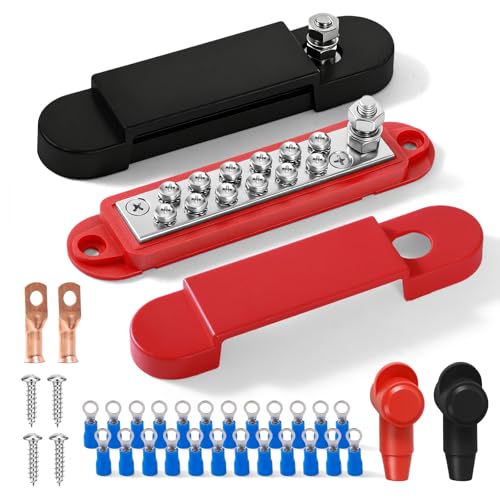
Best for users needing a compact, sturdy block with clear labeling and secure covers. The bus bar uses solid tinned copper with a rigid base, rated for 150A and up to 48V, making it suitable for inverters, chargers, and DC accessories. The unit includes 1/4″ studs and 12 terminals, with snap-lock covers to resist vibration. If you have limited mounting space, confirm the exact dimensions and wire routing clearance before buying.
RVMARINEPAT 12V 250A Bus Bar

Best for high-current marine or solar systems needing multiple large connections. This model uses six 5/16″ (M8) terminal studs and supports up to 250A at up to 48V DC. The distinctive round-corner base enhances stability, and the design provides open access for lug installation. Opt for this if your wiring includes several heavy gauge cables. Limitation: ensure the chosen mounting area accommodates the curved base and spacing to avoid interference with nearby components.
Buying Guide: Key Considerations
Which bus bar rating should you choose? Match max current to your system’s peak load plus a safety margin. For boats with modest lighting and accessories, 150A units are often sufficient. For larger systems, 250A options provide headroom. How many terminals do you need? Consider both the number of circuits and the size of your connectors. Larger studs enable thicker gauge cables and easier routing. Is the bus bar compatible with your voltages? Many marine blocks are designed for 12V systems but accept higher voltages; verify maximum voltage and enclosure protection. Is the cover secure? A locking or buckle design minimizes vibration and accidental contact. Check mounting space and clearance for wires and lugs.
Installation Tips
- Plan wire routing before mounting to minimize crossovers and heat buildup.
- Use appropriate gauge cables matched to the bus bar rating.
- Secure covers to prevent accidental contact during maintenance.
- Keep positive and negative blocks clearly separated to avoid shorts.
Frequently Asked Questions
- What is a bus bar used for in boats? It distributes power from a battery to multiple devices while simplifying wiring and reducing shorts.
- What amperage rating do I need? Choose based on your highest expected load with a safety margin; common boat options are 150A or 250A.
- Should I choose a single or dual bus bar? Dual blocks can separate positive and negative circuits or support a dedicated solar circuit.
- Are these bus bars marine-grade? Most are designed for marine and automotive environments, but verify corrosion protection and enclosure type.
- What maintenance is required? Check terminal screws periodically, re-tighten if needed, and inspect for corrosion or heat discoloration.
- Can I install these myself? Yes, with basic electrical wiring knowledge and proper safety precautions.