Best Group 24 Marine Battery Options for Boats and RVs
Find the right Group 24 marine battery to power your boat or RV with reliable starting power and long-lasting deep-cycle capability. This guide highlights five top options, explains who each is best for, and lists clear pros and limitations to help you choose quickly. Whether you need a dual-purpose battery for starting and trolling motor use or a true deep-cycle unit for auxiliary power, you’ll find practical, comparison-friendly details here.
| Product | Best For | Key Benefit |
|---|---|---|
| Interstate Batteries Marine/RV Battery 24M-AGM | All-around marine and RV use | 2x-3x longer life with dual-purpose AGM design |
| Mighty Max MM-G24M | Deep-cycle with solid starting power | 550 CCA and 700 CA for reliable starts |
| WEIZE Dual Purpose AGM Battery 24M | Budget-friendly dual-purpose | Quick charge capability and dual-purpose design |
| UPLUS BCI Group 24M | Compact, space-saving installations | High starting power in a compact size |
| LiFePO4 Options (SUPER EMPOWER 12V 100Ah & 12V 100Ah 2-Pack; GRNOE 12.8V 100Ah) | Long lifespan and expansion-ready systems | Thousands of cycles and scalable configurations |
Interstate Batteries Marine/RV Battery 24M-AGM

The Interstate 24M-AGM is a dual-purpose marine AGM battery designed to start a motor and power a trolling motor or accessories. Best for buyers who want a single, robust unit capable of both cranking and deep-cycle tasks. The key advantage is longer service life and quick recharge compared with conventional AGM packs. A potential limitation is that it may be heavier than some lighter-duty AGM options, requiring sturdy mounting and electrical connections.
Designed to withstand rugged conditions, this battery is marketed as “Interstate tough.” It delivers high-cranking power and deep-cycle endurance, suitable for fishing weekends and RV trips. Use this if you need a dependable, two-in-one power source that reduces weight and complexity by replacing two separate batteries in smaller vessels or dual-vehicle setups.
Mighty Max Battery MM-G24M 12V 90Ah Dual-Purpose
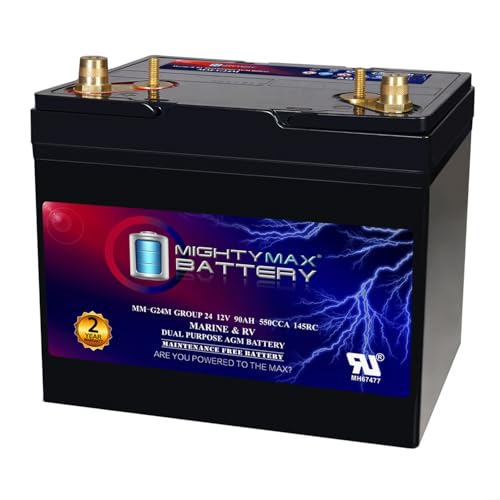
Mighty Max MM-G24M combines 90 Ah of deep-cycle capacity with dual-purpose starting capability. Best for boaters and RV users who want solid endurance for electronics, lights, and appliances while still maintaining reliable engine starts. Its 550 CCA and 700 MCA provide dependable performance across climates. A caveat is that true deep-cycle performance depends on proper charging and load management; over-discharging can shorten cycle life.
Selected for users needing a balanced power profile—strong starting power with steady deep-cycle support. Choose this if you value a reputable, compact unit that supports extended runs without frequent recharging.
WEIZE Dual Purpose AGM Battery 24M

WEIZE 24M is a dual-purpose AGM marine and RV battery with 90 Ah capacity and 550 CCA. It emphasizes quick charge capability and a design that aims to offer more cycle life than typical flooded options. Best for buyers who want a cost-effective option that still delivers reliable starts and decent deep-cycle support. A potential limitation is that WEIZE’s charging guidelines suggest careful attention to charging voltage and duration to maximize life.
This unit helps simplify systems by combining starting and deep-cycle duties in one battery. Choose this if you want straightforward installation with a budget-friendly approach and acceptable performance for moderate use.
UPLUS BCI Group 24M Dual Purpose Marine Battery

UPLUS 24M combines a compact footprint with strong starting power and dual-purpose capability. Best for vessels with tight battery compartments or RVs needing to save space while maintaining reliability for engines and onboard electronics. The 79 Ah rating and 550 CCA offer solid performance for many mid-size boats. A limitation to watch is that lighter weights may trade a bit of reserve capacity for space savings, so ensure fitment in your battery box before purchase.
Choose this if you need a space-saving option that still provides dependable starts and enough deep-cycle capability for cruising or weekend use.
SUPER EMPOWER LiFePO4 12V 100Ah (Two-Pack)

This LiFePO4 option is designed for deep-cycle use with a robust BMS that protects against overcharge, over-discharge, and temperature extremes. Best for long-term energy storage, auxiliary power, trolling motors, solar systems, and RV power banks. It is not intended for engine starting. The long cycle life—up to 15,000 cycles at 60% DOD—makes it appealing for users seeking durability and expansion capabilities. A limitation is that LiFePO4 cells have different charging regimes than lead-acid batteries and require compatible charging equipment.
Choose this when longevity, weight reduction, and scalable energy storage are your primary goals. It’s especially suitable for off-grid setups or extended boating trips where battery maintenance access is limited.
SUPER EMPOWER LiFePO4 12V 100Ah 2-Pack

This two-pack option adds redundancy for larger systems or expanding storage. Best for users who want modular energy storage and easy expansion. The same BMS protections and long cycle life apply, making it ideal for marine or RV configurations that require dependable, scalable power. A consideration is the higher upfront cost compared with lead-acid equivalents, though total lifecycle cost may be favorable due to longevity.
GRNOE Group 24 LiFePO4 Battery

The GRNOE LiFePO4 battery offers modular expansion with a scalable 4S4P design and up to 15,000 cycles. Best for long-term RV or marine energy storage projects where multiple modules can be added to reach higher capacities. It features a 100A BMS and robust protection against environmental challenges like salt spray. A limitation is the need for compatible BMS and charging systems to manage multiple modules safely.
Choose this if you plan to grow your power system or require a high-cycle, lightweight solution for critical life-support electronics and trolling motors in challenging environments.
Buying Guide: Key Considerations for Group 24 Marine Batteries
What is your primary need: starting power, deep-cycle capacity, or both? If you require robust starting performance with reasonable cycling, dual-purpose AGM options like the Interstate, Mighty Max, or WEIZe models are strong candidates. For long-term energy storage, LiFePO4 options from SUPER EMPOWER or GRNOE offer superior cycle life and lighter weight, but demand appropriate charging equipment.
Battery type matters: AGM is maintenance-free and spill-proof, while LiFePO4 provides faster charging, longer life, and lighter weight—at a higher upfront cost. Make sure your charger is compatible with the chosen chemistry and that your boat or RV battery compartment can physically accommodate the unit’s dimensions and weight.
Group size compatibility is essential. The Group 24M designation targets a common form factor; always measure your existing battery tray, terminals, and clearance. Consider space-saving units like the UPLUS model if you need a compact footprint, but verify that it does not compromise required capacity.
Cycle life and environmental resilience are practical factors. If you frequently discharge to low levels or operate in salty, humid conditions, look for batteries with reinforced plates, corrosion resistance, and robust BMS protections. For off-grid or extended trips, LiFePO4 options can offer compelling life-cycle benefits and expandability.
Frequently Asked Questions
- What is a Group 24 battery?
Ans: It is a standard battery size with specific dimensions and terminal placements used in marine and RV applications. - What’s the difference between AGM and LiFePO4?
Ans: AGM is lead-based and maintenance-free with good crash resistance; LiFePO4 is lighter, longer-lasting, and supports many more cycles but requires compatible charging. - What should I consider when choosing a dual-purpose battery?
Ans: Look for a balance of CCA/CA for starting power and Ah for deep-cycle needs, along with compatibility with your charger and space constraints. - Can I mix battery chemistries in the same system?
Ans: It is generally not recommended to mix chemistries due to differing charging profiles and cycle life. - Do LiFePO4 batteries require a different charger?
Ans: Yes. Use a charger compatible with LiFePO4 chemistry and follow recommended voltage and current guidelines. - Are there space considerations for Group 24 batteries?
Ans: Yes. Measure the tray height, width, length, and terminal positions to ensure a proper fit before purchase.