Best 400 Watt Marine Amps for Boats
Answering the demand for rugged, waterproof, high-power marine amplification, these 400-watt options suit saltwater and splash-prone setups. The best buyers are boaters needing reliable, compact power for multiple speakers or a single sub, and installers seeking straightforward wiring in tight spaces. Below are five top picks, each with a clear strength and a practical limitation to consider before buying.
| Product | Best For | Why It Stands Out |
|---|---|---|
| Kenwood KAC-M1814 | 4-channel system on a tight budget | Compact, bridgeable with 2-ohm load support |
| Skar Audio RP-800.1DM | Powerful subwoofer drive in a marine build | 800W RMS monoblock with marine coating |
| Pyle PLMRA400 | Four-channel marine sound for multiple speakers | Dual MOSFET power supply; robust protection |
| Pyle PLMRMP3A | Compact 4-channel with RCA/MP3 compatibility | Waterproof design and remote volume control |
| Rockford Fosgate TM400X4ad | Marine-grade power in a compact chassis | Constant Power class-AD tech; durable Element Ready |
Kenwood KAC-M1814 4-Channel Marine Amplifier

The Kenwood KAC-M1814 is a compact 4-channel digital marine amplifier designed for boats with limited space. It supports 2-ohm loads and features a 50Hz-200Hz high-pass filter for speaker protection and clearer mid‑bass reproduction. This model is best for multi-speaker installations where space is at a premium and users need bridgeable channels. A potential limitation is its max power ceiling, which may be lower than dedicated subwoofers in larger marine setups. Ideal for small to medium boat cabins or bow speakers paired with a small sub.
Skar Audio RP-800.1DM 800W Marine Mono Block
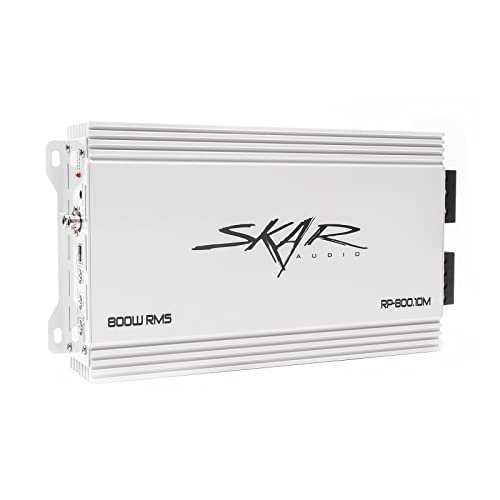
The Skar RP-800.1DM is a marine-rated, Class D monoblock amplifier delivering 800 watts RMS at 1 ohm. It’s designed for a dedicated subwoofer, with full waterproof coating on the circuit board and rust-proof painting on the case for corrosion resistance. This is a strong pick for bass-heavy marine systems where a single amp powers one sub. The trade-off is that it is a mono block, so it won’t directly power multiple coaxials without extra channels or a second amp.
Pyle PLMRMP3A Hydra Marine 400W 4-Channel

The Pyle PLMRMP3A is a 4-channel marine amplifier designed for versatile installations. It includes RCA inputs and a 3.5mm-to-RCA adapter for easier connections to devices that lack RCA outputs. A notable advantage is the included remote volume control, which helps in tuning from a seat or helm. A potential drawback is its general-purpose protection system, which may be less robust in extreme saltwater environments; ensure proper mounting and sealing during installation.
Pyle PLMRA200 2-Channel Elite Marine Amplifier

The PLMRA200 is a compact 2-channel marine amplifier that powers two speakers with clear stereo. It includes RCA inputs and a heavy-duty heatsink for thermal management, plus LED indicators for easy status checks. This model suits installations where two higher‑efficiency channels are enough, or when a small sub channel is added via another amp. Best for two-speaker zones on smaller boats; avoid if you need four full-range channels from a single chassis.
Rockford Fosgate TM400X4ad 4-Channel Power Marine

The Rockford Fosgate TM400X4ad offers 400 watts across four channels with class-AD topology and Element Ready protection. Its compact footprint and marine-grade durability are designed for motorsport and boat use. This amp is best for mid-sized boats needing balanced power across multiple speakers. A possible limitation is its advanced technology requiring careful setup for optimal performance, particularly in variable marine power conditions.
Taramp’s TS 400×4 2 Ohms White
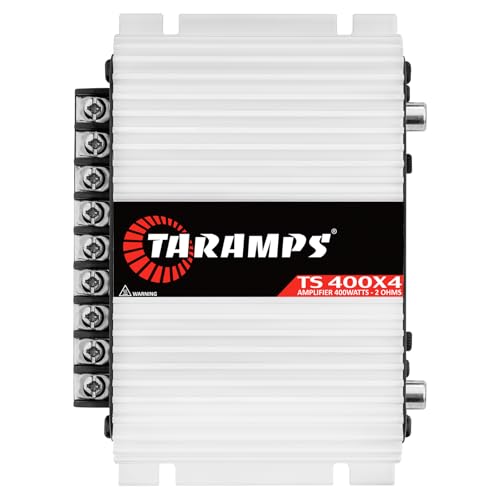
The Taramp’s TS 400×4 is a versatile multichannel amplifier delivering 400W RMS across four channels, with 2-ohm capability and high/low pass crossover options. It includes high-level inputs and RCA, allowing flexible integration with various head units. Choose this if you need bridged possibilities and multi-channel power in a compact marine-friendly package. A caution is that Taramp’s units can vary in performance across production lots, so verify wiring and enclosure compatibility during install.
Buying Guide
- Power needs: Determine whether you want four channels for multiple speakers or a single channel for a sub. Mono blocks like the RP-800.1DM are ideal for subs, while four-channel amps suit cabin or deck speaker arrays.
- Marine protection: Look for waterproofing, corrosion resistance, and salt spray protection. Marine-grade enclosures and conformal coating extend life in harsh environments.
- Impedance compatibility: Confirm speaker impedance your system uses (2 ohm vs 4 ohm) and ensure the amp can handle it without overheating or distortion.
- Input options: RCA inputs are common, but some models support high-level inputs for factory head units. Consider remote controls or gain adjustments for easier tuning on the water.
- Cooling and protection: Heatsinks, thermal protection, and soft-turn-on features protect both amp and electrical systems from surges and shorts.
- Physical fit: Measure mounting space on your boat and consider a compact chassis if space is limited. Marine amplifiers often have rugged mounting footprints but vary in depth and width.
FAQ
- What is the advantage of a marine-rated amplifier?
Marine-rated designs resist corrosion, moisture, and salt exposure, extending operational life in boats and harsh environments.
- Is 400 watts enough for a typical boat cabin setup?
It can be sufficient for a modest system with a pair of speakers or a small sub; larger cabins or more listeners may benefit from more channels or higher watts per channel.
- Should I choose a 4-channel or a mono-block for a boat sub?
For a sub only, a mono-block like the RP-800.1DM is efficient; for multi-speaker setups, a 4-channel amp provides more flexibility.
- What mounting considerations are important?
Ensure proper airflow, avoid direct sun exposure, and secure wiring to prevent movement during boating conditions.
- Are remote volume controls useful on boats?
Yes, they allow quick adjustments from the helm or seating areas without reaching the amplifier itself.
- How do I protect my amp from saltwater damage?
Use marine-grade enclosures, seal connectors properly, and clean the installation area to minimize corrosion risk.