Best Trickle Chargers for Boats: Reliable Onboard Battery Maintenance
When keeping boat batteries healthy, a high-quality trickle charger is essential. This guide highlights practical options for American boaters seeking reliable maintenance and desulfation features. The featured products are well-suited for people who want to keep marine, deep-cycle, and starting batteries ready for season after season. Whether you’re preparing for winter layup, summer cruising, or frequent short outings, these chargers help prevent sulfation, extend battery life, and provide automatic maintenance without constant supervision.
Top buyer profiles: a casual weekend boater will value simple maintenance and safety features; a dedicated angler or cruiser will want multi-bank capability and robust environmental resistance; those with limited space inside a boat hull will prefer compact, mountable designs. The following products are chosen for their clear charging modes, temperature compensation, and compatibility with common lead-acid and LiFePO4 batteries used on boats. A quick summary table follows the product listings.
Buying Guide Snapshot
- Battery type compatibility: Lead-acid (AGM, Gel, Flooded) and LiFePO4 options are common in boats. Choose a charger that supports your battery chemistry.
- Number of banks: Single-bank units work for one battery; multi-bank chargers can maintain several batteries in parallel.
- Temperature compensation: Ensures charging adapts to ambient temperature, preventing overcharge in heat and undercharge in cold.
- Mounting and installation: Onboard or direct-mount options provide a neat, reliable setup for engine compartments or hard-to-reach panels.
- Protection features: Look for overcharge protection, corrosion resistance, and battery maintenance functions like desulfation.
| Product | Type | Banks / Amps | Best For | Key Benefit |
|---|---|---|---|---|
| NoCo GENIUS1 | Smart Battery Charger | 1 Bank | Single-battery boats, compact spaces | Trickle and desulfate with temperature compensation |
| NoCo GEN5X2 | Two-Bank Onboard Charger | 2 Banks | Boats with two batteries or multiple circuits | Independent bank charging with multiple modes |
| NoCo GEN2D | Direct-Mount Charger | 1 Bank | Under-hood or tight spaces | Direct mount, maintains lead-acid specifics |
| NoCo GENIUS2 | Smart Battery Charger | 1 Bank | General marine use with LiFePO4 support | Force Mode for zero-volt recovery |
| NoCo GENIUS5 | Smart Battery Charger | 1 Bank | Medium to larger boats needing more power | Higher power, robust all-in-one charging |
NOCO GENIUS1: 1A 6V/12V Smart Battery Charger

Best for: Boatowners with a single battery or limited space who want automatic maintenance in a compact form. This unit operates as a battery charger, maintainer, trickle charger, and desulfator, with temperature compensation to prevent overcharging in heat and undercharging in cold. It supports 6V and 12V lead-acid types and LiFePO4 batteries.
Why selected: Its small footprint and multi-function approach suit smaller boats or compartments where space matters. The integrated thermal sensor keeps charging aligned with ambient temperature, protecting battery health over long storage periods.
Caution: It is a single-bank solution, so if you manage multiple batteries, you’ll need a separate unit or a multi-bank model.
NOCO Genius GEN5X2: 2-Bank, 10A Onboard Battery Charger
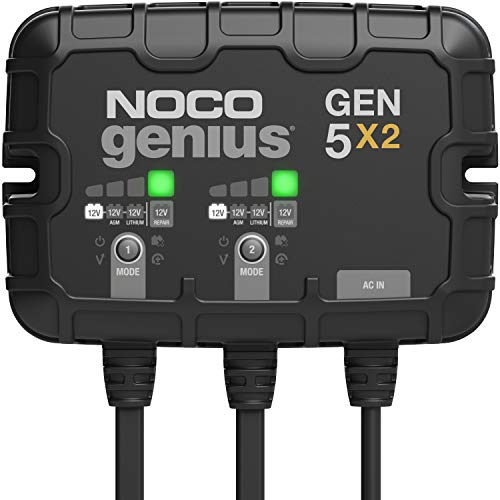
Best for: Boats with two batteries or separate circuits requiring independent charging. The two banks deliver up to 5A per bank and support multiple modes for lead-acid and lithium batteries, including a dedicated repair mode.
Why selected: It provides robust multi-bank charging in a compact package, making it ideal for dual-battery setups common on mid-sized boats or vessels with separate starting and house batteries.
Caution: The unit is more feature-rich, which may be overkill for single-battery applications or very small inflatables.
NOCO GEN2D: 2A 12V Direct-Mount Onboard Battery Charger
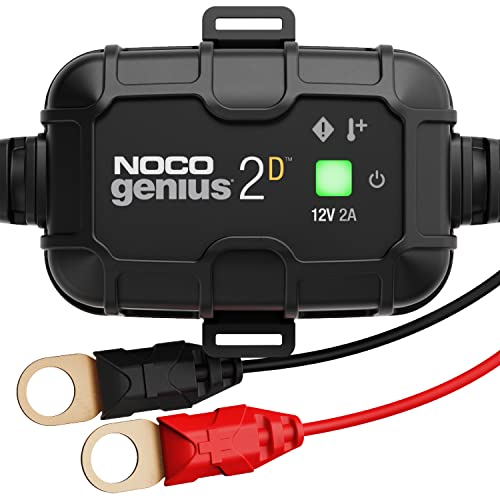
Best for: Boats with space-constrained engine wells or battery compartments where a direct-mount charger simplifies installation. This unit focuses on 12V lead-acid batteries, including flooded and maintenance-free types, with a design that attaches near the battery.
Why selected: Its direct-mount approach reduces wiring clutter and protects the charger from vibration, making it suitable for closely fitted bilge or engine bays.
Caution: It’s a 1-bank solution, so it isn’t ideal if you need to service multiple batteries from one unit.
NOCO GENIUS5: 5A 6V/12V Smart Battery Charger
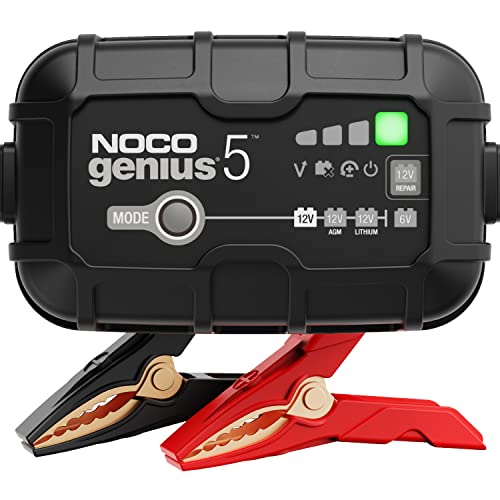
Best for: Boats that need more charging oomph in a single-bank format. The GENIUS5 delivers higher current for faster maintenance while maintaining compatibility with both lead-acid and lithium batteries.
Why selected: It balances power and compact design, making it a strong option for mid-size boats with a single-chassis charging requirement and a need for efficient maintenance across seasons.
Caution: While powerful, this is still a single-bank device; consider multi-bank options if you manage several batteries independently.
NOCO GENIUS2X2: 4A 2-Bank Smart Battery Charger

Best for: Boats that must charge two batteries simultaneously, such as separate starting and house batteries, or dual deep-cycle configurations. It provides 4A total across two independent banks and supports a broad range of battery chemistries.
Why selected: The two-bank design is ideal for vessels with two critical power systems, enabling balanced charging without swapping between banks.
Caution: More complex wiring than single-bank units; ensure proper mounting and disconnect protocols during installation.
Buying Guide: Practical Considerations And Comparisons
Choosing the right trickle charger for a boat comes down to battery type, charging needs, and installation constraints. Here are key questions and answers to help you decide.
What battery chemistry does your boat use?
Most boats rely on lead-acid variants (AGM, Gel, Flooded) and increasingly LiFePO4. Verify compatibility for each charger. LiFePO4 support often includes different charging profiles and voltages.
How many batteries require maintenance?
Single-bank chargers are simplest and best for one critical battery. Multi-bank units are better for boats with a separate starting battery and a house bank or two deep-cycle batteries.
Is space a constraint?
Direct-mount or compact onboard models suit tight engine compartments, while wall-mountable or smaller cases fit alcoves and panels.
Is temperature compensation important?
Yes. Temperature-based adjustments prevent overcharging in heat and undercharging in cold, extending battery life and reliability during storage and seasonal use.
What about dead batteries or low-voltage recovery?
Some models include a Force Mode or recovery feature to bring deeply discharged batteries back to life. If you regularly encounter near-zero voltage, this can be critical.
Installation and safety considerations
Install in a dry, ventilated area away from fuel sources. Follow the mounting instructions for a secure fit, and verify polarity and wiring before powered connection.
Frequently Asked Questions
- Can I use a trickle charger on LiFePO4 batteries? Yes, if the charger explicitly supports LiFePO4 chemistry and uses proper voltage settings for this battery type.
- What is a desulfator, and do I need one? A desulfator helps reduce sulfation on lead-acid batteries, potentially extending life. It is optional but beneficial for older or frequently discharged batteries.
- How many amps do I need for boat charging? For a single battery, 1-5 amps is common; for two batteries, 5-10 amps total (2.5-5 amps per bank) covers typical maintenance needs.
- Is a temperature sensor essential? It improves performance and longevity by adjusting charging to ambient conditions, especially in variable climates on boats.
- Can these chargers run continuously? Yes, most marine chargers are designed for long-term maintenance, but follow manufacturer guidance for your specific model and battery type.
- Do these units support solar charging integration? Some models are standalone or compatible with complementary solar charging setups; check compatibility with your system.