Best Boat Battery Terminal Blocks for Wiring Reliability
Answering the common need for secure, high-current connections on boats, these terminal blocks and bus bars are designed to organize and protect 12V power distribution. Ideal for boaters who want neat wiring, corrosion resistance, and easy expansion. This guide highlights five top options and who they’re best for, with practical considerations to help you choose.
| Product | Brand | Best For |
|---|---|---|
| RVBOATPAT Power Distribution Block 12V 150A | RVBOATPAT | Smaller 12V boats and light-duty solar wiring |
| WUPP 12 Volt Fuse Block | WUPP | Organized circuits with fuse protection, damp-proof |
| Seamaka 250A 12V Bus Bar | Seamaka | Higher current needs, robust construction |
| Joinfworld 12V 250A Bus Bar | Joinfworld | Large terminals and wide wire compatibility |
| Blue Sea Systems 2340 BusBar | Blue Sea Systems | Directly on battery terminals, reliable marine option |
RVBOATPAT Power Distribution Block 12V 150A

Best for compact boats and basic 12V systems requiring a simple positive and negative distribution. Features heavy-duty 150A capacity, 12 stainless M4 terminal screws, and a 1/4″ (M6) terminal stud for easier routing of wires. This kit includes separate positive and ground bus bars, plus covers and lugs for quick installation. Choose this if you want a straightforward, durable bus bar setup with minimal space requirements and easy wiring organization.
Caution: This unit is rated for up to 48V DC and 150A continuous current; high ambient temperatures can reduce usable current. Ensure wiring gauge and fuse protection match your load.
WUPP 12 Volt Fuse Block
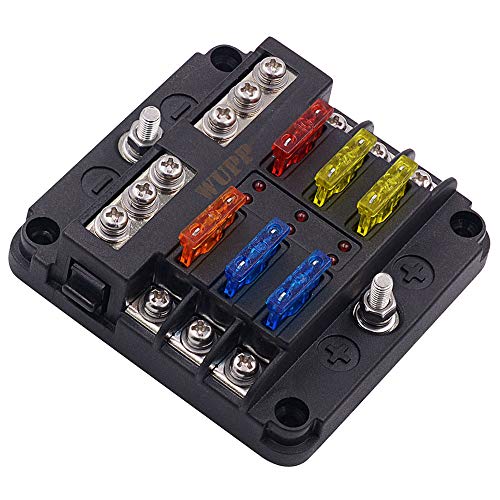
Better for organized circuits with built-in protection. This six-circuit fuse block features LED indicators for quick fault finding and a damp-proof housing. It’s best for boaters who want a neat wiring system with dedicated fuses and a separate ground path. Note that voltage across the circuit can remain present due to lighting within the block, even when fuses are not actively conducting.
Seamaka 250A 12V Bus Bar

Best for higher current draws in marine and automotive wiring. The brass bottom with 304 stainless steel terminals, nylon protective base, and thicker 3mm copper bar support up to 250A continuous. It accepts 180 installations from both sides, making it flexible for crowded engine compartments. Choose this for heavy-duty projects or when you anticipate larger gauge wires and more connections.
Caution: Brass and stainless components require proper corrosion protection in harsh marine environments. Regular inspection helps maintain conductivity.
Joinfworld Power Distribution Block Bus Bar 12V 250A

Best for wide wire compatibility and robust stud connections. It includes 4 x 5/16″ (M8) studs and 3 x #8 screw terminals on a 12V 250A rating. The thicker copper bus bar and nylon base provide strong mechanical stability and safer insulation. Ideal when you need a high-current junction with versatile terminal sizing. Limitation: ensure your wiring connectors fit the larger studs if space is constrained.
Blue Sea Systems 2340 Battery Terminal Mount BusBars

Best for direct installation on battery terminals with easy positive and negative busbars. It supports up to 32V DC and 100A continuous, using tin-plated copper for high conductivity. It’s a straightforward Marine-grade option when you want to add busbars without relocating components. Caution: not rated for very high current draws beyond 100A continuous.
Buying Guide
How to choose the right boat battery terminal block or bus bar
- Current rating: Match the continuous current to your load and future expansion. If you anticipate more devices, opt for 250A-rated units.
- Voltage compatibility: Most marine 12V systems are fine with 32V limits; verify that the block supports your peak voltage and any solar charging needs.
- Terminal size and type: Ensure studs and screw terminals fit your cables and lugs. Larger studs support heavier gauge wires.
- Corrosion resistance: Marine environments demand stainless steel, brass protection, and corrosion-resistant coatings.
- Insulation and safety: Look for nylon bases or protective covers to reduce short circuits and accidental contact.
- Ease of wiring: Some blocks include built-in fuses, LED indicators, or clear labeling to simplify troubleshooting.
- Size and mounting: Check available space in the battery compartment or along the hull. Consider side or dual-stud configurations for layout flexibility.
Frequently Asked Questions
- What is a boat battery terminal block used for?
It serves as a centralized connection point to distribute power from the battery to multiple circuits while keeping wiring organized and protected.
- Why choose a 250A bus bar over a 150A model?
A 250A bus bar accommodates higher current loads and future expansion without upgrading hardware.
- Are fuse blocks always required with bus bars?
Fuse blocks offer circuit protection. For high-current setups, pairing a bus bar with appropriate fuses improves safety and fault isolation.
- Can I install these blocks in an engine compartment?
Yes, but ensure adequate space, ventilation, and correct insulation to prevent heat buildup and short circuits.
- What maintenance do these blocks need?
Inspect connections for corrosion, clean any oxidation, and verify lug tightness periodically to maintain conductivity.
- Do these blocks fit both positive and negative connections?
Many products include separate positive and negative bus bars, while some use single-stud or dual-stud configurations for multiple wiring options.