Best Boat Fuel Tank Sender Options for Accurate Fuel Gauges
Looking for a reliable boat fuel tank sender to read your tank level accurately? This guide features five well-matched options designed for marine use, RVs, cars, and trucks. Each product aligns with common tank depths and standard 33-240 ohm gauges, helping you pick the right sender for your setup. The buyers below are best suited for: hobby boaters needing simple replacements, DIY installers, and anyone upgrading to a sturdier, corrosion-resistant unit.
| Product | Depth Range | Ohms Range |
|---|---|---|
| SEACHOICE 15461 Marine 6-12″ Kit | 6 to 12 inches | 33-240 ohms |
| Moeller 035722-10 Fuel Tank Sending Unit | 6 to 12 inches | 33-240 ohms |
| RUPSE Fuel Sender Unit 6″ (150mm) | 6 inches | 33-240 ohms |
| OXCANO 7″ (180mm) Fuel Sending Unit | 7 inches | 33-240 ohms |
| MAIMEIMI 240-33 Ohms Fuel Sending Unit | Adjustable up to ~27 inches (typical) | 240-33 ohms |
SEACHOICE 15461 Marine Fuel Sending Kit

Best for: Boats with a 6–12 inch tank depth needing a dedicated electric sending unit for reliable readings. This unit is designed to deliver accurate fuel level information for both gas and diesel tanks. It uses a standard 33-240 ohm range compatible with many dash gauges.
- Designed for 6 to 12 inch tanks
- Suitable for gas or diesel applications
- Plug-and-play potential with existing gauge systems
Caution: Verify the depth of your tank before installation to ensure proper float arm length. The kit does not specify anti-corrosion coatings beyond standard features.
Moeller 035722-10 Fuel Tank Sending Unit

Best for: Marine installations needing industry-standard calibration with corrosion-resistant internal components. The unit is calibrated to 33-240 ohms and pairs with dash-mounted gauges, making it a solid replacement for Moeller-equipped boats.
- Calibrated to 33-240 ohms
- Internal components resistant to rust and corrosion
- Requires dash gauge compatibility
Limitation: Some installations may require adapter fittings if the original mounting pattern differs from the SAE 5-hole standard.
RUPSE Fuel Sender Unit 6.8″ (175mm)
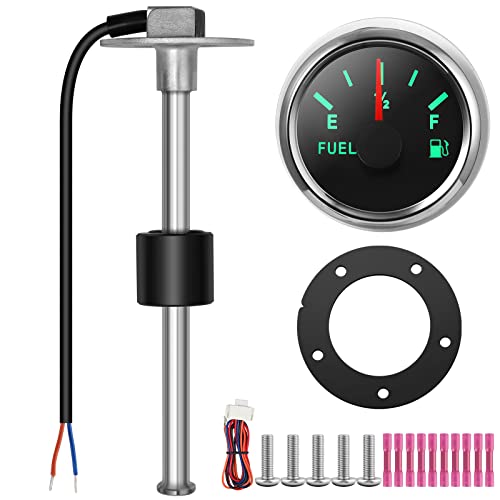
Best for: Boats and RVs that require a high-precision, stainless steel fuel sender with a long service life and clear backlit gauge readability. The unit uses corrosion-resistant materials and a robust reed switch design for stability.
- Stainless steel exterior
- 8 adjustable backlight colors for easy reading
- IP67 waterproof and anti-fog curved glass
Limitation: Installation requires SAE 5-hole mounting and compatible wiring; verify compatibility with existing dash wiring before purchase.
Rupse Fuel Sender Unit 6″ (150mm)

Best for: Systems needing compact, reliable measurement with corrosion-resistant steel and a clear backlit gauge readout. It matches common 33-240 ohm gauges and is simple to install with standard mounting hardware.
- Corrosion-resistant stainless steel
- 8-backlight color options
- SAE 5-hole mounting
Caution: Ensure the float arm length aligns with your tank depth to avoid incorrect readings.
OXCANO 7″ Marine Fuel Sending Unit

Best for: Extended-tank setups where a larger float arm improves accuracy and durability. The design emphasizes fewer moving parts and greater service life, making it a solid choice for larger boats or heavy-use environments.
- Wide usage across vehicles and marine craft
- Doughnut float design for durability
- No required tank adjustments for operation
Limitation: The 7-inch depth may not fit shallower tanks; confirm tank depth before ordering.
Buying Guide: How to Choose the Right Boat Fuel Sender
- What tank depth does your boat have? Choose a sender within the specified depth range to ensure accurate readings and proper float operation.
- Is your tank standard or irregular? If your installation uses nonstandard mounting, verify the mounting pattern (SAE 5-hole or alternatives) and gauge compatibility.
- What is your gauge ohm range? Most marine gauges use 33-240 ohms; confirm your dash gauge spec to avoid mismatches.
- Material and durability: Stainless steel bodies resist corrosion in saltwater and fresh water alike; consider IP rating if exposure to moisture is high.
- Electrical compatibility: Ensure the unit’s wiring terminals and gasket materials match your boat’s wiring harness and fuel compatibility needs.
- Readability: If you rely on night-time readings, prefer units with backlit gauges or clear display features.
- Installation effort: Some units require simple cutting or arm-length adjustments; others may need professional installation.
Frequently Asked Questions
- What does the ohm range mean for a fuel sender?
It indicates the electrical resistance of the sender as the tank fills and empties; matching this to your gauge is essential for accurate readings. - Can I mix sending units from different brands?
It’s not recommended; mismatches in mounting patterns and ohm ranges can cause incorrect readings or fit issues. - What is the advantage of a stainless steel sender?
Stainless steel resists corrosion, which extends the unit’s life in saltwater environments. - Will these senders work with any gauge?
They are typically designed for 33-240 ohm gauges; always verify your gauge’s ohm range before purchase. - Do all senders require cutting or modification?
Some models offer adjustable float arms or flexible mounting; others may require more extensive modification to fit your tank. - How do I verify compatibility with my tank depth?
Measure your tank depth where the sender will sit and compare with the unit’s advertised depth range to ensure proper operation.