Best Trolling Motor Terminal Block Solutions for Marine Power Distribution
If you’re wiring a trolling motor setup, a sturdy terminal block is essential for reliable, safe power distribution. This guide highlights five well-suited terminal blocks for 12V marine systems, explaining who each product is best for and why it stands out. Whether you’re outfitting a small bass boat or a larger craft with auxiliary power, these selections help organize connections, improve conductivity, and reduce short-circuit risks.
Summary of recommended products
| Product | Best For | Key Benefit |
|---|---|---|
| RECOIL S1P-38 Busbar | Small to mid-size trolling setups | Separate 3/8″ studs with protected cover |
| RED WOLF 12V 100A Block | Medium systems with mixed DC loads | High current capacity, corrosion-resistant |
| Joinfworld 12V 250A Pair | Dual-pole docking or multi-branch wiring | Distinct red/black blocks for polarity clarity |
| RECOIL S2PG 2-in-1 Block | Split positive/negative with divider | Compact dual-stud design with divider |
| Joinfworld 4x 5/16″ Block | Higher amperage and wider wiring | Four studs, adjustable junction options |
RECOIL S1P-38 Busbar Single 3/8” Studs

The S1P-38 is a compact busbar with 3/8″ stainless steel studs designed for 48V DC systems and up to 250A continuous. It includes eight-gauge ring terminals and stainless screws, with a reinforced polycarbonate cover to prevent accidental shorts. Best for: small to mid-size trolling setups where you need reliable single-stud connections and a protective enclosure. Caution: maximum voltage is 48V DC; ensure your system remains within this limit to avoid insulation issues.
RED WOLF 12V 100A Block

This dual-stud busbar uses 1/4″ (M6) studs and pure copper conductors, offering solid conductivity and corrosion resistance in 12–48V DC applications. It supports up to 100A and is reinforced with a flame-retardant nylon base. Best for: mid-range trolling motors with multiple branches and a need for a tidy layout. Limitations: continuous current may reduce with higher temperatures and humidity, so plan for cooling in hot conditions.
Joinfworld 12V 250A Pair

Includes a red and a black power distribution block with 3/8″ studs, rated up to 250A and suitable for up to 48V. The dual-block setup helps separate positive and negative connections for clear wiring. Best for: boaters needing polarity distinction and a straightforward two-block solution. Caution: ensure secure torque on larger terminals to maintain good contact and prevent loosening on rough waters.
Joinfworld Dual 5/16″ Bus Bar

Rated for 200A continuous in 12V systems, this dual-stud block uses M8 studs and a removable junction block for customization. Best for: users who need a moderate high-current distribution with the option to remove the junction block. Limitation: some setups may require additional brackets for secure mounting on rough seas.
RED WOLF 12V 150A Block
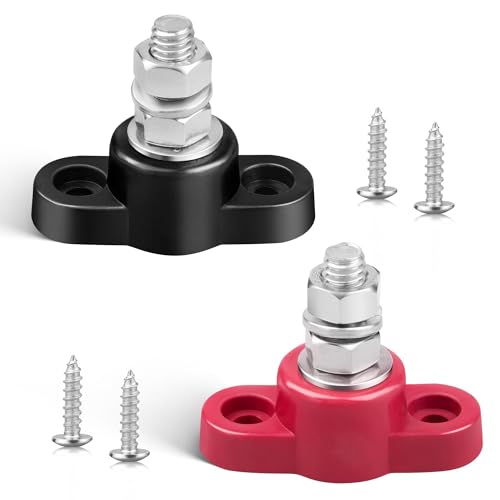
This 5/16″ (M8) dual-stud busbar supports up to 150A in 12–48V DC systems. It uses 316 stainless steel nuts and copper studs for durability and conductivity, with a flame-retardant nylon base. Best for: larger trolling setups where more branches are needed while keeping a compact footprint. Caution: exact continuous current will drop with humidity and temperature, so plan margin for variable marine conditions.
Joinfworld 4x 5/16″ Studs Block

This 4-stud design offers flexibility with four 5/16″ (M8) studs and additional #8 screw terminals. Rated for up to 250A in 12V circuits and up to 48V, it suits contemporary boats requiring robust distribution with multiple input wires. Best for: higher-current trolling setups needing multiple direct connections. Limitation: mounting hardware may be needed to secure the block on some consoles.
Buying Guide: Key Considerations for Trolling Motor Terminal Blocks
What voltage range do you operate in? Most marine systems run at 12–48V DC. Choose a block rated at or above your system’s voltage and current to avoid overheating or premature wear.
How many connections do you need? If you plan several branches, look for dual or multi-stud designs or blocks with removable junctions for clean wiring.
Material and durability matter. Copper conductors with stainless steel studs resist corrosion in saltwater environments. A reinforced or flame-retardant base adds safety.
Protection and enclosure. A polycarbonate cover or shield helps prevent accidental shorts from loose wires, splashes, or debris aboard.
Mounting and space. Measure the available space on your vessel’s console or battery tray. Some blocks include mounting feet or compact profiles for tight spaces.
Ease of use. Look for blocks with clearly labeled positive and negative terminals, and consider whether you need polarity separation or integrated junction blocks for tidy layouts.
FAQ
- What is a trolling motor terminal block used for? It distributes power from the battery to the trolling motor and any auxiliary loads while keeping connections organized and protected.
- What voltage is typical for trolling motor blocks? Most operate in 12–48V DC ranges; choose a block rated for at least your system’s voltage.
- Should I choose single-stud or dual-stud designs? Single-stud designs are compact for fewer connections; dual-stud designs simplify multiple branches and polarity separation.
- Are metal blocks better than plastic? Metal blocks with copper conductors offer better conductivity and durability, especially in saltwater environments, but ensure proper insulation.
- Can I mix different brands on the same boat? Yes, as long as the voltage and current ratings match and mounting considerations are satisfied. Ensure secure, corrosion-resistant hardware.
- What maintenance is recommended? Periodically inspect for corrosion, loose screws, or damaged wiring. Clean terminals and re-tighten connections as needed.