Best Boat Solar Panel Kit Options for Marine Enthusiasts
Answer: A boat solar panel kit is ideal for boaters who want reliable 12V charging on the water with minimal maintenance. The top picks below cover compact trickle charging, robust waterproofing, and higher-wower kits for longer trips. This guide highlights who each kit is best for and why, plus practical buying considerations for marine use. The table summarizes five suitable options to compare at a glance.
| Product | Best For | ||
|---|---|---|---|
| SOLPERK Solar Panel Kit 20W | Small boats and personal craft | 20W | Includes smart MPPT controller; waterproof and rustproof. |
| Voltset 12V Solar Battery Charger 20W | Compact boats and trailers needing steady trickle | 20W | Smart MPPT with 12V battery versatility. |
| Renogy 200W Starter Kit | Boats, RVs, and larger off-grid setups | 200W | Two 100W panels with PWM controller. |
| SOLPERK 50W Solar Panel Kit | Mid-size boats and lakeside trailers | 50W | IP65 controller; durable frame and glass. |
| SUNER POWER 50W Pro Kit | Reliable marine charging on mid-range boats | 50W | Ultra-Smart MPPT with automatic maintenance. |
Note: Each product here is selected for marine-friendly features such as waterproofing, corrosion resistance, and practical charging profiles for 12V systems. The table helps you compare general suitability, power, and durability at a glance.
SOLPERK Solar Panel Kit 20W for Boats and More
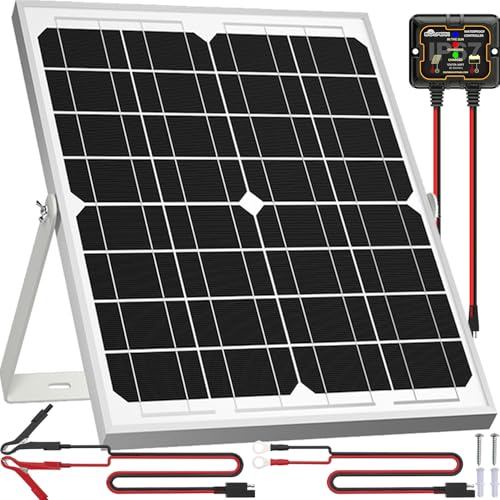
The SOLPERK 20W kit uses monocrystalline A+ cells with an efficiency range noted at 21%-30%. It is designed to charge 12V batteries such as LiFePO4, AGM, GEL, and more. A low-iron tempered glass surface and corrosion-resistant aluminum frame provide waterproofing and long life, withstanding wind and weather up to 2400Pa and 5400Pa snow load. The included smart MPPT controller claims an 8A rating and a 20%-30% higher charging efficiency than some competitors. This kit is best for small boats, trailers, and personal craft where compact size and automatic maintenance are priorities. Caution: larger boats may outgrow its 20W output, particularly in shaded conditions.
Voltset 12V Solar Battery Charger 20W Kit

The Voltset 20W kit features a high-efficiency MPPT charger designed to deliver 20%-30% faster charging for 12V batteries. The A+ monocrystalline panel maximizes power conversion, making it suitable for cars, RVs, boats, and trailers. It includes multi-layer protection against overcharge, over-discharge, short circuits, and reverse polarity, plus night-time power conservation. Best for sailors who need a reliable, versatile charger for medium-sized craft. A limitation is its 20W output, which may be modest for larger battery banks or extended offshore voyages.
Renogy 200W Monocrystalline Starter Kit

The Renogy starter kit brings 200W of solar capacity with two 100W panels and a 30A PWM controller. It claims an average daily output of about 1000Wh under good sun and 22% cell efficiency. The kit emphasizes durable encapsulation and heat-dissipating back sheets for steady performance. This option is best for larger boats or RVs where more solar input is feasible and space allows. Practical caution: PWM controllers may be less efficient in heavily shaded conditions compared to MPPT systems, though they are robust and simple to install.
SOLPERK 50W Solar Panel Kit

The SOLPERK 50W kit offers higher output with 21%-30% conversion efficiency and a 12V charge controller rated IP65. It’s designed to maintain batteries in boats, trailers, RVs, and other outdoor vehicles. The panel uses a low-iron tempered glass and aluminum frame for 100% waterproof and rustproof performance, with an expected lifespan up to 25 years. Best for mid-sized boats needing a reliable, water-resistant charging solution. Caution: ensure mounting clearance and wiring protection to avoid water ingress at sea spray zones.
SUNER POWER 50W Pro Kit

The SUNER POWER 50W Pro kit features Ultra-Smart MPPT technology with tracking efficiency up to 99% and peak conversion efficiency around 98%. The improved three-stage charging (Bulk, Absorption, Float) aims to maximize battery health and lifespan. It includes maintenance-free charging, stopping at full charge and resuming when discharged. Best for boaters who want advanced MPPT performance without manual intervention. Limitation: higher-end MPPT systems may involve more setup complexity than basic controllers.
Buying Guide
What should you consider when selecting a boat solar panel kit?
- Power needs: Assess your battery bank and daily draw. More amp-hours and higher daily usage justify larger kits (e.g., 100–200W) rather than tiny 12–20W kits.
- Controller type: MPPT controllers extract more power, especially in variable boating conditions, but PWM controllers are simpler and more affordable for small setups.
- Durability and weatherproofing: Marine environments demand corrosion resistance, tempered glass, and robust frames. Look for IP ratings and snow/wind load specifications when relevant.
- Installation space: Consider the available deck or hull space and mounting options. Pre-drilled holes and plug-and-play wiring simplify setup.
- Battery compatibility: Check compatibility with LiFePO4, AGM, GEL, and flooded batteries. Some kits emphasize universal 12V compatibility across chemistries.
- Maintenance needs: Some modules include automatic maintenance features that stop charging at full capacity, which reduces risk of battery overuse on long trips.
FAQ
- What size boat solar panel kit do I need? — Choose based on battery capacity, typical sunny hours, and desired daily charging. Small craft may do well with 20–50W, while larger boats or off-grid use may require 100–200W or more.
- Is MPPT worth it on a boat? — Yes, MPPT controllers generally convert more of the sun’s energy into usable charge, especially under partial shade or cooler temperatures common at sea.
- Can I mix panels from different brands? — Mixing panels can work if they share voltage and current characteristics, but consistent performance is easier with matched panels and a common controller.
- Do I need a deep-cycle battery for boating? — Deep-cycle batteries are preferred for longer, steady discharge cycles typical of marine use, but verify compatibility with your charger.
- What maintenance does a solar kit require on a boat? — Regular cleaning of panels, checking connections, and ensuring the controller is free of moisture and corrosion helps maintain performance.
- How weatherproof are these kits? — Most marine-focused kits use tempered glass, aluminum frames, and waterproof controllers; IP65 or better ratings are common but still require proper sealing and mounting.