Best Lithium Batteries for Marine Use: 5 Top Picks for Boats and RVs
Direct answer: lithium batteries designed for marine use provide longer cycle life, safer chemistry, and lighter weight than traditional lead-acid options. This guide highlights five top options, explaining who they’re best for and why they stand out on the water or in off-grid marine setups. Suitable buyers include anglers needing reliable cranking power, boaters seeking lightweight house power, RV owners blending marine devices with trolling motors, and anyone upgrading to LiFePO4 energy storage. A quick buying table follows to compare core specs at a glance.
| Product | Capacity | Best For | Notes |
|---|---|---|---|
| LiTime 165Ah Dual Function | 165Ah / 1200 CCA | Starting + storage on boats | 2-in-1 design; cross-brand compatibility |
| SUPER EMPOWER 100Ah | 100Ah | Marine house power | Long cycle life; drop-in replacement |
| Lampword 15Ah | 15Ah | Light trolling/marine devices | Smaller pack; useful as auxiliary |
| DJLBERMPW 100Ah | 100Ah | Marine and RV deep cycle | High cycle count; built-in BMS |
| Balanergy 100Ah | 100Ah | Off-grid boats/ RVs | Long life; low-temp protections |
LiTime 12V 165Ah Dual Purpose Marine Battery

The LiTime 165Ah LiFePO4 battery combines starting power with storage capability in a single unit. It provides up to 1200 CCA (@14°F) or 1300 MCA (@32°F), helping to avoid cold-start failures while powering marine devices such as fish finders and trolling motors. It is ABYC-compliant for cross-brand use and is designed to fit Mercury, Honda, Suzuki, Evinrude, and other brands. Best for boat owners who want to reduce battery count without sacrificing cranking reliability. A potential limitation is that higher capacity units may require careful wiring to balance starting and auxiliary loads in older boats.
SUPER EMPOWER 12V 100Ah LiFePO4 Battery
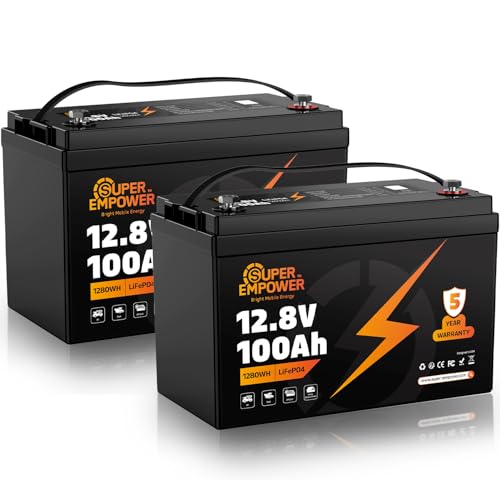
Designed for deep cycle energy storage, this 100Ah LiFePO4 unit emphasizes reliability for RVs, marine power systems, trolling motors, and off-grid setups. It includes an integrated BMS to guard against overcharge, over-discharge, overcurrent, short circuit, and temperature extremes. It is a true drop-in replacement for lead-acid in many applications and promises long cycle life (up to about 5000 cycles at 100% DOD). Best for users needing a long-life house battery and easy installation; caution: this battery is primarily for storage, not engine starting.
Lampword 12V 15Ah LiFePO4 Battery Kit

Lampword’s 15Ah LiFePO4 pack is a compact option with longer cycle life and broader operating temperature range. It highlights higher energy density versus lead-acid and lower self-discharge. Suitable for small trolling motors, accessory power, or as a supplementary marine energy source. A limitation is its smaller capacity, so use is best for light-duty loads or as part of a string in parallel for higher total capacity.
DJLBERMPW 100Ah LiFePO4 Battery

DJLBERMPW’s 100Ah LiFePO4 battery offers a strong blend of depth of cycle and practical features, including a built-in 100A BMS, low-temperature protection, and a long lifespan. It supports up to 15000 deep cycles at 60–100% DOD, making it well-suited for marine and RV deep-cycle needs. Best for those who want robust protection and a high cycle life; consider proper charging practices to maximize longevity, particularly in cold environments.
Balanergy 12V 100Ah LiFePO4 Battery

Balanergy’s 100Ah LiFePO4 battery emphasizes a high cycle life and a smart BMS with temperature protection, making it suitable for off-grid boating, trolling motors, and RV use. It’s designed for stable daily performance and features a flame-retardant ABS case for safety. Best for users seeking a balance of longevity and safety features; be mindful of proper cold-weather charging recommendations to preserve performance in subfreezing environments.
Buying Guide: Key Considerations For Marine Lithium Batteries
- Purpose: Do you need cranking power, house power, or both? Some models pair 2-in-1 capabilities, while others are optimized for deep-cycle use only.
- Capacity And Power: Match Ah rating and BMS protection to your boat’s loads, trolling motors, and electronics. Higher CCA is important for cold starts on larger engines.
- Size And Fit: Check group size (BCI) and dimensions to ensure fit in existing battery boxes or compartments.
- Temperature Considerations: Look for low-temperature protections and charging guidelines to avoid performance losses in cold marinas.
- Charging Compatibility: Consider BMS features and whether your charger supports LiFePO4 charging profiles and multiple banks if needed.
- Longevity And Cycles: LiFePO4 batteries typically offer thousands of cycles; factor total cost of ownership against lead-acid.
- Installation And Safety: ABYC-compliant installations improve cross-brand safety; ensure proper venting and secure mounting.
Frequently Asked Questions
- Q: Are LiFePO4 marine batteries safer than lead-acid? A: LiFePO4 chemistry is generally considered safer due to stable chemistry, lower gas emission, and better thermal stability, though proper handling is still essential.
- Q: Do I need a special charger for LiFePO4 batteries? A: Yes, use chargers compatible with LiFePO4 charging profiles and appropriate for the bank configuration you use.
- Q: Can I use a single LiFePO4 battery for both starting and house power? A: Some 2-in-1 models offer starting and storage, but many deep-cycle packs are designed for house power only; verify compatibility with your engine.
- Q: How long do LiFePO4 marine batteries last? A: Many LiFePO4 packs offer thousands of cycles; actual lifespan depends on depth of discharge and charging practices.
- Q: Will these batteries fit in my current battery box? A: Check group size (BCI) and dimensions; some models are drop-in replacements for common sizes but others may need boxes or brackets modification.
- Q: Should I parallel multiple batteries? A: Paralleling can increase capacity and runtime; ensure matched voltages and proper wiring for balanced charging.