Best 12V RV Air Conditioners for Off-Grid Comfort
Answering the question: which 12V air conditioners are best for RVs and similar vehicles? This guide highlights five dependable models suited for off-grid use, camping trips, and mobile living. Each product section explains who it’s best for, why it was selected, and a clear caveat to consider. This article helps shoppers compare cooling power, energy use, and noise levels to pick the right unit for your vehicle and battery setup.
Summary table of chosen products:
| Product | Best For | Key Benefit | Notes |
|---|---|---|---|
| OutEquip 12V 10000 BTU Rooftop with Heater | RVs needing heater option | Fast cooling; heater for mild cold | Heater is not for extreme cold |
| Aspligo 8000 BTU 12V Rooftop | Smaller RVs and vans | Efficient 8000 BTU cooling | Roof opening must fit specs |
| VEVOR 10000 BTU 12V Mini Split | Truck cabs and fleet vehicles | Fast cooling with inverter tech | Noise around 65 dB |
| Jrswin 15000 BTU 12V DC RV A/C | Mid to large RVs | High cooling capacity with 3-speed fan | Higher power draw |
| Gidrox 10000 BTU 12V DC with Heater | Off-grid campers needing heat | 3-minute comfort; app remote | Energy use best with ample battery |
OutEquip Pro 12V 10k BTU Rooftop A/C

Best for RV owners who want quick cooling with a heater option for mild shoulder seasons. This unit delivers 10,000 BTU in minutes and includes a 4,500 BTU heater for supplemental warmth. Construction features UV-stabilized ABS, an EPDM gasket, and a zinc-coated condenser for durability. Choose this if you need off-grid capability and a built-in heating path for cool early mornings. A limitation is the heater’s suitability only for mild or smaller spaces in extreme cold.
Why it’s selected
- Fast cooling and reliable performance in typical RV interiors.
- Heater adds versatility for fluctuating temperatures.
- Robust weather resistance helps in remote camping.
Aspligo 12V Rooftop DC A/C, 8000 BTU

Best for smaller RVs, vans, or campers needing compact footprint with solid cooling. The unit provides about 2300 W cooling and 750 W power consumption, with a remote control and simple LED display. Roof opening must exceed 350×250 mm, so verify your installation before purchase. This model suits users who prioritize energy efficiency and straightforward operation over maximum BTU in a tight space.
Who it’s best for
- Owners with limited roof space and moderate cooling needs.
- Users prioritizing remote control and easy operation.
VEVOR 12V 10k BTU Truck A/C Unit
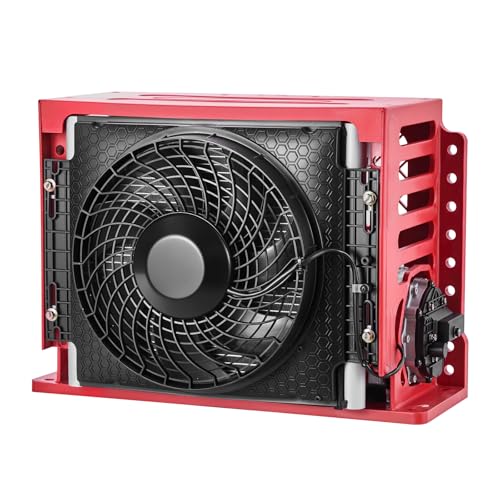
Best for cab comfort in semi trucks and other fleet vehicles. This 10,000 BTU unit uses automotive-grade inverter technology for energy efficiency and a smart variable-frequency compressor to adjust speed as needed. It can run for 6–8 hours on a 12V battery, with noise levels around 65 dB. The trade-off is that it’s louder than some off-grid residential units and may require battery planning for all-night use.
Why select this
- Strong airflow helps quickly cool large cabs.
- Energy-efficient inverter design reduces power draw.
- Quiet enough for overnight parking in many contexts.
Jrswin 15,000 BTU DC RV A/C
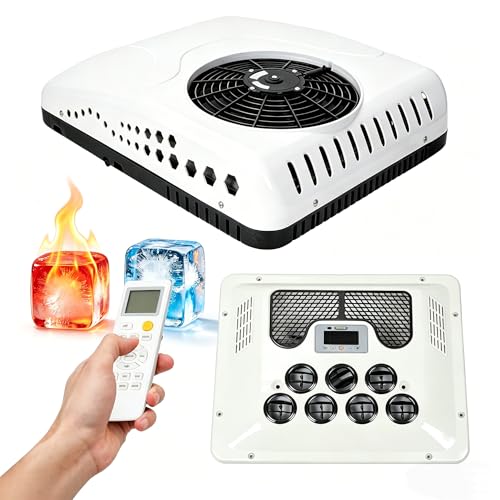
Best for mid-to-large RVs needing strong cooling. The unit provides 15,000 BTU and uses a 12V DC power supply with a 3-speed fan. It’s designed for off-grid compatibility and features a digital display for easy temperature control. A potential drawback is higher energy consumption, so pairing with a sufficiently large battery bank is important to maximize run time.
Best-use scenarios
- Large RVs or motorhomes with high cooling demands.
- Off-grid setups that require robust cooling without frequent generator use.
Gidrox 12V 10k BTU A/C With Heater

Best for off-grid travelers who want both cooling and heating. This unit delivers about 10,000 BTU and operates on 12V DC directly from the RV battery, removing the need for an inverter in many setups. It is noted for fast cooling and a quiet Sleep mode around 40 dB. A caution is that all-night operation depends on battery capacity, so plan battery size accordingly. The app remote adds convenience for on-the-go adjustments.
Why it stands out
- Fast cooling with inverter-like performance on 12V power.
- Integrated heating for flexible climate control.
- Quiet operation supports comfortable sleeping environments.
Buying Guide: 12V RV Air Conditioners
Key considerations help you pick the right unit for your vehicle and power setup.
- Power source and battery capacity — Can your RV battery handle 350–750 W steady draw or higher BTU loads?
- BTU needs and space — Larger vehicles need 10000–15000 BTU; smaller spaces may suffice with 8000 BTU.
- Heating capability — Determine if you need a heater for shoulder seasons or occasional cold mornings.
- Installation footprint — Check roof opening dimensions and weight limits before buying.
- Noise level — Consider dB ratings for comfortable sleeping or quiet nights.
- Reliability and weather resistance — Look for UV-stabilized housings and gasket quality for harsh conditions.
Practical questions buyers ask
- What size RV needs 10,000 BTU versus 8,000 BTU?
- Is an external generator required for off-grid use?
- Can these units run without air conditioners during the day and heat at night?
- How do I calculate required battery capacity for all-night operation?
- Are 12V units compatible with all RV battery types?
- What maintenance is needed for rooftop units?
Summary of buyer considerations
- Choose higher BTU for larger or hotter spaces; lower BTU for compact areas.
- Prefer units with efficient inverters for longer off-grid life.
- Heater-inclusive models provide year-round comfort in variable climates.
- Verify roof openings, mounting hardware, and electrical compatibility before purchase.
Frequently Asked Questions
- Do 12V RV air conditioners require a generator?
- Can I install a 12V AC unit on any roof?
- Is 15000 BTU overkill for a small RV?
- Which features improve off-grid performance?
- What maintenance is needed?
- Can these units heat and cool simultaneously?
Not always. Many can run off the RV battery for several hours, depending on battery size and efficiency.
No. Roof opening size and weight limits determine compatibility. Check manufacturer specs.
It may be excessive for cramped spaces; better for larger campers or quick cooling in hot conditions.
Inverter-style compressors, low power draw, and off-grid battery compatibility boost performance.
Keep the condenser clean, inspect seals, and ensure mounting hardware remains secure in varying weather.
Some models include a built-in heater, but use heater features only as specified by the manufacturer for safety and efficiency.