Best Cleats on a Boat for Secure Docking and Organization
Answer: For most boaters, stainless steel or nylon dock cleats in 4–6 inches offer the best balance of strength, corrosion resistance, and easy handling. This guide highlights five top options suited to sailing, kayaks, and personal watercraft, plus practical buying considerations. The right cleat choice depends on vessel size, rope thickness, and whether decor is a factor.
The following quick table summarizes the five highlighted products, helping you compare size, material, and best-use scenarios at a glance.
| Product | Material | Size Range | Best For |
|---|---|---|---|
| Laorde Nylon Boat Cleats (4″/5″/6″/8″, 4 Pack) | Heavy-duty nylon | 4–8 inches | Boats, kayaks, docks; lightweight and decorative use |
| ZOMCHAIN Boat Cleat (4 inch, 2 pcs) | 316 stainless steel | 4 inches | Heavy-duty mooring; corrosion resistance |
| SHENGHUISS Boat Open Base Cleat (4 inch, 2 Pack) | 316 stainless steel | 4 inches | Versatile mounting on wooden/metal surfaces |
| Laorde Nylon Boat Cleats (6 inch, 4 Pack) | Heavy-duty nylon | 4–6 inches | Stronger mooring; larger boats |
| VEITHI 4 inch Dock Cleats (4 Pack) | Iron with electrophoretic coating | 4 inches | Budget-friendly, corrosion resistance, dock/deck use |
Laorde Nylon Boat Cleats 4″/5″/6″/8″ (4 Pack)

Reference features: Versatile sizes in 4″, 5″, 6″, and 8″; heavy-duty nylon for marine environments; suitable for securing ropes on boats, kayaks, canoes, and docks; also usable as maritime decor or garden supports. Best for lighter vessels and decorative applications where a non-metal option is preferred. Caution: nylon cleats may not offer the same load-bearing capacity as stainless or metal cleats in high-tension mooring scenarios.
Best for: Small to mid-sized boats, kayaks, and decorative or light-duty mooring needs. The wide size range makes this option flexible for multiple uses around the dock or boatyard. Selected for its versatility and lightweight installation.
ZOMCHAIN Boat Cleat (4 inch)

Reference features: 316 marine-grade stainless steel; 4 inch open base; includes mounting hardware; highly polished finish; anti-corrosion for saltwater use. Best for: Boats that require strong, rust-resistant mooring points with relatively compact cleat size. Caution: 4 inch size may be insufficient for high-tension lines on larger boats.
SHENGHUISS Boat Open Base Cleat 316 Stainless Steel (4 inch, 2 Pack)

Reference features: Premium 316 stainless steel; open base design suited for wooden docks, metal roofs, and decks; easy installation with screws or nails; durable for indoor/outdoor use. Best for: Docks or decks where corrosion resistance and versatile mounting are priorities. Caution: Open-base design requires solid backing and precise alignment for best performance.
Laorde Nylon Boat Cleats 6 Inch (4 Pack)
Reference features: 6 inch nylon dock cleats in a four-pack; same durable nylon construction as smaller sizes; versatile for securing ropes and for decorative uses. Best for: Medium boats and kayaks requiring higher clearance and stronger hold than 4″ options. Caution: Higher profile might require more clearance on tight docks.
VEITHI 10 Inch Dock Cleats, 2 Pack
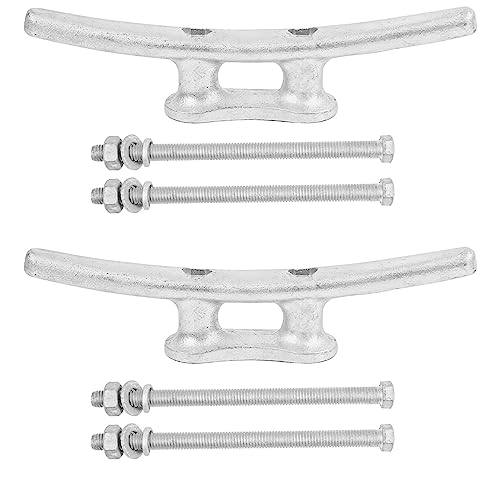
Reference features: 10 inch long, hot-dipped galvanized cast iron; includes bolts and nuts; wide footprint for strength; corrosion-resistant galvanized coating. Best for: Larger boats or docks needing robust, high-torque mooring points. Caution: Heavier cleats require more substantial mounting hardware and may be overkill for small vessels.
Buying Guide
- Material matters: Stainless steel (316) offers high corrosion resistance for saltwater use. Nylon cleats are lighter and decorative but may not handle high-tension mooring. Galvanized iron provides a budget-friendly option but can be heavier and require secure mounting.
- Size selection: Choose 4″ for small boats and kayaks; 5–6″ suits mid-sized craft; 8–10″ cleats are better for larger vessels or high-tension lines. Ensure rope diameter and cleat groove clearance fit your lines.
- Mounting base design: Open base helps with versatile mounting but needs solid backing. Closed or welded bases offer more uniform load distribution. Consider dock or deck material when selecting hardware.
- Installation considerations: Pay attention to mounting hardware type (screws vs. bolts), required backing, and the potential need for corrosion-resistant fasteners in marine environments.
- Use case clarity: If you want decor plus function, nylon options can blend with maritime decor while providing basic mooring. For critical mooring, prioritize stainless steel or galvanized metal with proven load capacity.
- Maintenance: Rinse salt buildup after use; inspect for corrosion or cracking in metal cleats; replace worn or bent cleats promptly.
FAQs
- What size cleat should I choose for a small boat? A 4″ cleat is typically suitable for small boats and kayaks, while 5″ and 6″ can offer additional bite for larger lines.
- Is stainless steel better than nylon for mooring? Yes, stainless steel generally provides greater load capacity and corrosion resistance under high-tension mooring conditions; nylon is lighter and decorative with lower load demands.
- Can I install any cleat on wooden docks? Most open-base or bolt-in cleats can be installed on wood, but ensure backing and hardware are appropriate for the load and weather exposure.
- Do cleats require special maintenance? Rinse after exposure to saltwater, check for corrosion or cracks, and tighten hardware as needed to prevent loosening from wave action.
- Are there decorative goals with cleats? Yes, nylon and certain open-base designs can blend with nautical decor while providing functional mooring points.
- What is the advantage of a 10-inch cleat? Longer cleats provide a larger bite and higher load distribution, useful for larger boats or strong mooring lines, but require robust mounting.