Best Marine Battery Switch Boxes for Reliable Power on the Water
Answering the needs of boaters seeking safer, simpler battery management, these marine battery switch boxes help isolate, combine, or switch between power sources with ease. They’re best for small to mid-size boats, sportfishing vessels, and kayaks or jon boats that require dependable DC control without cluttered wiring. The top picks below cover compact designs, multiple mounting options, and clear safety features to prevent accidental power flow. Use this guide to compare who each product serves best and why it stands out in real-world marine use.
Quick Product Snapshot
| Product | Best For | Why It Stands Out |
|---|---|---|
| Blue Sea Systems m-Series 6006 | Compact installs | Removable knob for safety; flexible mounting |
| Seachoice Battery Select Switch | Two-battery systems | Easy battery selection; UL/CE approved |
| Nilight 90015A Battery Switch | Rugged marine power cuts | High current handling; weatherproof readiness |
| Newport Trolling Motor Smart Battery Box | All-in-one power hub | USB and DC ports; clean wiring |
| Blue Sea Systems 4‑Position Mini Selector 6007 | Emergency power sharing | Emergency combine feature; versatile mounting |
Blue Sea Systems m-Series Battery Switch On/Off With Knob

The Blue Sea Systems m-Series 6006 offers a compact design suitable for tight panel spaces. It supports surface, rear, or front mounting, making it flexible for varied cockpit or console layouts. The removable knob helps prevent accidental current flow in the DC system, an important safety feature during service. This unit is best for boaters who need a dependable, space-efficient switch with straightforward installation and safety-minded details. A potential limitation is that, in very busy panels, the knob’s removal could require extra care during maintenance.
Seachoice Battery Select Switch For Dual Batteries

This Seachoice model is designed for two or more batteries and systems under 50V. It allows easy selection between batteries for starting, charging, or operation in parallel, making it ideal for boats with two critical power sources. It is UL listed and CE approved, which adds a level of electrical compliance. Best for owners who want straightforward switching with recognized safety certifications, though it may be less feature-rich for those needing more than two batteries or advanced integration.
USAMADE Marine Battery Switch Panel With Recessed Cover

This recessed cover panel keeps cockpit switches protected from the elements, featuring a simple white acrylic-capped ABS door for a clean look. It’s best for sailors who want a weather-resilient, door-protected mounting option while maintaining easy access to battery controls. A limitation is that it specifies fit for switches up to 5 1/2 inches in diameter, so ensure your unit matches this dimension for proper clearance.
Nilight Battery Switch 12-48V Heavy Duty

Nilight’s model is a heavy-duty, 12-48V DC disconnect switch with ABS housing and insulated rear cover. It handles high current: 275 A continuous, 455 A intermittent, and 1250 A momentary at 12V, making it suitable for larger marine systems or vehicles with significant power draws. Best for boats needing robust isolation with clear safety margins. It is a standalone switch that can be paired with other switches, but users should verify it fits existing mounting provisions and wiring space.
Blue Sea Systems e-Series 4-Position Selector
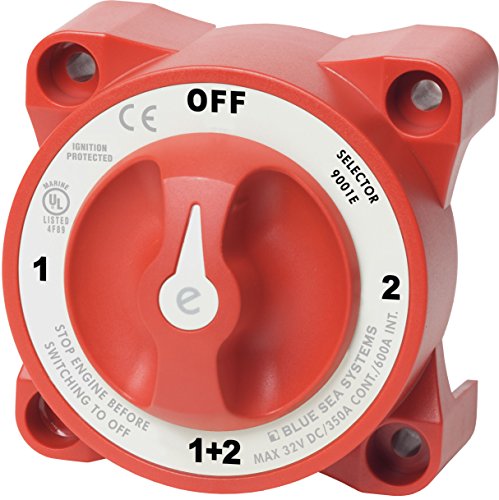
The Blue Sea Systems e-Series 4-Position selector is designed for compact installations with multiple mounting options for surface or rear placement. It is ignition protected, making it a wise choice for engine rooms in gasoline-powered boats. Best for users who need a four-position selector with safety features and flexible installation. A potential caveat is that its complex mounting and wiring could require careful planning for retrofit projects on older panels.
Buying Guide: How To Choose The Right Marine Battery Switch Box
- Power needs and voltage range: Confirm the system voltage (commonly 12V or 24V) and current requirements. Select a switch with a continuous rating that comfortably exceeds the peak draw of your equipment.
- Battery configuration: Determine whether you need a single, dual, or multi-battery setup. Choose models offering battery combine or parallel options if you rely on dual power sources for starting and electronics.
- Mounting flexibility: Consider panel space and mounting options. Some switches are designed for surface, rear, or front mounting; others fit recessed panels with specific cutouts.
- Safety features: Look for features like removable knobs, ignition protection, rear terminal insulation, and anti-spark designs to minimize accidental power flow and short circuits.
- Durability and environment: ABS housing, weatherproof enclosures, and corrosion resistance matter for exposed cockpit or engine room installations.
- Ease of installation and maintenance: Choose components with clear wiring diagrams, compatible stud sizes, and simple mounting hardware to speed up installation and servicing.
- Future-proofing: If planning upgrades, pick a model with more positions or a modular design to accommodate additional batteries or electronics.
Frequently Asked Questions
- What is a battery switch box used for on boats? It isolates, connects, and manages power from one or more batteries to the boat’s electrical system, helping prevent battery drain and accidental shorts.
- Should I choose a 2-position or multi-position switch? If you have two batteries and basic needs, a two-position switch may suffice. Multi-position units are better for combining and switching between several power sources.
- Is an ignition-protected switch important? Yes, for engines or engine compartments, ignition-protected switches reduce the risk of sparks igniting flammable vapors.
- Can I install a battery switch myself? Many marine switches are designed for straightforward DIY installation, but review the wiring diagrams and ensure proper safety procedures are followed.
- What maintenance is required? Periodically inspect terminals for corrosion, ensure mounting remains secure, and verify that the switch operates smoothly in both positions.
- Do these switches support USB or DC ports? Some units combine a power hub with USB or DC ports, providing a centralized charging and electronics interface for on-board devices.