Best Electric Motors for Rowboats: Quiet Power for Small Craft
Answering the question for rowboat owners: these electric trolling motors deliver quiet, reliable propulsion for small boats, kayaks, canoes, and inflatables. They’re best for anglers, casual paddlers, and light-load boaters who want maneuverability without exhaust noise. The top picks below are chosen for saltwater and freshwater durability, shaft length, thrust, and control features. Each product section highlights who it’s best for, how it performs, and a practical caution. A quick comparison table at the start helps you scan key specs at a glance.
| Product | Thrust | Shaft | Water Type | Best For |
|---|---|---|---|---|
| Newport NV-Series 36lb | 36 lb | 30″ | Saltwater/Freshwater | Lightweight setups, kayaks, canoes |
| Newport NV-Series 55lb | 55 lb | 30″ | Saltwater/Freshwater | All-day trolling, medium boats |
| Newport NV-Series 62lb | 62 lb | 36″ | Saltwater/Freshwater | Larger boats, heavier loads |
| ATAUEFHEY 45lb | 45 lb | — | Saltwater/Freshwater | Versatile, compact setups |
| Newport Kayak Series 55lb | 55 lb | 24″ | Saltwater/Freshwater | Kayak and small craft with shallow mounting |
Note: each product is selected for reliable corrosion resistance, practical thrust levels, and user-friendly control features. The following sections break down five options to help you choose the right fit for your rowboat style and typical paddling conditions.
Newport NV-Series 36lb Thrust Transom Motor

- Best for lightweight rowboats and kayaks when portability is a priority.
- Features: 36 lb thrust, 12V or 24V option, saltwater capable, 30″ shaft, LED battery indicator, two-blade propeller.
- Selection note: Choose this if you sail small craft in calm to moderate conditions and want easy storage.
Best for: anglers and casual paddlers who need quiet, efficient propulsion without heavy gear. Limitation: lower thrust may be insufficient for larger or windy days.
Newport NV-Series 55lb Transom Trolling Motor
- Better for: boats that require more thrust without sacrificing battery life for all-day use.
- Features: 55 lb thrust, 12V, 30″ shaft, LED battery meter, 5 forward/3 reverse, 3-blade propeller.
- Limitation: top speed around 4 mph depends on boat shape and load.
Best for: larger dinghies and mid-sized boats where steady power and a longer run time matter.
Newport NV-Series 62lb Thrust Saltwater Motor
- Best for: larger boats or heavier loads where maximum thrust improves maneuverability.
- Features: 62 lb thrust, saltwater rating, 36″ shaft, LED indicator, 3-blade propeller, adjustable mount and direction.
- Limitation: higher weight and power draw may reduce battery life on long runs.
Choose this if you regularly boat in wind or current and need robust push and control.
45lb Thrust Saltwater Transom Motor by ATAUEFHEY

- Best for: versatile, budget-conscious buyers needing reasonable thrust for small boats.
- Features: 45 lb thrust, propeller designed for efficiency, five forward/two reverse gears, copper motor construction for durability.
- Limitation: details on shaft length are not specified, so depth placement may require careful mounting.
Recommended for: budget-minded rowers who still want reliable saltwater performance and adjustable gearing.
Newport Kayak Series 55lb Transom Motor
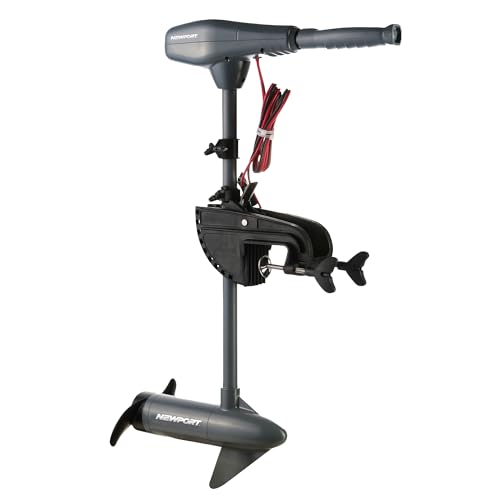
- Best for: kayaks and small craft needing a compact 24″ shaft with dependable saltwater durability.
- Features: 55 lb thrust, 24″ fiberglass shaft, all-aluminum motor head with corrosion-resistant hardware, 8 speeds (5 forward, 3 reverse).
- Limitation: shorter shaft may limit mounting on higher freeboard boats; verify shaft fit for your hull.
Pick this if you paddle lightweight kayaks and need precise control with a compact profile.
Buying Guide: What To Consider When Choosing an Electric Rowboat Motor
- How much thrust do you need? Match thrust to boat size, weight, water conditions, and planned use. Lighter rowboats can run efficiently on 36–55 lb, while larger or windier days may require 62 lb or more.
- What shaft length is right? A longer shaft (30″–36″) helps prevent the prop from hitting shallow bottoms and drafts; shorter shafts work on low-profile hulls like some kayaks.
- Power source and voltage compatibility? Most marine trolling motors run on 12V or 24V systems. Verify battery availability and charging options for your trips.
- Material and corrosion resistance? Saltwater-ready motors use corrosion-resistant housings and hardware; freshwater units may tolerate lighter conditions but still benefit from protection.
- Control and mounting features? Consider adjustable tilt, telescoping handles, and mounting angle. A motor with LED battery indicators helps monitor run-time in the field.
- Noise and fish-friendliness? Brushless motors tend to run quieter with less vibration, which is beneficial for sensitive fishing environments.
- Maintenance and serviceability? Look for motors with accessible propellers, simple gear systems, and readily available replacement parts.
FAQs
- Q: Is a higher thrust motor always better for a small rowboat? A: Not necessarily. For light boats, higher thrust can waste battery life; choose the minimum thrust that reliably moves the craft in typical conditions.
- Q: Do I need a saltwater-rated motor for freshwater use? A: Saltwater-rated motors resist corrosion in both environments, but cost and weight may be higher. If you only use fresh water, a freshwater-rated model may suffice.
- Q: How long will a trolling motor run on a battery? A: Run time depends on thrust, battery capacity, boat weight, and water conditions. Larger batteries provide longer endurance, especially at moderate speeds.
- Q: Can I install a trolling motor on a kayak? A: Yes, with a suitable transom mount or bow-mount adapter and proper weight distribution. Verify shaft length and mounting compatibility with your kayak design.
- Q: What maintenance is needed? A: Regularly inspect mounting hardware, propeller for debris, battery connections, and corrosion protection on saltwater models.
- Q: Are these motors compatible with solar charging setups? A: Some configurations support solar charging with the right controller and battery type; check your battery and motor specs before pairing.